





Related: Volvo's Vera Automated Tug Begins Work in Swedish Port
Volvo Announces Next-Generation Driver Assist Systems for Select Class 8 Models
Volvo said the latest versions of its Active Driver Assist technology will be standard equipment in all new VNR and VNL models, and available as optional equipment on VNX models, beginning later this year.
June 25, 2019

Volvo's VADA is a comprehensive collision mitigation system that activates driver alerts and foundation braking according to information detected by these advanced sensors
Photo: Volvo Trucks North America
3 min to read
Volvo is making its Active Driver Assist system available as either standard, or optional equipment, for its VNR, VNL and VNX Class 8 truck models.
Volvo said its Active Driver Assist (VADA) 2.0, a comprehensive collision mitigation system, will be made standard in the new Volvo VNR and VNL models, and available on VNX models, beginning later this year. According to Volvo, the system enhances the original VADA platform by integrating radar and camera capabilities to help drivers maintain a safe following distance through alerts and improved traffic awareness, as well as emergency braking to reduce the risk of collisions.
“The Volvo Active Driver Assist technology we first introduced with Bendix Wingman Fusion in 2017 was a groundbreaking achievement for increased efficiency and safety through automation,” said Johan Agebrand, product marketing director, Volvo Trucks North America. “Continuing that partnership, we have improved the capabilities of this collision mitigation technology across the board and are confident that VADA 2.0 will further enhance safety for all motorists.”
VADA is a comprehensive collision mitigation system launched by Volvo Trucks North America in 2017 which uses camera and radar sensors to detect motorized vehicles within the vehicle’s proximity. The technology enables a series of features to activate driver alerts and foundation braking according to information detected by these advanced sensors. Available in Q3 2019, with improvements scheduled to roll out through late 2020, VADA 2.0 offers enhancements to many features including:
Automatic Emergency Braking (AEB) uses camera and radar sensors to determine how traffic is behaving around the truck. When a vehicle is detected, audible and visual warnings alert the driver to take action. If the driver does not respond, AEB engages to mitigate potential collisions. VADA 2.0 expands the capability of AEB beyond the current VADA, allowing it to operate across multiple lanes of traffic.
Lane Departure Warning (LDW) alerts the driver when an unintentional lane departure occurs. VADA 2.0 allows for adjustable volume and audio mute override options and enables drivers to turn off the system momentarily (10 minutes) for select functions.
Highway Departure Warning and Braking (HDB) automatically activates if the driver does not take corrective action after a Lane Departure Warning and the system detects that the vehicle may leave the drivable roadway, slowing the vehicle by a pre-defined MPH.
Adaptive Cruise Control (ACC) with Cruise Auto Resume enables the truck to revert back to cruising speed with Cruise Auto Resume (also known as “Slow & Go”) at speeds above 10 mph, an improved feature in VADA 2.0.
Driver Awareness Support offers an in-cab windshield-mounted camera with data capture support to enhance driver coaching and data availability.
“We are excited to introduce Volvo Active Driver Assist 2.0 as standard in our truck models, representing the next generation of active safety products,” said Ashraf Makki, product marketing manager – technology, Volvo Trucks North America. “Every feature included in this new technology enables our products to run more efficiently, and offers additional safety benefits for our customers and professional drivers.”
Future updates to VADA 2.0 will include Adaptive Cruise Control with Traffic Stop & Driver Go, Lane Change Support with audible alert adjustment and standalone data capture options without the need for Lane Departure Warning, Volvo added.
More Safety & Compliance

FMCSA Pauses Biennial-Update Enforcement Amid Motus Transition
Carriers whose updates were due on or after June 1 have more time, while FMCSA works to stabilize its new registration system and warns of phishing sites impersonating its new carrier registration system, Motus.
Read More →
ZF Expands Commercial Vehicle Push in North America
ZF is expanding its North American commercial-vehicle presence with new transmission applications, electrification, trailer technology and autonomous-driving systems.
Read More →
Truck Drivers Need More Than Another Alert
Fleets have more visibility into truck health, safety events, and driver activity than ever. The next challenge is turning all that information into useful guidance for the person who has to decide what to do next.
Read More →
Tesla Wants a Self-Driving Semi. Are Cameras Enough?
Could Tesla’s camera-only autonomous driving technology work on an 80,000-pound Semi? In this commentary, HDT's Deborah Lockridge takes a look at Tesla, Cybercab, and how autonomous trucks see the road.
Read More →
What DOT’s Automated Vehicle Strategy Means for Trucking
The U.S. Department of Transportation issued a new automated-vehicle strategy that outlines plans for driverless-truck regulations, cross-state freight corridors, and federal safety standards.
Read More →
NYC Expands Speed, Pedestrian Safety Tech Across Fleet
New York City is expanding intelligent speed assistance and pedestrian-alert systems across its municipal fleet, moving the technologies from pilot programs into vehicle procurement and retrofit requirements.
Read More →
FMCSA Removes 110 Truck Driver Training Schools from Certified ELDT List
Federal regulators also are targeting more than 160 additional training providers and launching a nationwide audit of third-party CDL skills testers as part of a broader crackdown on trucking fraud.
Read More →
Beyond DOT Compliance: What Makes a Trucking Fleet Truly Safe?
A trucking fleet can follow every rule and still make unsafe decisions. The real test comes when safety conflicts with freight, productivity, or cost.
Read More →
Hours of Service Pilot Programs: FMCSA Readies for 2027 Rollout
Two pilot programs could eventually reshape hours-of-service rules, giving truck drivers options to pause their 14-hour clock or use longer split sleeper rest periods.
Read More →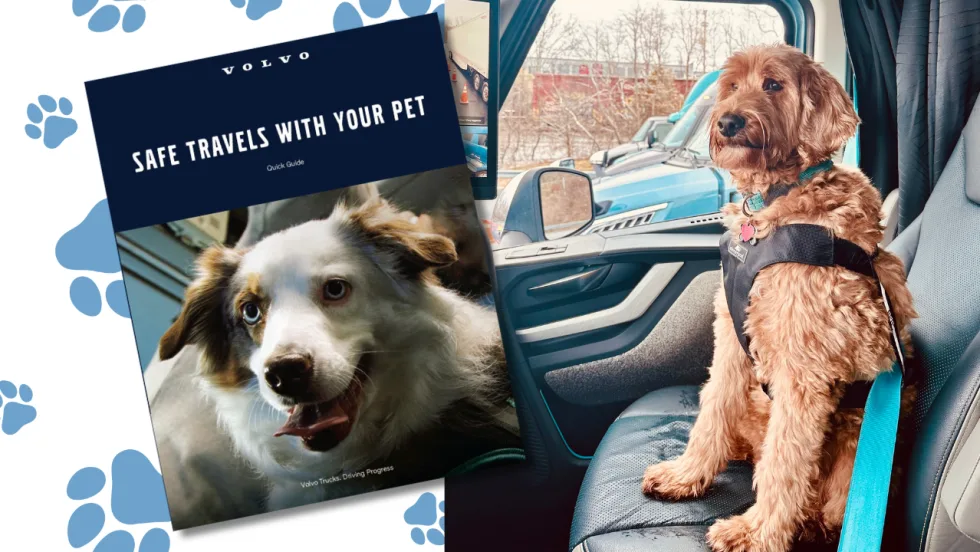
New Guide Offers Pet Safety Tips for Truck Drivers
Hundreds of thousands of pets travel in truck cabs. A new safety guide from Volvo Trucks and the Center for Pet Safety offers practical advice for truck drivers who bring dogs and cats along for the ride.
Read More →