




Related: Tips to Reduce & Prevent Incidents
6 Tips to End Trucking Workplace Injuries
Trucking fleets focus much of their attention on minimizing risks on the road, but there are also risks when a driver is on his or her feet, due to the risk of a fall.
by Jane Jazrawy
April 10, 2019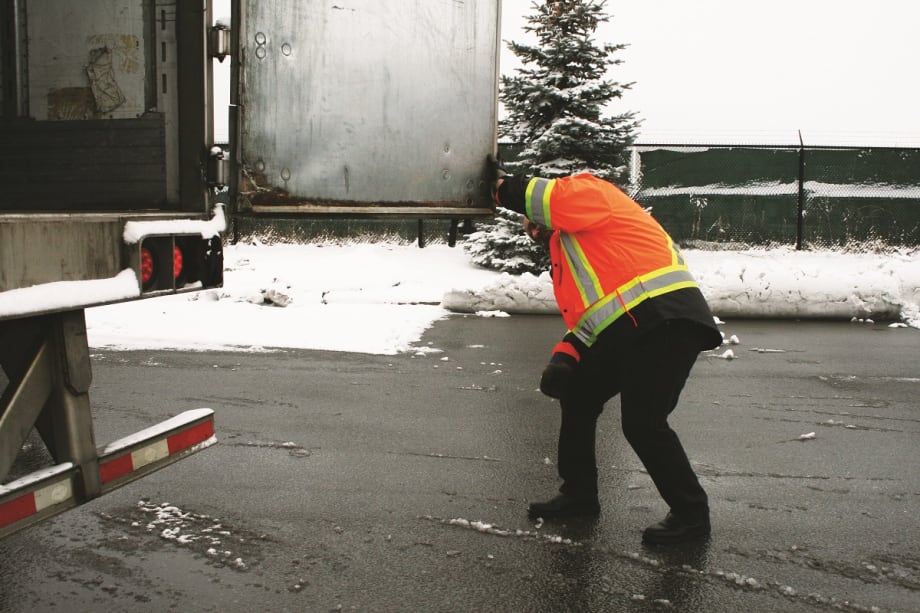
Safety vests containing pockets mean drivers aren’t trying to climb with something in their hands. Drivers need to be aware that wet conditions can be slippery for them as well as for their trucks.
5 min to read

Proper footwear is key to preventing slips, trips, and falls, as is climbing using three points of contact.
Photos: CarriersEdge
Trucking can be a hazardous profession for drivers – and that’s before the driver has even set foot in the cab or put the vehicle in gear. For good reason, fleets focus much of their attention on minimizing risks on the road, but there are also risks when a driver is on his or her feet, due to the risk of a fall.
In fact, slips, trips, and falls may be the industry’s most overlooked and underappreciated threat to drivers’ health and wellbeing. The Bureau of Labor Statistics’ data for 2017 show that 27% of injuries in the truck transportation industry came from slips, trips, and falls, vs. just 17% from injuries sustained in a collision or other motor-vehicle-related incidents.
Fleet managers who want to keep their drivers safe and reduce lost-time accidents and injuries (not to mention reduce injury claims) have an opportunity to make a significant difference. Most injuries can be prevented with a little investment in your drivers along with following common-sense practices.
1. Invest in feet
Don’t underestimate the value of your drivers’ feet. They use their feet every day to climb in and out of cabs, walk around shipping yards, and kick things out of the way. They need the best protection possible, and that does not come with cowboy boots, rubber overshoes or flip-flops.
If you are not providing a shoe allowance for your drivers, consider it. It encourages drivers to invest in steel-toed, ANSI-certified safety shoes to protect their feet.
2. Invest in equipment
If your equipment isn’t properly maintained and repaired, slips and falls can happen because of missing or damaged steps and handholds. Check that drivers are both reporting these defects and getting a proper response from the shop.
3. Jumping is for trampolines
Some drivers have the bad habit of jumping from the backs of trailers, loading docks, and their cabs. It may seem like a short distance, but every time you jump down from even a short height, your body has to absorb the impact of the landing. The higher up you are, the higher the impact, with your joints and lower back taking the most punishment. As drivers age, those jolts to the joints will catch up to them – if they don’t immediately injure themselves by landing the wrong way.
4. Put it in a pocket
Of course, the alternative to jumping is to climb using three points of contact (two hands and one foot or one hand and two feet). It may take a couple of seconds longer, but it’s worth it in the long run when compared to the cost and time lost from injuries. But when drivers are carrying tools or a phone, it may be a nuisance to have both hands free.
That’s where pockets come in – one of those simple technologies that we often take for granted, but they are extraordinarily useful, especially when you need both your hands.
Find safety vests that have pockets to add that extra layer of convenience, and provide them to drivers as part of their personal protective equipment. It’s easy to encourage people to use pockets – but they have to be available!
5. Slippery when wet
Drivers know water and ice make traction more challenging for their tires. But it’s also problematic for shoes.
Puddles of water on a lot can be hazardous, because you can’t see how deep they are or what’s at the bottom. And most people who have lived in wintery areas are familiar with the experience of having your feet fly out from under you in the middle of an icy parking lot.
Wearing a good pair of safety shoes with proper treads is essential, but so is your awareness of conditions. If the temperature is cold or it’s raining, drivers need to watch their step on metal surfaces such as cab steps or metal docks. If the temperature is hovering around freezing and there is snow on the ground, check for ice under the snow as well.
Drivers should also watch for other slippery substances on steps and docks, such as oil and grease. Remember that these substances might also be on your footwear as well as the surface you’re walking on. For fleet managers, having a policy about keeping your site clean and clear of fuel or oil spills is essential. Everyone needs to understand and follow it.
6. Do they know how to use it?
Equipment such as a ladder or a fall arrest harness that is used incorrectly, worn, or in need of repair, can be as much a threat as a patch of ice or an oil spill on a metal step.
Fall arrest harnesses, for example, have to be inspected and worn correctly. An improperly worn harness not only won’t protect you, but it also can actually cause injury in the case of a fall. Train drivers how to use them. Ask drivers to demonstrate that they can inspect and don the harness properly with a qualified trainer who can give them feedback.
Bottom line: slips, trips and falls are a clear and present danger to your drivers, and to your company when it comes to injury claims. To truly have a partnership with your drivers in keeping them safe, think about these two things: How have you educated drivers on how to reduce risks? And, more importantly, what investments have you made to help drivers avoid injury?
Jane Jazrawy is CEO of CarriersEdge, a developer of online safety courses for the trucking industry, based in Markham, Ontario. It recently developed a new online course on fall protection. This article was authored under the guidance and editorial standards of HDT’s editors to provide useful information to our readers.
Subscribe to Our Newsletter
More Safety & Compliance

FMCSA Pauses Biennial-Update Enforcement Amid Motus Transition
Carriers whose updates were due on or after June 1 have more time, while FMCSA works to stabilize its new registration system and warns of phishing sites impersonating its new carrier registration system, Motus.
Read More →
ZF Expands Commercial Vehicle Push in North America
ZF is expanding its North American commercial-vehicle presence with new transmission applications, electrification, trailer technology and autonomous-driving systems.
Read More →
Truck Drivers Need More Than Another Alert
Fleets have more visibility into truck health, safety events, and driver activity than ever. The next challenge is turning all that information into useful guidance for the person who has to decide what to do next.
Read More →
Tesla Wants a Self-Driving Semi. Are Cameras Enough?
Could Tesla’s camera-only autonomous driving technology work on an 80,000-pound Semi? In this commentary, HDT's Deborah Lockridge takes a look at Tesla, Cybercab, and how autonomous trucks see the road.
Read More →
What DOT’s Automated Vehicle Strategy Means for Trucking
The U.S. Department of Transportation issued a new automated-vehicle strategy that outlines plans for driverless-truck regulations, cross-state freight corridors, and federal safety standards.
Read More →
NYC Expands Speed, Pedestrian Safety Tech Across Fleet
New York City is expanding intelligent speed assistance and pedestrian-alert systems across its municipal fleet, moving the technologies from pilot programs into vehicle procurement and retrofit requirements.
Read More →
FMCSA Removes 110 Truck Driver Training Schools from Certified ELDT List
Federal regulators also are targeting more than 160 additional training providers and launching a nationwide audit of third-party CDL skills testers as part of a broader crackdown on trucking fraud.
Read More →
Beyond DOT Compliance: What Makes a Trucking Fleet Truly Safe?
A trucking fleet can follow every rule and still make unsafe decisions. The real test comes when safety conflicts with freight, productivity, or cost.
Read More →
Hours of Service Pilot Programs: FMCSA Readies for 2027 Rollout
Two pilot programs could eventually reshape hours-of-service rules, giving truck drivers options to pause their 14-hour clock or use longer split sleeper rest periods.
Read More →
New Guide Offers Pet Safety Tips for Truck Drivers
Hundreds of thousands of pets travel in truck cabs. A new safety guide from Volvo Trucks and the Center for Pet Safety offers practical advice for truck drivers who bring dogs and cats along for the ride.
Read More →