




Nikola Teases New All-Electric Truck Models on Twitter
“ICE” – the internal combustion engine – “is the enemy. Not hydrogen or BEV,” said Nikola as it said in a tweet that it's going to produce both battery-electric and hydrogen-electric trucks.

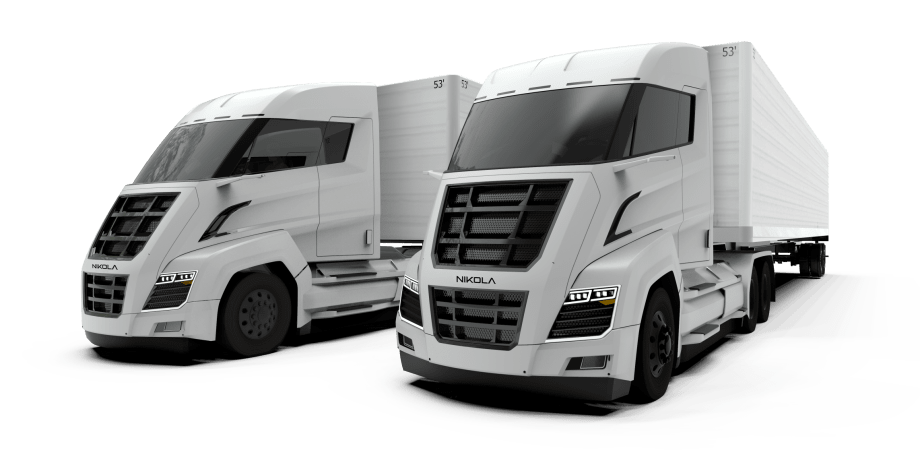
Nikola now says it will have both electric and hydrogen-electric trucks.
Image: Nikola
Breaking: Our CEO, @nikolatrevor will announce Nikola Two and Nikola Tre in both Hydrogen and BEV at Nikola World. You will be able to order both trucks in 500kWh, 750kWh and 1mWh options BEV. Don't miss Nikola World 2019. Hydrogen long haul, BEV short haul. #emissionsgameover
— Nikola Motor Company (@nikolamotor) February 8, 2019
Nikola Motors exploded onto the scene three years ago, initially promising an all-electric, long-haul, tractor. Almost immediately, that mission statement was amended, detailing a hybrid hydrogen-battery electric drive system, which Nikola said would give its truck 1,000 miles of range between refueling stops.
But it appears the company never gave up on its initial, proposed, all-electric truck. In a surprise tweet late last week, the company announced that at its Nikola World technology showcase in April it will announce short-haul, battery-electric versions of the Nikola Two and Nikola Tre in addition to the hydrogen-electric model.
Nikola said the all-electric truck is designed for inner city delivery routes and weight-sensitive applications. However, the company stressed that it is not phasing out hydrogen drivetrains. Indeed, Nikola said it is expecting to see 50 times the number of orders for hydrogen drivetrains over electric ones – but noted that in some applications, battery-electric trucks “work great.”
Details are sketchy – Twitter being what it is – but Nikola did give away some additional information on the news in a series of additional Tweets. Both trucks will be offered in 500kWh, 750kWh and 1mWh versions. And there will be an option to spec Nikola’s hydrogen-electric drivetrain instead of a battery-electric one.
H2 is 5,000 lbs lighter than BEV and is cheaper for long haul applications even with H2 costs. BEV is for inner cities and non weight sensitive applications. Nikola is not phasing our hydrogen at all, we will see 50:1 more hydrogen orders but some applications BEV works great.
— Nikola Motor Company (@nikolamotor) February 8, 2019
Looking specifically at the Nikola Two model, the company tweeted that it will be an 80,000 lbs. vehicle that uses 2.25 kWh per mile in most applications. The 1 MWh model has a range of 400 miles, which falls to 300 miles in cold weather, the company said.
1) BEV @ 80,000 lbs. uses ~ 2.25 kWh per mile in real weather and normal hills on routes. 1MWh gets about 400 miles. Only 90% battery is useable. In cold weather, you get 300 miles / 1Mwh. Takes 69,000 "21700" cells @ 68grams = 1MWh. 10.5k weight in cells. 20k truck weight
— Nikola Motor Company (@nikolamotor) February 8, 2019
2) Fuel cell 80 kg H2 gets 7-10 miles per kg and uses same 2.25 kWh per mile as BEV. Fuel cell weight 15k -17k so about 3k – 5k pounds less than BEV. Fuel Cell can't be beat long haul and BEV is good option for short haul. World needs both. ICE is enemy, not hydrogen or BEV
— Nikola Motor Company (@nikolamotor) February 8, 2019
The Nikola Tre previously was announced as a fully electric hydrogen-powered day cab tractor aimed at markets in Europe.
Nikola unveiled its first hydrogen-electric prototype, the Nikola One, in December 2016.
The official word debut for the Nikola Two and Nikola Tre is stated for the Nikola World technology fair in Scottsdale, Arizona, April 16 and 17, 2019.
More Equipment

How Volvo Updated Its D13 for EPA 2027 [Watch]
Volvo’s updated D13 promises lower emissions without sacrificing performance or fuel economy. Take a closer look at what changed inside the engine in this HDT Spotlight video.
Read More →
Michelin Tire Improves Efficiency and Durability for Regional Fleets
The Michelin X Multi Energy D2 is a regional haul drive tire engineered to help fleets improve fuel efficiency, durability and traction in demanding stop-and-go operations.
Read More →
ZF Expands Commercial Vehicle Push in North America
ZF is expanding its North American commercial-vehicle presence with new transmission applications, electrification, trailer technology and autonomous-driving systems.
Read More →
Tesla Wants a Self-Driving Semi. Are Cameras Enough?
Could Tesla’s camera-only autonomous driving technology work on an 80,000-pound Semi? In this commentary, HDT's Deborah Lockridge takes a look at Tesla, Cybercab, and how autonomous trucks see the road.
Read More →
Kodiak: Driverless Long-Haul Truck Launch on Track for 2026
Kodiak AI says its driverless long-haul safety case is 93% complete and it remains on track to begin commercial operations by year-end 2026.
Read More →
What DOT’s Automated Vehicle Strategy Means for Trucking
The U.S. Department of Transportation issued a new automated-vehicle strategy that outlines plans for driverless-truck regulations, cross-state freight corridors, and federal safety standards.
Read More →
East Coast Port Launches $45M Electric Truck Push
The Port Authority of New York and New Jersey announced millions in incentives for zero-emission drayage trucks, yard tractors, and new charging hubs near the port.
Read More →
PlusAI Going Public to Fund Autonomous Truck Launch
A SPAC deal could provide PlusAI with up to $300 million as it works toward a 2027 commercial launch of factory-built autonomous trucks.
Read More →
NHTSA Moves to Rewrite Truck Fuel-Economy Rules
The National Highway Traffic Safety Administration says it lacks authority to regulate medium- and heavy-duty truck engines separately from complete vehicles, but the existing standards have not yet been eliminated.
Read More →
Detroit Opens Orders for EPA 2027 Engines
Detroit isn’t starting from scratch to meet EPA 2027 diesel emissions standards. Its Gen 6 DD13 and DD15 engines keep much of today’s platform while updating the fuel and aftertreatment systems.
Read More →