




Related: The 3D Future: Is It a Print?
Daimler Produces its First 3D-Printed Metal Part
In Europe, Mercedes-Benz Trucks has printed its first spare part made of metal that has passed all stages of the company’s quality assurance process.
by Staff
August 3, 2017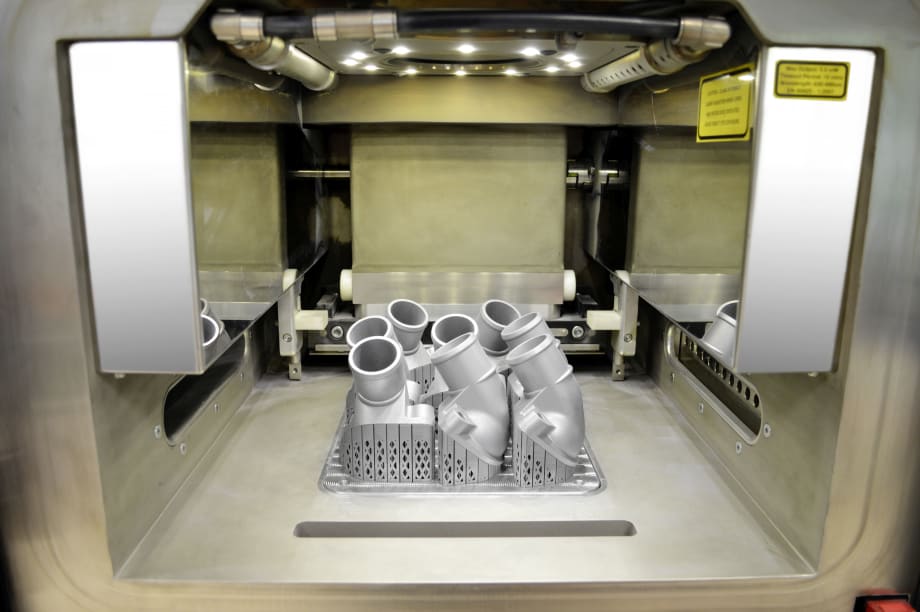
The view into the interior of the 3D printer shows the first printed thermostat covers, which are still connected to the work platform. After removal of the platform and support structure, the aluminium/silicon metallic powder is removed by suction, sieved, cleaned and ecologically fed back into the recycling system. Photo: Daimler
2 min to read
The view into the interior of the 3D printer shows the first printed thermostat covers, which are still connected to the work platform. After removal of the platform and support structure, the aluminium/silicon metallic powder is removed by suction, sieved, cleaned and ecologically fed back into the recycling system.Photo: Daimler
In Europe, Mercedes-Benz Trucks has printed its first spare part made of metal that has passed all stages of the company’s quality assurance process.
The 3-D printed part was a thermostat cover for older series Mercedes-Benz truck and Unimog models. Daimler said this was the first time the company was able to print a strong metal version in original quality.
Printing parts that are made of metal could lead to cost-effective, rapid, and flexible production of parts in small batches. Producing metal parts directly from digital records saves money on special tools, storage, and transport costs.
"With the introduction of 3D metal printing technology, Mercedes-Benz Trucks is reasserting its pioneering role among global commercial vehicle manufacturers," said Andreas Deuschle, head of marketing and operations for customer services & parts at Mercedes-Benz Trucks. "We ensure the same functionality, reliability, durability, and cost-effectiveness with 3D metal parts as we do with conventionally produced parts."
The parts division of Mercedes-Benz Trucks began using 3D printing with increasing success for aftermarket and replacement parts about a year ago. Since then, the customer services and parts division has worked with researchers and pre-developers at Daimler to improve and expand the use of the latest 3D printing processes of plastic parts.
Metal components produced through 3D printing processes are an extension of this program, allowing metallic components to be produced on demand. The process was initially used to produce rarely ordered aluminum parts, but in the future it could extend to peripheral engine parts made of metal, in-engine parts, or parts in cooling systems, transmissions, axles, or chassis.
“The particular added value of 3D printing technology is that it considerably increases speed and flexibility, especially when producing spare and special parts,” said Deuschle. “This gives us completely new possibilities for offering our customers spare parts rapidly and at attractive prices, even long after series production has ceased.”
More Equipment
Kodiak Hauls Produce in California Autonomous Truck Pilot
Kodiak AI and DTL Transport have begun hauling produce between Fresno and Los Angeles under California’s new rules for testing heavy-duty autonomous trucks. A safety driver remains behind the wheel.
Read More →
Used-Truck Remarketing Math Is Changing
Used-truck value is no longer just a concern at trade-in. Decisions made throughout a truck’s first life can influence what it’s worth years later.
Read More →
How Volvo Updated Its D13 for EPA 2027 [Watch]
Volvo’s updated D13 promises lower emissions without sacrificing performance or fuel economy. Take a closer look at what changed inside the engine in this HDT Spotlight video.
Read More →
Michelin Tire Improves Efficiency and Durability for Regional Fleets
The Michelin X Multi Energy D2 is a regional haul drive tire engineered to help fleets improve fuel efficiency, durability and traction in demanding stop-and-go operations.
Read More →
ZF Expands Commercial Vehicle Push in North America
ZF is expanding its North American commercial-vehicle presence with new transmission applications, electrification, trailer technology and autonomous-driving systems.
Read More →
Tesla Wants a Self-Driving Semi. Are Cameras Enough?
Could Tesla’s camera-only autonomous driving technology work on an 80,000-pound Semi? In this commentary, HDT's Deborah Lockridge takes a look at Tesla, Cybercab, and how autonomous trucks see the road.
Read More →
Kodiak: Driverless Long-Haul Truck Launch on Track for 2026
Kodiak AI says its driverless long-haul safety case is 93% complete and it remains on track to begin commercial operations by year-end 2026.
Read More →
What DOT’s Automated Vehicle Strategy Means for Trucking
The U.S. Department of Transportation issued a new automated-vehicle strategy that outlines plans for driverless-truck regulations, cross-state freight corridors, and federal safety standards.
Read More →
East Coast Port Launches $45M Electric Truck Push
The Port Authority of New York and New Jersey announced millions in incentives for zero-emission drayage trucks, yard tractors, and new charging hubs near the port.
Read More →
PlusAI Going Public to Fund Autonomous Truck Launch
A SPAC deal could provide PlusAI with up to $300 million as it works toward a 2027 commercial launch of factory-built autonomous trucks.
Read More →