




Sen. Boxer Opposes Resurrecting Trucker Rest-Break Reform
An effort appears under way to insert a pro-trucking reform twice shot down by this Congress in the Fiscal Year 2017 THUD bill. However, if Sen. Barbara Boxer, the Ranking Member of the Environment and Public Works Committee, has her way, the proposal will die yet a third death on Capitol Hill.

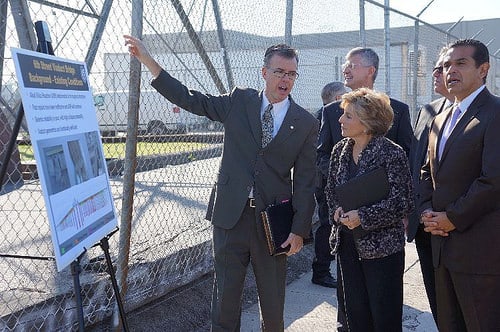
Sen. Barbara Boxer visiting a bridge project in Los Angeles. Photo: boxer.senate.gov

Sen. Barbara Boxer visiting a bridge project in Los Angeles.Photo: boxer.senate.gov
An effort appears under way to insert a pro-trucking reform twice shot down by this Congress in the Fiscal Year 2017 Transportation, Housing and Urban Development (THUD) bill that the Senate Appropriations Committee is expected to mark up soon.
However, if Sen. Barbara Boxer (D-CA), the influential Ranking Member of the Environment and Public Works Committee, has her way, the proposal will die yet a third death on Capitol Hill.
If the proposal is identical to the one that never made it into last year’s highway bill or this year’s aviation bill, it would aim to prevent states from enacting their own meal and rest break rules for CDL drivers. It would also prohibit states from requiring that those drivers be paid certain types of added compensation, such as detention pay.
In an April 14 letter to leaders on the Senate Appropriations Committee, Boxer expressed her strong opposition to “any efforts” to attach “a terrible anti-safety provision” to the THUD bill that would “dock the pay of truck drivers by attacking state laws that protect their pay during bathroom or lunch breaks, or when performing necessary activities like loading or unloading a truck."
Boxed added that “Truck drivers get paid for meal and bathroom breaks under the laws of 20 states. But truck drivers in all 50 states would be affected by this dangerous provision because their states would be barred from passing laws that protect them from being docked not only for bathroom and meal breaks, but for ‘non-driving’ responsibilities, such as loading the truck. This provision overturns court decisions reaching all the way to the Supreme Court.”
Calling the provision “a poison pill,” Boxer warned that “including it in the THUD appropriations bill would end any chance of the bill moving swiftly in the Senate...”
Proponents of the reform measure have been pushing hard for Congress to more directly address state preemption of federal driver rules ever since a Supreme Court ruling last May upheld a California statute requiring a paid 10-minute rest break every four hours and a paid 30-minute meal period every five hours for truck drivers.
A Feb. 1 letter sent to the House Committee on Transportation and Infrastructure by an array of 80 stakeholder organizations argues that it is necessary “to clarify the preemption provision of the FAA Authorization Act of 1994 to restore the goals Congress intended when it sought national uniformity for motor carriers in the transportation of property.”
The signatories of that letter included the American Trucking Associations, the 50 ATA-affiliated state trucking associations, the National Private Truck Council, the Truckload Carriers Association and the Truck Renting and Leasing Association. Also signed on are the Association of American Railroads, the Intermodal Association of North America, the National Association of Manufacturers, the National Retail Federation and the U.S. Chamber of Commerce.
The letter contends that Congress needs to express the preemption provision more explicitly because “The Supreme Court has repeatedly explained that the language chosen by Congress reflects a very broad preemptive purpose, regardless of whether the effect on carrier prices, routes or services is direct or indirect, as long as the effect is more than tenuous or remote.
“However, some courts— particularly the Ninth Circuit— have consistently failed to faithfully implement Congress’ goals,” the letter states. “The upshot is serious inefficiencies that harm not just motor carriers, but the shippers and consumers who rely on trucks to move their goods, and, by extension, the national economy.”
More Fleet Management

Geotab Links Fleet Card to Vehicle Data
The new card combines fuel discounts with telematics-based purchase controls. Geotab’s analysis also points to potential savings from choosing lower-priced fuel stops.
Read More →
How MFA Helps Protect Trucking Fleets
Multi-factor authentication adds protection when passwords are stolen. Here’s how it works and where fleets should start.
Read More →
How Better Freight Data Helps Trucking Teams Get Ahead of Disruption
Trucking and logistics teams have plenty of data. The problem is getting the right information in front of the right people soon enough to act. Better-connected data can help teams spot trouble earlier and make smarter decisions before small problems become big ones.
Read More →

Trimble: Taking Artificial Intelligence in Trucking Beyond Faster Tasks
At Insight 2026, Trimble executives argued that fleets may need to redesign workflows to get more from AI as it introduced new products and enhancements. AI’s value will depend on how fleets combine automation with their people's knowledge.
Read More →
Build a bulletproof fleet: Uniting ELDs and dash cams for total compliance
An ELD can prove compliance, but it cannot always prove what happened on the road. Discover how uniting accurate ELD data with AI-powered dash cam video can help your fleet strengthen compliance, defend against liability, protect drivers and reduce operational costs.
Read More →
Nominations Open for HDT Emerging Leaders
Heavy Duty Trucking is looking for accomplished trucking fleet professionals under 40 who are making an impact and helping lead the industry forward.
Read More →
Why Private Fleets Are Taking More Freight
Private fleets are putting their own trucks on demanding customers and high-cost lanes as companies seek greater control over service, costs, and capacity.
Read More →
Color Match Smarter: Tools That Restore & Perform
For fleet managers and collision repair professionals keeping heavy-duty trucks on the road, getting the color right the first time isn't just about appearance — it's about efficiency, turnaround time, and bottom-line results. Discover how today's digital color tools are transforming the repair process from guesswork to precision.
Read More →
FMCSA Pauses Biennial-Update Enforcement Amid Motus Transition
Carriers whose updates were due on or after June 1 have more time, while FMCSA works to stabilize its new registration system and warns of phishing sites impersonating its new carrier registration system, Motus.
Read More →
2026 Blueprint for Countering Smarter Supply Chain Theft
Cargo theft is no longer just the cost of doing business. It's a multi-billion-dollar criminal enterprise exploiting vulnerabilities across your fleet, drivers, and supply chain.
Read More →