




Calif. County Opens Public-Access CNG Station
Santa Clara County in California cut the ribbon for its $1.5 million public-access compressed natural gas (CNG) fueling station on Oct. 8.
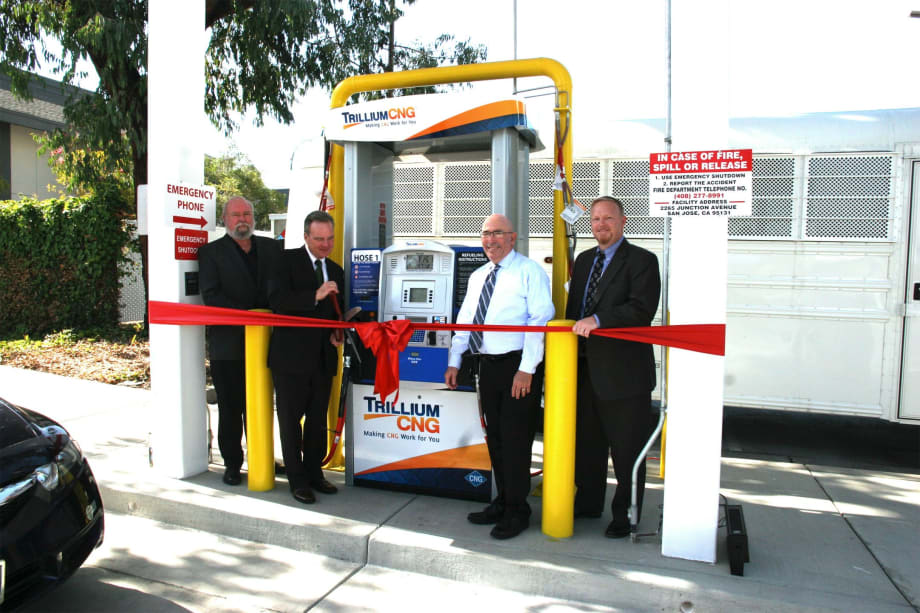
County officials get ready to cut the ribbon for the new CNG fueling station. Photo courtesy of Santa Clara County
County officials get ready to cut the ribbon for the new CNG fueling station. Photo courtesy of Santa Clara County
Santa Clara County in California cut the ribbon for its public-access compressed natural gas (CNG) fueling station at its Fleet Division in San Jose on Oct. 8. The $1.5 million project is a public-private partnership between the county and Trillium CNG, with $300,000 in offset funding from the California Energy Commission, according to a county release.
“Today’s opening of this compressed natural gas fueling station represents a chance to not only deploy alternative fuel vehicles for the county fleet, but also to make it easier for the public to choose environmentally friendly vehicles to reduce greenhouse gas emissions within this critical transportation corridor,” said Dave Cortese, County Santa Clara Board of Supervisors president.
The county entered in to a concessionaire agreement with Trillium for the management and operation of the fueling station, including fuel prices and collecting station revenues. In exchange, Trillium will compensate the county a flat fee of $3,000 per month for the term of the contract, plus $0.25 per gasoline gallon equivalent (GGE) of CNG dispensed. Although total revenue will depend on the amount of CNG dispensed, the county estimates the revenue from concession payments would total $87,000 per year.
The county has a ten-year operation and maintenance agreement with Trillium CNG and two five-year options to extend that contract. The CNG station has two dual-hose dispensers allowing two CNG vehicles to fuel at the same time.
The county has a goal reduce its greenhouse gas emission by 80% before 2050. This CNG fueling station will help the county to achieve at least 25% of its fleet as alternative fuel vehicles, saving at least $1.25 per GGE. The county expects to save a minimum of $7,500 per year in fuel costs within the first year of operation.
The county fleet includes heavy-duty, medium-, and light-duty vehicles. Initially the CNG buses operated by the Sheriff’s Office to transport inmates will be serviced at the fueling station. In the year ahead, the County will be adding CNG vans.
"This is good for our air quality and will also have positive economic benefits for all county residents,” said Dave Snow, deputy director, Facilities and Fleet Department. “The county will save on fuel costs and benefit financially from the fuel that is sold publicly. Everyone will benefit from cleaner air.”
More Fuel Smarts
Trucking’s Diesel Squeeze Isn’t Letting Up
With diesel topping $6 a gallon nationally, ATA's Bob Costello explains why fleets should prepare for continued pressure at the pump.
Read More →
FlowBelow Redesigns Trailer AeroSlider to Cut Fuel Use
The lighter trailer aerodynamic system installs in less than 45 minutes, according to the company, with potential payback in under a year depending on fuel prices and trailer mileage.
Read More →
Why Diesel Price Relief Efforts May Fall Short
Diesel prices have eased from September’s record high, but doubts about additional Russian supply and limits on dyed-diesel tax relief mean trucking fleets still face expensive fuel. And prices could go higher.
Read More →
Why Small Fuel Savings Matter in Trucking
Can better fuel economy help pay for driver raises? In this podcast, GP Transco explains how small efficiency gains create room to reinvest in its people.
Read More →
How GP Transco Cuts Trucking Fuel Costs, a Tenth of a Gallon at a Time
What’s another tenth of a mile per gallon worth? GP Transco shares how equipment upgrades and driver coaching turn small gains into meaningful fuel savings.
Read More →
Electric Yard Tractors Move Beyond Pilots
Operating-cost savings have overtaken sustainability goals as the leading reason surveyed fleets are adopting battery-electric terminal tractors, according to new NACFE research.
Read More →
Geotab Links Fleet Card to Vehicle Data
The new card combines fuel discounts with telematics-based purchase controls. Geotab’s analysis also points to potential savings from choosing lower-priced fuel stops.
Read More →
Fleet Economics Shape Electric Truck Outlook
ACT Research expects costs, charging infrastructure, and technology improvements to drive zero-emission commercial vehicle adoption as federal regulations and incentives retreat.
Read More →
Wex Adds Cardless Fuel Payments for Over-the-Road Customers
A new fuel card feature for Wex customers offers convenience and security.
Read More →
New California Law Could Shed Light on Electric Truck Prices
Why do battery-electric Class 8 trucks remain so expensive? A California bill signed by Gov. Gavin Newsom would give fleets and state agencies more visibility into what manufacturers charge.
Read More →