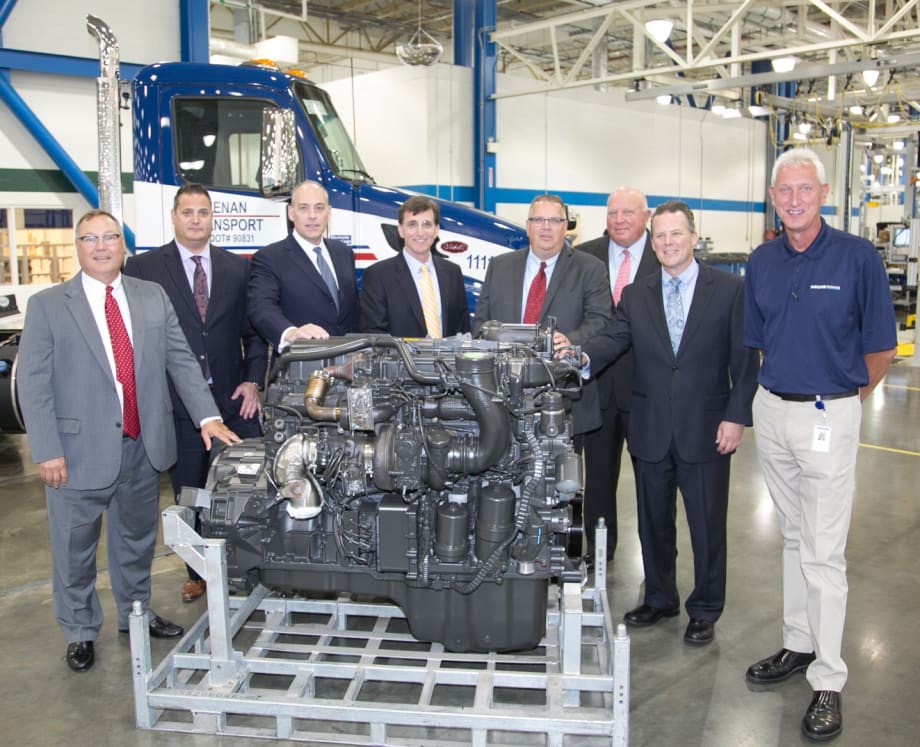
The 100,000th Paccar MX-13 engine produced for North America was recently presented to Kenan Advantage Group, which will operate it in a Peterbilt Model 579.
by Staff
August 21, 2015
Representatives from AMG Peterbilt of Columbus, Kenan Advantage Group, Paccar Engines and Peterbilt Motors celebrated the production of the 100,000th Paccar MX-13 engine.
1 min to read
Representatives from AMG Peterbilt of Columbus, Kenan Advantage Group, Paccar Engines and Peterbilt Motors celebrated the production of the 100,000th Paccar MX-13 engine.
The 100,000th Paccar MX-13 engine produced for North America was recently presented to Kenan Advantage Group, which will operate it in a Peterbilt Model 579.
KAG, a major tank truck transporter and logistics provider headquartered in Canton, Ohio, was of the first fleets to order an MX-13 in 2010.
Ad Loading...
The engine was presented to KAG President Bruce Blaise and Vice President – Fleet Services Bruce Stockton during an event at the Paccar engine plant in Columbus, Miss., where the MX-13 is manufactured for North American markets. They were joined by Dean Martin, president of sales for AMG Peterbilt of Columbus.
Paccar MX engines have been powering DAF (a Paccar company) trucks throughout the world and over 400,000 engines are in operation today. The engine accumulated more than 50 million test miles before it was introduced in North America. It can be spec’d with up to 500 horsepower and 1,850 ft.-lb. of torque.
Detroit's DD13, DD15, and DD16 engines get a pre-SCR boost, 3% fuel-efficiency gains, and familiar service intervals as Daimler prepares for trucking's next emissions era.
Aurora announced it has validated a 1,000-mile driverless lane beyond Hours of Service limits and plans to have more than 200 self-driving trucks on the road by the end of the year.
Mercedes‑Benz Trucks Classic is opening the anniversary year “130 Years Trucks” at Retro Classics Stuttgart from February 19 to 22, 2026. Check out these photos.
The Environmental Protection Agency is asking diesel engine makers to provide information about diesel exhaust fluid system failures as it considers changes to emissions regulations.
The companies also said they plan to coordinate deployment planning across priority freight corridors and define routes and operational design domains for U.S. commercial service while laying the groundwork for expansion into key European markets.