




Green Strategy Discussions Kick Off Work Truck Show
Alternative fuels and powertrains will work if an organization’s top people favor the concepts, speakers said at Tuesday's Green Truck Summit ahead of the NTEA Work Truck Show.

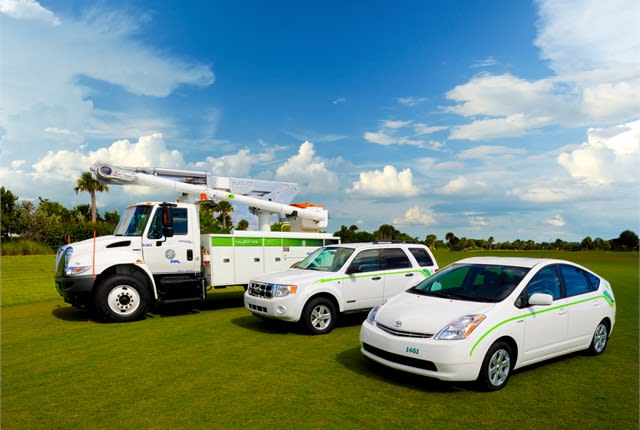
Some of Florida Power & Light's green vehicle fleet. Photo courtesy Florida Power & Light.
Some of Florida Power & Light's green vehicle fleet.Photo courtesy Florida Power & Light.
Alternative fuels and powertrains will work if an organization’s top people favor the concepts, speakers said at Tuesday's Green Truck Summit ahead of the NTEA Work Truck Show.
Speakers included fleet managers from the City of Fort Wayne, Indiana, and Florida Power & Light. Larry Campbell, fleet manager for Fort Wayne, has had the backing of elected officials since the fleet's first move away from total reliance on traditional fuels to gasoline-electric hybrids from Ford and General Motors. This prompted a partnership with two suppliers for diesel-electric hybrid trucks and use of biodiesel in medium- and heavy-duty trucks starting in 2003.
He said the mayor and city council members wanted to adopt “green” vehicles to reduce emissions and save fuel money, which the fleet has accomplished. A B20 biodiesel blend last year cut diesel use by 330,000 gallons and reduced greenhouse gas emissions by tens of thousands of tons.
Teething problems included plugged fuel filters caused by the biofuel’s solvent action that cleaned out gunk from the tanks and lines of older trucks, he said. After about three months, however, the filter problems ceased.
“But we learned to implement biofuels gradually, first B5, then B10, then up to B20” to reduce other adoption problems, he said. All diesels in all trucks and off-road equipment burn it without problems.
(Biofuel should meet the American Society for Testing Meterials' D6751 specification, cautioned Jennifer Weaver of the National Biodiesel Board in another session.)
Hybrids from Navistar International and Enova Systems save about 10% in fuel a year for the city. That's not significantly high because of the nature of urban work-truck operations, Campbell acknowledged, but still enough to reduce fuel expenses by an average of $2,784 per truck per year with diesel cost at $3.20 per gallon.
With diesel prices since down, the savings are less. But grants arranged through the Indiana Clean Cities program offset the prices of the hybrids in the first place.
Other savings come through idle reduction settings on trucks’ electronic controls. The fleet bought the software and installed it on the control modules, but some drivers weren’t aware of the program and complained about engines shutting down suddenly.
“Those drivers were told to report to the office after their shifts,” Campbell said. They had to be educated, and he said training on new equipment is vital.
Managers also found that the hybrids’ battery regeneration function was fighting the engine brakes, so mechanics turned off the brakes and the problem went away. In preparing trucks, places had to be found on chassis to mount hybrid components, such as motors on drivelines and batteries on frames. The fleet found that extra batteries were needed for most chassis.
Data captured through telematics showed extremely high engine idling – up to 20 hours a day on Water Department trucks. They go to repair sites and sit for many hours while work proceeds; in cold weather workers want the cabs heated, not just to warm themselves during breaks but also to dry out clothes.
The solution was installing engine cab heaters from Enova. They use 1 gallon of fuel per day while idling engines burn 1 to 1.5 gallons per hour. Water Department trucks now save 630 gallons of fuel per per vehicle per year, and reduce greenhouse gas emissions by 34,760 pounds.
“You’d think convincing electric utility executives to use electric vehicles would be a no-brainer,” said Claude Masters of Florida Power & Light. “But that’s not the case. We had to put together strong business cases for them.”
Masters and his colleagues did so, and now use a variety of electric and hybrid trucks: diesel-electric hybrid bucket trucks from Altec-JEMS, Odyne and Allison; VIA electric powertrain conversions of vans and pickups; and XL Hybrid bolt-on conversions of cargo vans. All work well, though some had initial problems. And training is very important.
“If you give a driver something he doesn’t want, the first thing he’ll do is break it, then he’ll tell you, ‘See, I told you it was a piece of junk,’” Masters said. Altec does a lot of field training for FP&L, and it convinces most people that the alternative-fuel powertrains are “cool,” and drivers buy into the idea.
On fuel, FP&L has been using B20 since 2003 and now consumes 2.5 million gallons a year. The company buys B100 – 100% biofuel – that meets its own stringent specification from known, reliable suppliers, then blends it with petroleum diesel to get the 20-80 mix.
B20 is used in straight diesel as well as hybrid trucks. Masters calls the latter “technology stacking,” with the two innovations, B20 and hybrid drives, combining for greater savings. B20-fueled hybrids allow FP&L to reduce its diesel buying by 60 to 80% a year, he said.
Electric-powered cab air conditioning in Florida's heat and humidity offers "significant" savings from not having to idle truck engines, Masters added.
Plan on where certain trucks will go into service, he said. For example, don't just send new plug-in hybrids to a location and find that it doesn't have the power outlets to plug into.
And, “Don’t discount the considerable value in image” from green trucks, Masters said. “We call it out (with special graphics) on the sides of our trucks, and people pay attention to that.”
Payback of the higher acquisition costs varies with the type of innovation, but must be considered at the beginning of a project, both managers said. “If you’re not using the equipment enough, it’s not going to pay for itself,” said Campbell of Fort Wayne. Clean Cities programs can help calculate those figures.
There are online calculators from government and suppliers, “and the truth will be somewhere in between,” Masters said. “Fuel savings will give the biggest savings, but executives might also simply love hybrids and electric vehicles. So an 11-year payback on a vehicle with a 12-year life might be just fine with our president.”
More Fleet Management

Color Match Smarter: Tools That Restore & Perform
For fleet managers and collision repair professionals keeping heavy-duty trucks on the road, getting the color right the first time isn't just about appearance — it's about efficiency, turnaround time, and bottom-line results. Discover how today's digital color tools are transforming the repair process from guesswork to precision.
Read More →
FMCSA Pauses Biennial-Update Enforcement Amid Motus Transition
Carriers whose updates were due on or after June 1 have more time, while FMCSA works to stabilize its new registration system and warns of phishing sites impersonating its new carrier registration system, Motus.
Read More →
2026 Blueprint for Countering Smarter Supply Chain Theft
Cargo theft is no longer just the cost of doing business. It's a multi-billion-dollar criminal enterprise exploiting vulnerabilities across your fleet, drivers, and supply chain.
Read More →


How Telematics Improves Visibility, Control, and Performance in Refrigerated Fleets
Explore how telematics help refrigerated fleets improve visibility, uptime, efficiency, compliance, and cargo protection across connected cold chain operations.
Read More →
What the U.S.-Canada Trade War Means for Trucking
Escalating U.S.-Canada tariffs could disrupt cross-border freight, reduce truck volumes, raise costs, and create new uncertainty for carriers on both sides of the border.
Read More →
What Are Trucking’s Top Concerns for 2026?
The American Transportation Research Institute wants to know what's worrying trucking fleet managers, drivers, and other stakeholders in its annual Industry Issues survey.
Read More →
American Trucking Associations Looks for a New Leader
ATA President and CEO Chris Spear abruptly left his job at the association on August 21, at a pivotal time for the trucking industry.
Read More →
Public Wi-Fi Cybersecurity Risks: How Truck Drivers and Fleets Can Protect Their Data
Public Wi-Fi can expose truck drivers and fleets to credential theft, malware, and other cyber threats. Here’s how to reduce the risk on the road.
Read More →
For Nicky Cupp, Fleet Innovation Starts With Frustration
HDT Truck Fleet Innovator Nicky Cupp turns everyday pain points at Fraley & Schilling into opportunities for better technology and smarter processes.
Read More →
Adam Buttgenbach’s Approach to Electric Trucks: Start With Where They Fit
HDT Truck Fleet Innovator Adam Buttgenbach helped PepsiCo build one of North America’s largest EV fleets by focusing on where electric trucks make operational sense.
Read More →