





Protecting Your Payloads: 5 Essential Strategies for Cargo Security
Cargo Theft Losses Jump 60% in 2025 as Criminals Target Higher-Value Freight
Cargo theft activity across North America held relatively steady in 2025 — but the financial damage did not, as ever-more-sophisticated organized criminal groups shifted their cargo theft focus to higher-value shipments.
January 22, 2026
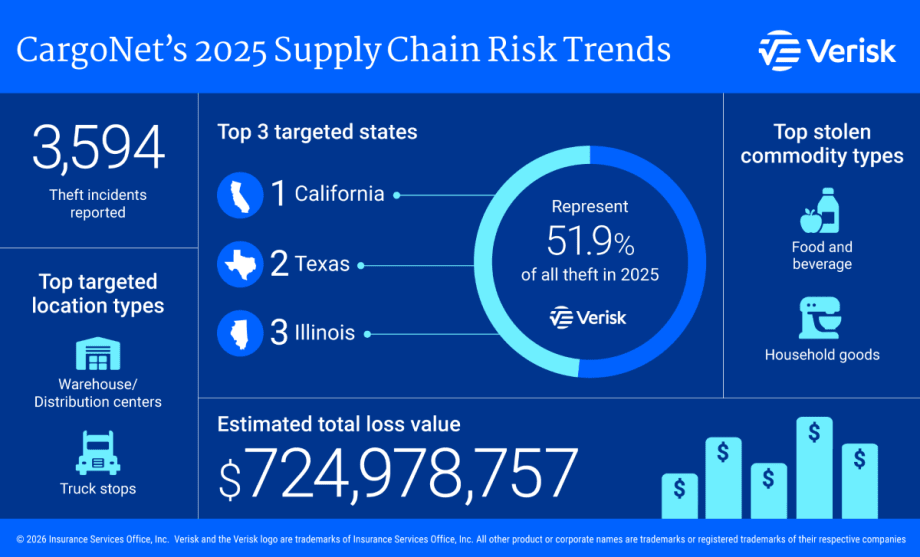
CargoNet’s findings suggest that cargo theft is becoming less opportunistic and more strategic.
Credit: CargoNet
4 min to read
Cargo theft activity across North America held relatively steady in 2025 — but the financial damage did not, as ever-more-sophisticated organized criminal groups shifted their cargo theft focus to higher-value shipments.
According to new analysis from Verisk CargoNet, estimated cargo theft losses surged to nearly $725 million last year. That is a 60% increase from 2024. In comparison, confirmed cargo theft incidents rose 18%, climbing from 2,243 to 2,646.
Organized criminal groups have shifted their focus toward higher-value shipments and expanded into new geographic areas, CargoNet found.
The average theft value jumped 36%, rising to $273,990 per incident, up from $202,364 the year before.
A More Sophisticated Cargo Theft Threat Model
CargoNet’s findings suggest that cargo theft is becoming less opportunistic and more strategic.
“Criminal enterprises are becoming more selective and sophisticated, targeting extremely high-value shipments rather than relying on opportunistic theft,” said Keith Lewis, vice president of operations at Verisk CargoNet.
“This strategic shift explains how losses can rise 60% even as overall incident volume holds steady.”
Rather than small regional crime rings stealing whatever is easiest to access, organized groups, often international, are conducting deeper reconnaissance, selectively choosing loads that maximize financial return, and using more sophisticated methods.
“Cargo theft in the United States fundamentally changed between 2020 and 2022,” said Scott Cornell, chair of the Transported Asset Protection Association, or TAPA Americas, in an interview with HDT Talks Trucking.
“A good portion of cargo theft being conducted in the United States right now is driven by these very large, sophisticated, organized crime rings that are operating from dozens of different countries,” said Cornell, who has been doing cargo theft investigations for over 30 years in supply chain security.
“And their preferred method is strategic theft, which always starts with the use of deception to trick a member of the supply chain into giving them the freight unknowingly but willingly.”
Cargo Theft Spreads Beyond Traditional Hotspots
While California remained the biggest hotspot with 1,218 incidents, CargoNet’s data shows theft activity continuing to disperse geographically — often into areas historically considered lower risk.
That’s due to the growth of strategic theft, which doesn’t rely on cargo thieves physically having a team where the freight is, like traditional straight theft does.
“This ability to be anywhere and target freight anywhere has seen cargo theft really seep into all parts of the United States," said Cornell. "It's all over the country now. It doesn't matter if you're in Wyoming or Iowa or Nebraska; cargo theft is coming.”
In California, theft declined 11% in Los Angeles County, but surged elsewhere, including Kern County (up 82%) and San Joaquin County (up 44%).
Other states experiencing sharp increases included New Jersey (up 50%), Indiana (up 30%), and Pennsylvania (up 24%).
That dispersion presents a growing challenge for fleets and shippers that may not have historically invested heavily in cargo security outside traditional theft corridors, CargoNet concluded.
Food, Metals, and High-Tech Equipment Top Cargo Theft Targets
Shifts in targeted commodities were another defining trend in 2025, CargNet found.
Food and beverage theft spiked 47%, with 708 reported incidents. The types of products targeted varied by region:
Meat and seafood were heavily targeted in the Northeast, particularly in New Jersey.
Tree nuts were more frequently stolen on the West Coast.
Metal theft surged 77%, driven largely by continued demand for copper products, a trend that has affected everything from construction materials to electrical components.
In contrast, theft of consumer-grade electronics such as televisions and personal computers declined.
Instead, organized groups increasingly targeted enterprise computing hardware and cryptocurrency mining equipment, which offer higher resale value and are often moved in large, concentrated shipments.
Vehicle-related products, including tires, auto parts, and motor oils, also remained attractive targets.
CargoNet noted a particular focus on engines and components destined for domestic vehicle assembly plants, underscoring the growing intersection between cargo theft and supply chain disruption.
Cargo Theft: What to Watch in 2026
CargoNet expects these trends to continue into 2026, particularly the targeting of high-value technology products such as RAM modules, enterprise storage drives, and advanced computing equipment.
The company is also monitoring the growth of theft-by-deception schemes, in which criminals misdirect shipments tendered to legitimate carriers — often bypassing controls focused on the tendering process itself.
CargoNet also flagged potential ripple effects from heightened enforcement of non-domiciled CDL drivers.
Many complex cargo theft operations rely on acquiring or impersonating carriers with strong compliance histories. Increased enforcement could reduce available capacity while expanding the pool of distressed carriers, according to CargoNet, potentially creating new opportunities for fraudulent takeovers.
More Fleet Management

Sponsored•September 16, 2026
Color Match Smarter: Tools That Restore & Perform
For fleet managers and collision repair professionals keeping heavy-duty trucks on the road, getting the color right the first time isn't just about appearance — it's about efficiency, turnaround time, and bottom-line results. Discover how today's digital color tools are transforming the repair process from guesswork to precision.
Read More →
FMCSA Pauses Biennial-Update Enforcement Amid Motus Transition
Carriers whose updates were due on or after June 1 have more time, while FMCSA works to stabilize its new registration system and warns of phishing sites impersonating its new carrier registration system, Motus.
Read More →
Sponsored•September 14, 2026
2026 Blueprint for Countering Smarter Supply Chain Theft
Cargo theft is no longer just the cost of doing business. It's a multi-billion-dollar criminal enterprise exploiting vulnerabilities across your fleet, drivers, and supply chain.
Read More →


Sponsored•September 1, 2026
How Telematics Improves Visibility, Control, and Performance in Refrigerated Fleets
Explore how telematics help refrigerated fleets improve visibility, uptime, efficiency, compliance, and cargo protection across connected cold chain operations.
Read More →
What the U.S.-Canada Trade War Means for Trucking
Escalating U.S.-Canada tariffs could disrupt cross-border freight, reduce truck volumes, raise costs, and create new uncertainty for carriers on both sides of the border.
Read More →
What Are Trucking’s Top Concerns for 2026?
The American Transportation Research Institute wants to know what's worrying trucking fleet managers, drivers, and other stakeholders in its annual Industry Issues survey.
Read More →
American Trucking Associations Looks for a New Leader
ATA President and CEO Chris Spear abruptly left his job at the association on August 21, at a pivotal time for the trucking industry.
Read More →
Public Wi-Fi Cybersecurity Risks: How Truck Drivers and Fleets Can Protect Their Data
Public Wi-Fi can expose truck drivers and fleets to credential theft, malware, and other cyber threats. Here’s how to reduce the risk on the road.
Read More →
For Nicky Cupp, Fleet Innovation Starts With Frustration
HDT Truck Fleet Innovator Nicky Cupp turns everyday pain points at Fraley & Schilling into opportunities for better technology and smarter processes.
Read More →
Adam Buttgenbach’s Approach to Electric Trucks: Start With Where They Fit
HDT Truck Fleet Innovator Adam Buttgenbach helped PepsiCo build one of North America’s largest EV fleets by focusing on where electric trucks make operational sense.
Read More →