




ACT Expo 2026 Announces Keynote Speakers
ACT Expo has tapped Mack’s Stephen Roy and Rivian CEO RJ Scaringe as its 2026 keynote speakers.

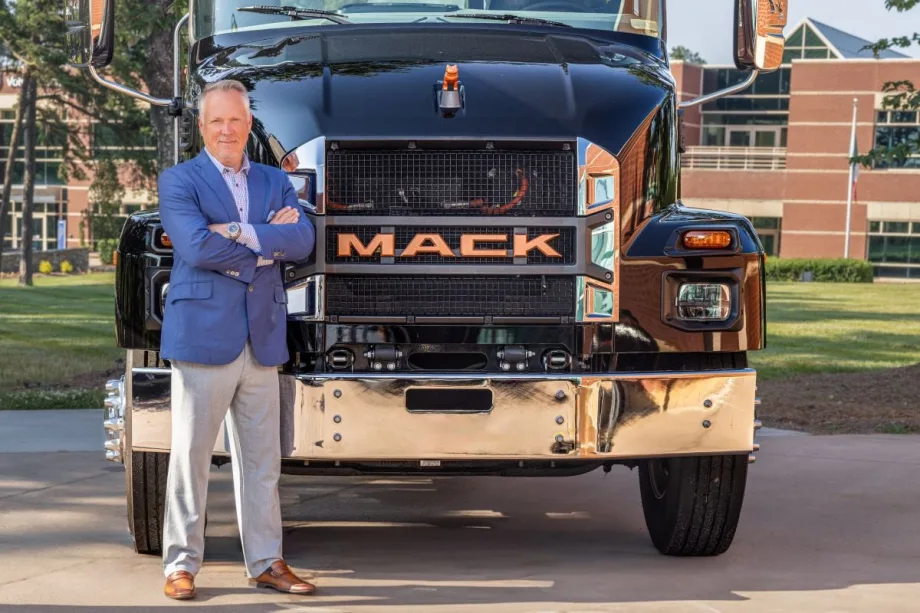
Stephen Roy, president of Mack Trucks and chairman of Volvo Group North America, will deliver a keynote address at ACT Expo on Tuesday, May 5, 2005.
Photo: Mack Trucks
The Advanced Clean Transportation Expo (ACT Expo) has lined up two high-profile OEM leaders to headline its 2026 conference.
The influential trucking conference has named Mack Trucks president Stephen Roy and Rivian founder and CEO RJ Scaringe as keynote speakers for next year’s event in Las Vegas.
ACT Expo 2026 will take place May 4–7 at the Las Vegas Convention Center.
The show will once again bring together fleets, manufacturers, and technology providers at a time when trucking is grappling with rising costs, rapid technology change, and growing pressure to improve efficiency, safety, and environmental performance.
ACT Expo recently announced it was expanding the show's scope to better address the myriad issues the trucking industry faces today.
For fleets, the pairing of Roy and Scaringe signals a conference agenda focused less on hype and more on how advanced vehicle technologies are actually being deployed—and monetized—in real-world operations.
Stephen Roy: The Truck as a Digital Platform
Roy, who serves as both president of Mack Trucks and chairman of Volvo Group North America, is scheduled to deliver his keynote on Tuesday, May 5.
His remarks will center on how connected systems, software-defined vehicles, and data-driven tools are reshaping the modern heavy-duty truck.
Under Roy’s leadership, Mack and Volvo have leaned heavily into connectivity, over-the-air updates, and advanced analytics as tools to improve uptime and reduce total cost of ownership.
His ACT Expo keynote is expected to focus on how fleets are increasingly using vehicle data to move from reactive maintenance to more predictive strategies—and how digital intelligence is becoming as important as iron and horsepower.
“Today’s trucks are defined by much more than hardware,” Roy said in a statement announcing the keynote. “Connected vehicles, software-defined platforms, and data-driven tools are revolutionizing the industry and helping fleets dramatically improve uptime, efficiency, and safety.”
Roy also plans to address how these technologies intersect with sustainability and decarbonization goals—an area where many fleets are still sorting through what delivers real operational value versus what simply adds cost or complexity.
For ACT Expo attendees, Roy’s perspective comes from overseeing one of the industry’s broadest portfolios of heavy-duty technologies, spanning conventional powertrains, advanced safety systems, and connected vehicle ecosystems already in widespread fleet use.
RJ Scaringe: Electrification Beyond the Pilot Phase
On Wednesday, May 6, Rivian CEO RJ Scaringe will take the keynote stage to discuss what fleet electrification looks like once it moves beyond pilot projects and into daily, high-utilization operations.
Rivian now has thousands of electric delivery vehicles operating in real-world fleet service, and the company has expanded availability of its commercial vehicles to fleets of all sizes.
Scaringe’s keynote will focus on lessons learned from those deployments—particularly around total cost of ownership, reliability, and operational consistency.
“Fleet electrification is happening at scale, every day,” Scaringe said. “I’m excited to share what we’re learning from real-world deployments and how thoughtful vehicle design, software, and data can help fleets lower costs, improve uptime, and operate more reliably in demanding environments.”
Scaringe is also expected to address how vehicle design choices, embedded software, and advanced driver-assistance systems influence day-to-day fleet performance—an increasingly important conversation as more fleets weigh whether electric trucks can meet their duty cycles without disrupting operations.
While Rivian is best known in some circles for its consumer vehicles, its growing footprint in commercial delivery gives Scaringe a data-rich vantage point on where electrification works today—and where challenges remain.
ACT Expo’s Role in a Transitional Moment
ACT Expo organizers said the 2026 program is designed to help fleets navigate a market defined by economic pressure and accelerating technology cycles.
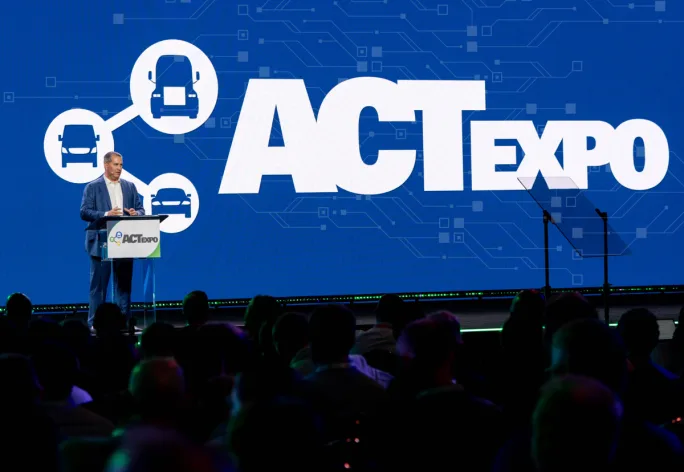
Erik Neandross, President of Clean Transportation Solutions at TRC speaks at ACT Expo in 2025.
Photo: ACT Expo
With freight markets still uneven and capital spending under scrutiny, fleets are demanding clearer answers about which technologies improve productivity, safety, and reliability now—not five years down the road.
For more than 16 years, ACT Expo has positioned itself as a forum for practical decision-making rather than speculative forecasts. The 2026 agenda will continue that approach, covering topics such as AI, automation, connected vehicles, software-defined platforms, advanced powertrains, and zero-emission solutions.
By bringing together fleet operators, OEMs, technology providers, infrastructure partners, utilities, and policymakers, ACT Expo aims to give fleets direct access to both the tools and the peer experience needed to make confident equipment and technology decisions.
With keynote speakers representing both a legacy heavy-duty manufacturer and a newer entrant pushing electrification at scale, ACT Expo 2026 is shaping up as a snapshot of an industry balancing innovation with the realities of fleet economics.
More Fleet Management

How MFA Helps Protect Trucking Fleets
Multi-factor authentication adds protection when passwords are stolen. Here’s how it works and where fleets should start.
Read More →
How Better Freight Data Helps Trucking Teams Get Ahead of Disruption
Trucking and logistics teams have plenty of data. The problem is getting the right information in front of the right people soon enough to act. Better-connected data can help teams spot trouble earlier and make smarter decisions before small problems become big ones.
Read More →
Trimble: Taking Artificial Intelligence in Trucking Beyond Faster Tasks
At Insight 2026, Trimble executives argued that fleets may need to redesign workflows to get more from AI as it introduced new products and enhancements. AI’s value will depend on how fleets combine automation with their people's knowledge.
Read More →


Nominations Open for HDT Emerging Leaders
Heavy Duty Trucking is looking for accomplished trucking fleet professionals under 40 who are making an impact and helping lead the industry forward.
Read More →
Why Private Fleets Are Taking More Freight
Private fleets are putting their own trucks on demanding customers and high-cost lanes as companies seek greater control over service, costs, and capacity.
Read More →
Color Match Smarter: Tools That Restore & Perform
For fleet managers and collision repair professionals keeping heavy-duty trucks on the road, getting the color right the first time isn't just about appearance — it's about efficiency, turnaround time, and bottom-line results. Discover how today's digital color tools are transforming the repair process from guesswork to precision.
Read More →
FMCSA Pauses Biennial-Update Enforcement Amid Motus Transition
Carriers whose updates were due on or after June 1 have more time, while FMCSA works to stabilize its new registration system and warns of phishing sites impersonating its new carrier registration system, Motus.
Read More →
2026 Blueprint for Countering Smarter Supply Chain Theft
Cargo theft is no longer just the cost of doing business. It's a multi-billion-dollar criminal enterprise exploiting vulnerabilities across your fleet, drivers, and supply chain.
Read More →
How Telematics Improves Visibility, Control, and Performance in Refrigerated Fleets
Explore how telematics help refrigerated fleets improve visibility, uptime, efficiency, compliance, and cargo protection across connected cold chain operations.
Read More →
What the U.S.-Canada Trade War Means for Trucking
Escalating U.S.-Canada tariffs could disrupt cross-border freight, reduce truck volumes, raise costs, and create new uncertainty for carriers on both sides of the border.
Read More →