





From the Editor: This story originally was published December 19 and was updated December 22 with new data from Truckstop.com.
Beyond the Spot Rate Spike: What Freight Capacity and 2026 Look Like for Trucking
A late-year spot rate surge has drawn attention, but analysts say the bigger story is slower freight demand, shrinking capacity, and what that means for trucking heading into 2026.
December 22, 2025
A year-end look at the trends of 2025 and ahead into 2026, focusing on freight rates, freight demand, and trucking capacity.
Credit: Heavy Duty Trucking
7 min to read
Is a spike in spot freight rates over the past few weeks an inflection point for trucking, or a weather- and holiday-related short-term trend? Will 2026 see an end to the record-long freight recession?
Data from Truckstop.com and FTR Transportation Intelligence showed a surge in broker-posted spot rates the week after Thanksgiving, especially in refrigerated freight, that exceeded seasonal expectations, reaching their highest level since January 2023.
And for the week ending December 19, Truckstop.com said its data showed a much stronger spot market than usual for a period that ended nearly a week before Christmas. Dry van spot rates were especially strong, posting their best year-over-year comparison since February 2022 and reaching their highest level since January 2023.
Spot rates are likely to rise sharply again this week and typically increase during the week that includes New Year’s Day, according to a Truckstop news release.
A modest increase in load postings, coupled with the decline in truck postings, resulted in a Market Demand Index of 108.0 – the strongest level since the week of the International Roadcheck roadside inspection event in May.
However, Truckstop.com and FTR warned, spot rate volatility often occurs around major holidays and does not necessarily signal a change in trend.
DAT: Inverted Market
C.H. Robinson found reason for optimism in recent spot market numbers. The DAT load-truck-ratio spiked to 9.9-to-1 the week ending December 6, according to the tech-enabled brokerage giant.
C.H. Robinson said this was the highest of the current truckload downcycle and higher than the 9.1-to-1 ratio the week ending January 11, 2025, which was driven by year-end carrier exits, holidays, and severe weather.
However, at DAT Freight & Analytics, Chief of Analytics Ken Adamo noted that for the month of November, average contract rates were higher than spot rates in November, maintaining the pricing dynamic that has persisted across the freight market since early 2022.
“The market remains fundamentally inverted,” Adamo said in a news release.
“Oversupply persists, shippers are cautious amid economic uncertainty, and many carriers are still operating unprofitably. December should bring some seasonal lift, but we will need to see sustained strength after the holidays to gain confidence that the market is poised to flip.”
2025 a 'Lackluster' Year for Trucking Freight, Rates
Looking overall at 2025, it was a “lackluster” year for freight rates, said Avery Vise, vice president of trucking at FTR, in an interview.
However, late November and into December, he said, saw dry van rates running stronger over a period of several weeks than they were a year ago, which is unusual.
“What does that mean? I think it's an indication of the other big trend of the year, which is on the capacity side, the other side of the ledger. And that is that we've just seen it continue chipping away at trucking capacity in order to meet what we now see as a pretty low level of demand.”
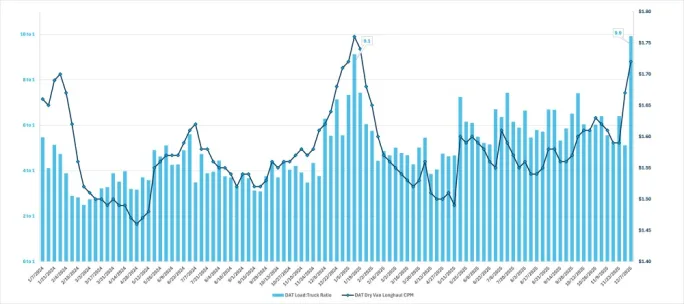
DAT tracked a spike in freight rates the week after Thanksgiving.
Credit: DAT
Was it theWeather?
ACT Research President and Chief Analyst Ken Vieth said unusually cold weather east of the Mississippi contributed to the run-up in spot rates over the past few weeks.
“We've had three fairly significant storms since Thanksgiving. And so that's backed freight up.”
However, like Vise, he believes the strength in spot rates is partly a recognition of the supply-demand balance getting tighter.
“We think we are getting closer to equilibrium, but we're not there yet," he said in an interview. "So we look for a lot of this spot rate increase that we've seen over the past two or three weeks to roll off in the short term.”
Are We Finally Drawing Down Overcapacity Enough?
These and other analysts who track trucking numbers say 2026 could be somewhat better than 2025, as much of the excess freight capacity has been driven from the market.
Motive addressed the overcapacity question in its Holiday Outlook Report published in early December. After two years of steep contraction, the trucking market has settled into a flatter baseline, according to the report.
Through October 2025, there were relatively few carrier exits per month, with a total of 2,125 carriers leaving the market.
Capacity is still shrinking, but the market is no longer shedding carriers at the same intensity seen in 2023 and 2024.
That’s why Hamish Woodrow, head of strategic analytics and data engineering at Motive, frames 2025 as a year of pause after a hard reset.
The market is “largely flat,” he says, with exits happening “at a much slower pace.”
What stands out most, he said, is the balance. “For every carrier that exits, another one is entering,” he said.
That balance means fleets are operating in a market where capacity isn’t tightening quickly, but it’s not expanding either. Going into the holiday push, that’s a calmer capacity picture than fleets have been dealing with, although it doesn't signal a true rebound, Motive said.
“If we go back a year,” said FTR’s Vise, “I would say we had a capacity and a freight problem. We still had too much capacity, we still had too little freight. Now I really think we just have too little freight."
However, he said, there is still some elevated capacity among the small carriers operating almost exclusively in the freight market.
What About Freight Demand?
Of course, capacity is only half of the equation. Some economists are expressing concerns about the broader economy, including job growth, manufacturing, inflation, interest rates, the housing market, and continued uncertainty around tariffs.
U.S. Bank’s quarterly freight payment index reported freight volumes were down about 3% in the third quarter. (The index measures freight shipments and the spend activity associated with those shipments.)
That’s “probably not a surprise given all the tariff activity and what we saw in general slowness,” Jeff Pape, General Manager of Transportation for U.S. Bank, told Heavy Duty Trucking in an interview.
Compared to the prior year, volumes were down about 10%.
“But at the same time, what we're seeing is that shippers are paying more in the form of rates,” he said. “Spending rose about 2% quarter over quarter and it was up about 3% from earlier in the year.”
On the demand side, “Broadly speaking, the economy is growing, yet not very quickly,” said Woodrow.
The retail sector is seeing moderate growth, in line with the rest of the United States, he said, as reflected in Motive’s Big Box Retail Index, which tracks exits and entries to distribution facilities at the Top 50 retailers.
Looking Ahead to 2026 in Trucking Freight and Rates
So if the recent spot rate run-up isn't the beginning of a true rebound, what can we expect from 2026?
U.S. Bank’s Pape said after more than three years of freight recession and all the uncertainty around tariffs this year, “What we're seeing now [is], both shippers and carriers are getting to a point where [they say] we have to move on.
“Tariffs aren't going away,” he said. “We have to start adapting to what a new normal would look like. So a lot of companies now are starting to look at how they manage that going forward.”
This means shippers are going to start replacing inventory, he said, which can lead to more freight.
“We think probably by mid-second quarter next year, we'll start to see some of this normalize again,” Pape said. “And we're hopeful that we'll see some sustainable growth, but I think it's going to take some time.”
C.H. Robinson Increased Rate Forecast
C.H. Robinson recently increased its 2026 dry van truckload rate forecast from 4% year-over-year growth to 6%.
“Capacity is tighter than expected post-Thanksgiving, and with only a few weeks left in the year, rate increase impacts will roll through into 2026," according to the giant tech-focused broker.
Again, the increase is driven by the supply side of the market – capacity returning to more normal levels.
“According to our latest projections, truckload capacity is expected to return to a more normalized level in the first half of 2026 — sometime between February and June,” said Michael Castagnetto, president, North American Surface Transportation at C.H. Robinson.
First-quarter 2026 rates are projected to drop from their December year-end high, following normal seasonal trends, but not as steeply as they did in 2024 and 2025, according to Castagnetto.
“When they increase in Q2, as they typically do with the onset of produce and beverage seasons, they’ll be starting from a higher point and will likely end up at a higher point than in 2024 or 2025.”
Poised for a Recovery
“I think that the trucking industry is poised for a recovery.” Vise said.
“I think unlike the situation in, say, 2023 and 2024, a recovery in freight would actually make a difference, where I'm not so sure it would have in ‘23. I think we had so much excess capacity in ‘23 that we could not realistically have gotten out of that through freight demand. I think we're now there. We are now dependent on freight demand.”
Subscribe to Our Newsletter
More Fleet Management

Sponsored•September 16, 2026
Color Match Smarter: Tools That Restore & Perform
For fleet managers and collision repair professionals keeping heavy-duty trucks on the road, getting the color right the first time isn't just about appearance — it's about efficiency, turnaround time, and bottom-line results. Discover how today's digital color tools are transforming the repair process from guesswork to precision.
Read More →
FMCSA Pauses Biennial-Update Enforcement Amid Motus Transition
Carriers whose updates were due on or after June 1 have more time, while FMCSA works to stabilize its new registration system and warns of phishing sites impersonating its new carrier registration system, Motus.
Read More →
Sponsored•September 14, 2026
2026 Blueprint for Countering Smarter Supply Chain Theft
Cargo theft is no longer just the cost of doing business. It's a multi-billion-dollar criminal enterprise exploiting vulnerabilities across your fleet, drivers, and supply chain.
Read More →


Sponsored•September 1, 2026
How Telematics Improves Visibility, Control, and Performance in Refrigerated Fleets
Explore how telematics help refrigerated fleets improve visibility, uptime, efficiency, compliance, and cargo protection across connected cold chain operations.
Read More →
What the U.S.-Canada Trade War Means for Trucking
Escalating U.S.-Canada tariffs could disrupt cross-border freight, reduce truck volumes, raise costs, and create new uncertainty for carriers on both sides of the border.
Read More →
What Are Trucking’s Top Concerns for 2026?
The American Transportation Research Institute wants to know what's worrying trucking fleet managers, drivers, and other stakeholders in its annual Industry Issues survey.
Read More →
American Trucking Associations Looks for a New Leader
ATA President and CEO Chris Spear abruptly left his job at the association on August 21, at a pivotal time for the trucking industry.
Read More →
Public Wi-Fi Cybersecurity Risks: How Truck Drivers and Fleets Can Protect Their Data
Public Wi-Fi can expose truck drivers and fleets to credential theft, malware, and other cyber threats. Here’s how to reduce the risk on the road.
Read More →
For Nicky Cupp, Fleet Innovation Starts With Frustration
HDT Truck Fleet Innovator Nicky Cupp turns everyday pain points at Fraley & Schilling into opportunities for better technology and smarter processes.
Read More →
Adam Buttgenbach’s Approach to Electric Trucks: Start With Where They Fit
HDT Truck Fleet Innovator Adam Buttgenbach helped PepsiCo build one of North America’s largest EV fleets by focusing on where electric trucks make operational sense.
Read More →