




Why Trucking Companies Should Consider Accounts Receivable Insurance
Accounts receivable (A/R) insurance protects trucking companies against the risk that a customer won’t pay their invoices.
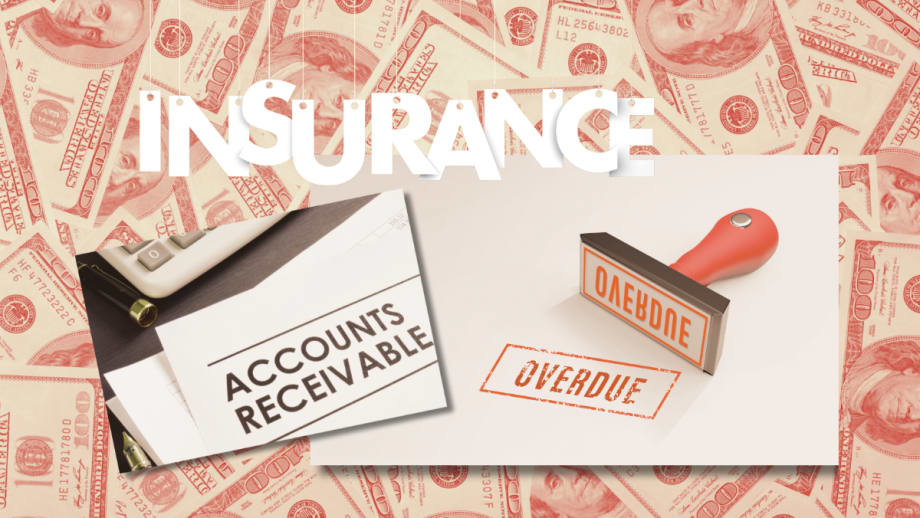
A/R insurance can strengthen factoring agreements or credit lines by reducing lender risk, often leading to lower costs or higher advance rates.
Graphic: HDT/Canva
Financial instability is increasingly visible in the U.S. trucking market today.
In 2024, the industry experienced a net contraction of over 10,000 motor carriers, with freight brokerages decreasing by 11.5% year-over-year.
For carriers, each closure is more than a market headline. It represents potential unpaid invoices and lost cash flow.
With margins already stretched by higher equipment, fuel, insurance, and labor costs, a single default or delayed payment can ripple quickly through operations.
Risk in an Uncertain Market
Delivering freight today and getting paid months later — or not at all — has become one of the most pressing risks carriers face.
Accounts receivable (A/R) insurance protects trucking companies against the risk that a customer won’t pay their invoices.
Coverage typically includes broker and shipper insolvency, prolonged nonpayment, and outright defaults.
Imagine: a carrier delivers freight worth $75,000, but before the invoice clears, the broker files for bankruptcy.
With A/R insurance, the carrier can file a claim and receive reimbursement for the unpaid invoice, often within weeks. That payment stability can be the difference between meeting payroll and fueling the fleet or being forced to cut back operations.
Understanding how the coverage works is only the first step. The real opportunity lies in how carriers can use A/R insurance not just to survive defaults but to strengthen financing and fuel growth.
More Than Just a Safety Net
By converting receivables into insured assets, carriers gain a tool that can strengthen their balance sheet and open doors to financing.
Banks and lenders are far more willing to extend credit against insured invoices, often advancing a higher percentage.
For example, without A/R insurance, a midsize fleet with $5 million in receivables might only be able to borrow 75%, or $3.75 million.
With insured receivables, that advance rate could rise to 90%, or $4.5 million. That’s an extra $750,000 in working capital — money that can be immediately reinvested back into the business.
That financing can translate directly into growth: adding trucks to capture more freight demand, hiring drivers to support expansion, or investing in new technology that improves efficiency.
Just as important, A/R insurance allows fleets to extend more competitive payment terms to shippers and brokers, knowing that even if a counterparty fails, the invoices are protected.
It also reduces concentration risk, giving carriers the confidence to pursue larger contracts with big-name shippers without fearing that one customer’s financial collapse could destabilize the entire business.
Best Practices for Fleets
For fleets considering accounts receivable insurance, the key is to treat it as both a protective tool and a growth enabler.
Here are a few practical ways to make the most of it:
- Start with your biggest risks. Not every receivable needs to be insured. Many carriers begin by covering their largest or most concentrated accounts and the invoices that would hurt most if they went unpaid.
- Pair it with factoring or financing. A/R insurance can strengthen factoring agreements or credit lines by reducing lender risk, often leading to lower costs or higher advance rates.
- Leverage insurer credit monitoring. Most providers offer credit assessments and alerts on brokers and shippers. Use this intelligence to spot red flags before they turn into unpaid invoices.
- Reframe it as an investment, not just a cost. Premiums are typically a fraction of the receivables insured. When paired with the financing and growth opportunities it unlocks, the return on investment can be substantial.
- Work with a broker who understands transportation. Insurance advisors familiar with the trucking industry can help customize coverage, ensuring the policy matches your cash flow cycle and client mix.
Trucking is a business built on trust, but in a volatile freight market, trust alone isn’t enough. Broker bankruptcies, shipper defaults, and prolonged payment terms have made receivable risk one of the industry’s biggest threats.
Accounts receivable insurance offers a way to turn that risk into resilience, protecting today’s cash flow while unlocking tomorrow’s growth. For carriers, it’s both a shield against disruption and a launchpad for expansion.
More Fleet Management

2026 Blueprint for Countering Smarter Supply Chain Theft
Cargo theft is no longer just the cost of doing business. It's a multi-billion-dollar criminal enterprise exploiting vulnerabilities across your fleet, drivers, and supply chain.
Read More →
How Telematics Improves Visibility, Control, and Performance in Refrigerated Fleets
Explore how telematics help refrigerated fleets improve visibility, uptime, efficiency, compliance, and cargo protection across connected cold chain operations.
Read More →
What the U.S.-Canada Trade War Means for Trucking
Escalating U.S.-Canada tariffs could disrupt cross-border freight, reduce truck volumes, raise costs, and create new uncertainty for carriers on both sides of the border.
Read More →

What Are Trucking’s Top Concerns for 2026?
The American Transportation Research Institute wants to know what's worrying trucking fleet managers, drivers, and other stakeholders in its annual Industry Issues survey.
Read More →
American Trucking Associations Looks for a New Leader
ATA President and CEO Chris Spear abruptly left his job at the association on August 21, at a pivotal time for the trucking industry.
Read More →
Public Wi-Fi Cybersecurity Risks: How Truck Drivers and Fleets Can Protect Their Data
Public Wi-Fi can expose truck drivers and fleets to credential theft, malware, and other cyber threats. Here’s how to reduce the risk on the road.
Read More →
For Nicky Cupp, Fleet Innovation Starts With Frustration
HDT Truck Fleet Innovator Nicky Cupp turns everyday pain points at Fraley & Schilling into opportunities for better technology and smarter processes.
Read More →
Adam Buttgenbach’s Approach to Electric Trucks: Start With Where They Fit
HDT Truck Fleet Innovator Adam Buttgenbach helped PepsiCo build one of North America’s largest EV fleets by focusing on where electric trucks make operational sense.
Read More →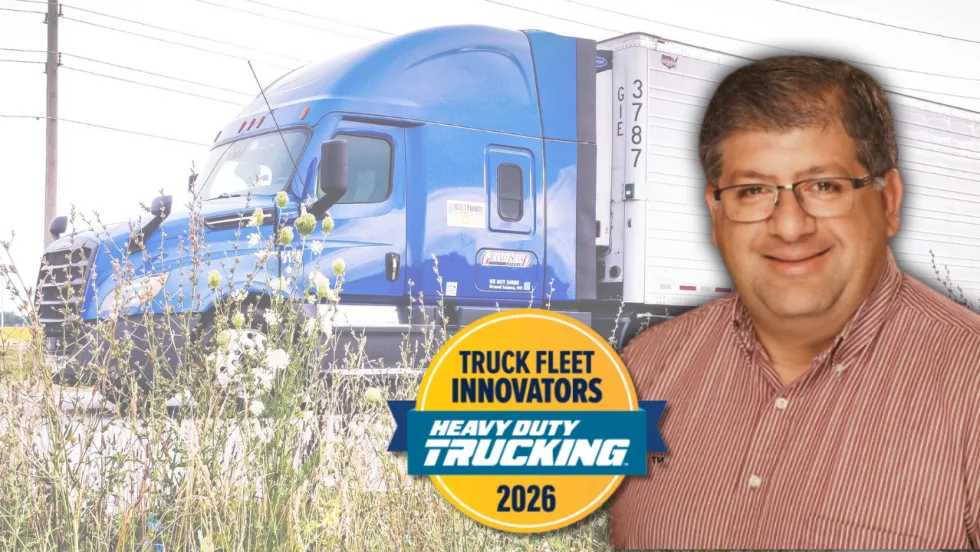
Deen Albert: Let Automation Do the Math, People Make the Decisions
HDT Truck Fleet Innovator Deen Albert makes sure people are still at the heart of operations at Grand Island Express, even while adopting artificial intelligence tools. AI-assisted dispatch helped boost revenue 25% with the same number of trucks.
Read More →
Trimble’s New AI Agent Takes Aim at Fleet Back-Office Busywork
Arc Agent works across Trimble TMS products to automate repetitive tasks such as freight orders, maintenance, invoices, fuel costs and more.
Read More →