




Daimler Fuel Cell Trucks Log More than 225,000 Operational Kilometers
Five Mercedes-Benz GenH2 Trucks have successfully completed more than 225,000 kilometers in initial customer trials with Air Products, Amazon, Holcim, INEOS Inovyn, and Wiedmann & Winz.

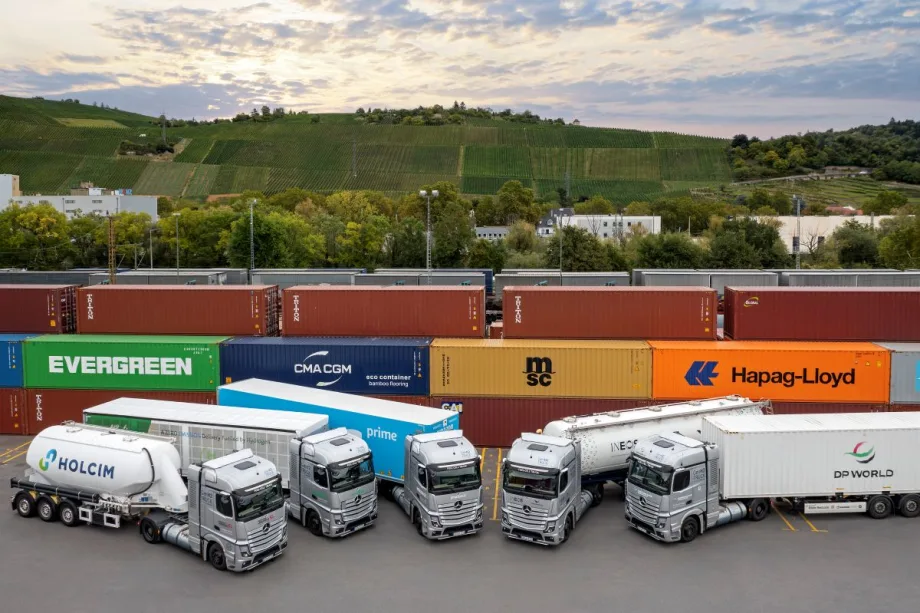
The Mercedes-Benz GenH2 prototype trucks feature hydrogen fuel cell technology developed and manufactured by cellcentric, a joint venture of Daimler Truck and Volvo Group.
Photo: Daimler Truck
Daimler Truck has announced that its GenH2 hydrogen fuel cell trucks have logged more than 225,000 kilometers in real-world fleet operations in Europe.
According to the OEM, five Mercedes-Benz GenH2 trucks have completed trips that equal circling the globe five-and-a-half times.
This news follows the completion of customer trials that began in July 2024.
That month, the company started the trials with the deployment of five Mercedes-Benz GenH2 Trucks in Europe together with Air Products, Amazon, Holcim, INEOS Inovyn and Wiedmann & Winz in regular logistics operations.
Real-World Fleet Conditions
According to Daimler, the aim of the trials was to test the reliability and efficiency of the vehicles under real-world conditions.
They would also give those customers the early opportunity to gain first-hand experience in transporting goods with fuel cell trucks.
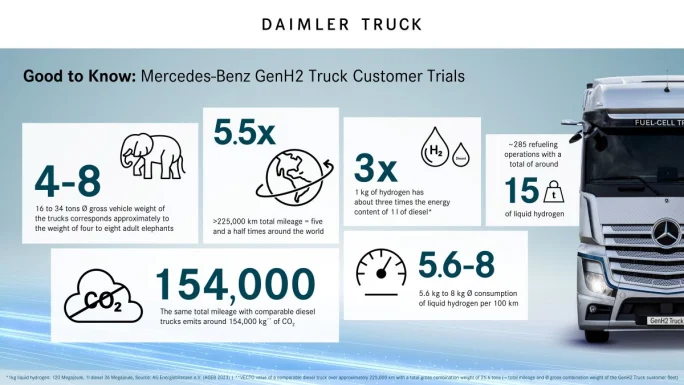
In total, the five prototypes have now covered more than 225,000 kilometers in customer operations.
This distance corresponds to about five trips around the Earth along the equator.
For the same total distance, a comparable diesel truck with a gross combination weight of 25.6 tons would have had to refuel with around 58,000 liters of diesel fuel, emitting around 154 tons of CO2*.
The Mercedes-Benz GenH2 prototype trucks feature hydrogen fuel cell technology developed and manufactured by cellcentric, a joint venture of Daimler Truck and Volvo Group.
Over the total mileage, the average hydrogen consumption lay between 5.6 kg/100 km and 8 kg/100 km, depending on the application.
Average gross combination weight for the trucks was between 16 tons and 34 tons.
“The initial customer trials are extremely valuable for the further development of our fuel cell trucks,” said Michael Scheib, head of entire vehicle development, Mercedes-Benz Trucks. “By deploying the GenH2 Trucks in real-world logistics operations, we have been able to demonstrate their performance, reliability and efficiency across various transport applications and gain important insights. This enables us to refine the technology and vehicles according to the specific needs of our customers all the way to series production. Furthermore, the intensive use of the liquid hydrogen fueling stations during the trials enables further optimization of the refueling process. All these practical experiences also help us to optimally prepare our sales and service for the deployment of hydrogen trucks for our customers.”
Customer Deployment Confirms Practicality
The five GenH2 Trucks were deployed by customers on specific routes within Germany during the trial period and took on various transport tasks.
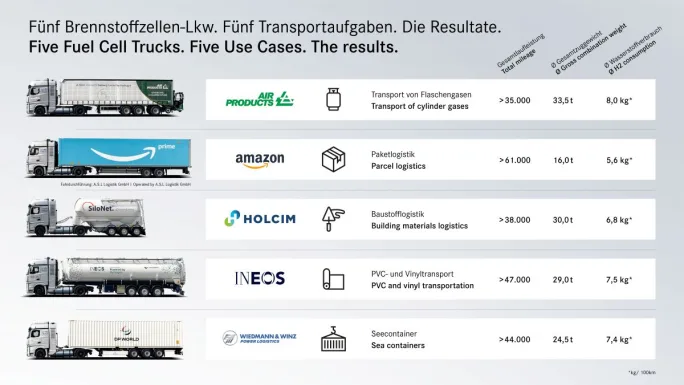
Amazon’s transportation partner used the Mercedes-Benz GenH2 Truck within its logistics network on a dedicated route between the Fulfillment Center in Frankenthal (Rhineland-Palatinate) and the Delivery Station in Sindelfingen (Baden-Wuerttemberg).
Air Products used the Mercedes-Benz GenH2 Truck for the transportation of bottled gases from its bottle filling plant in Hattingen on the Ruhr River and supplied gas centers and customers from there.
Wiedmann & Winz deployed the hydrogen truck in a so-called 'combined transport' application. Its Mercedes-Benz GenH2 Truck transported sea containers to industrial and commercial customers for the international logistics service provider DP World.
Holcim deployed the fuel cell truck for its construction material logistics to transport cement deliveries from its plants in the Ruhr area to its customers in Western Germany and the Netherlands.
Vervaeke -- the logistics partner of INEOS Inovyn -- used the GenH2 Truck for PVC and vinyl transport. During the initial customer trial phase, the prototypes remained under the direct supervision and responsibility of the manufacturer.
Direct customer feedback regarding the trials confirmed that the vehicles integrated reliably and smoothly into daily logistics operations, Daimler reported.
In particular, customers emphasized practicality similar to that of today’s diesel trucks. These attributes included a long range of 1,000 kilometers or more, as well as short refueling times of 10 to 15 minutes.
The first round of GenH2 trials showcased the potential of hydrogen fuel cell technology in fleet operations.
Photo: Daimler Truck
Daimler said the trials show that GenH2 trucks are suitable for long-distance haulage, flexible routes and unplanned deployments.
Drivers also praised the dynamic power delivery, smooth and comfortable ride, and low noise levels.
According to Daimler, these are advantages the Mercedes-Benz GenH2 can leverage as an electrically powered vehicle. The trucks use hydrogen as an energy source. They have a fuel cell output of 300 kW and a 70-kWh battery for situational power peaks.
Overall, Daimler said, customer feedback underlines the reliable operation and practical usage of hydrogen-powered fuel cell trucks.
Refueling with Liquid Hydrogen
The vehicles were refueled by the drivers at liquid hydrogen (sLH2) filling stations in Woerth am Rhein (Rhineland-Palatinate) and the Duisburg area (North Rhine-Westphalia).
In total, 285 refuelings were carried out as part of the customer trials with a total of approximately 15 tons of liquid hydrogen.
When developing hydrogen-based drive technologies, Daimler Truck prefers liquid hydrogen.
The OEM said that in this aggregate state, the energy carrier has a significantly higher energy density. As a result, more hydrogen can be added to the two tanks, each with a capacity of 40 kg. This significantly increases the range and enables comparable performance of the vehicle with that of a conventional diesel truck.
Liquid hydrogen is also much easier to transport, and liquid hydrogen tanks offer advantages in terms of cost and weight compared to compressed gaseous hydrogen tanks. Additionally, the use of liquid hydrogen enables a higher payload -- an important criterion in flexible and demanding long-distance haulage.
Second Trial Phase to Begin Soon
Daimler Truck said it will follow up with a second round of trials with the same Mercedes-Benz GenH2 Trucks and five further customers starting in the fourth quarter of 2025.
The trials simulated real-world diesel fleet applications as closely as possible.
Photo: Daimler Truck
The aim of these trials is to gather further experience with another set of use cases in real-world operations and optimally prepare the fuel cell trucks for series production on the basis of customer requirements.
Daimler Truck has already started the development phase for the next generation of fuel cell trucks in parallel.
A total of 100 next-generation fuel cell trucks are planned to be assembled at the Mercedes-Benz plant in Woerth as part of small series production and deployed at various customers from the end of 2026 onwards.
Daimler Truck pursues a dual-track strategy with battery-electric and hydrogen-powered vehicles.
However, progress in building out hydrogen refueling stations has been much slower than expected.
As a result, the OEM said, customers will not be able to operate hydrogen trucks in large numbers in the next couple of years.
As a result, Daimler predicts the large-scale industrialization of fuel cells and the planned series production of hydrogen-powered trucks with a focus on Europe will occur in the early 2030s.
More Fuel Smarts

Trucking’s Diesel Squeeze Isn’t Letting Up
With diesel topping $6 a gallon nationally, ATA's Bob Costello explains why fleets should prepare for continued pressure at the pump.
Read More →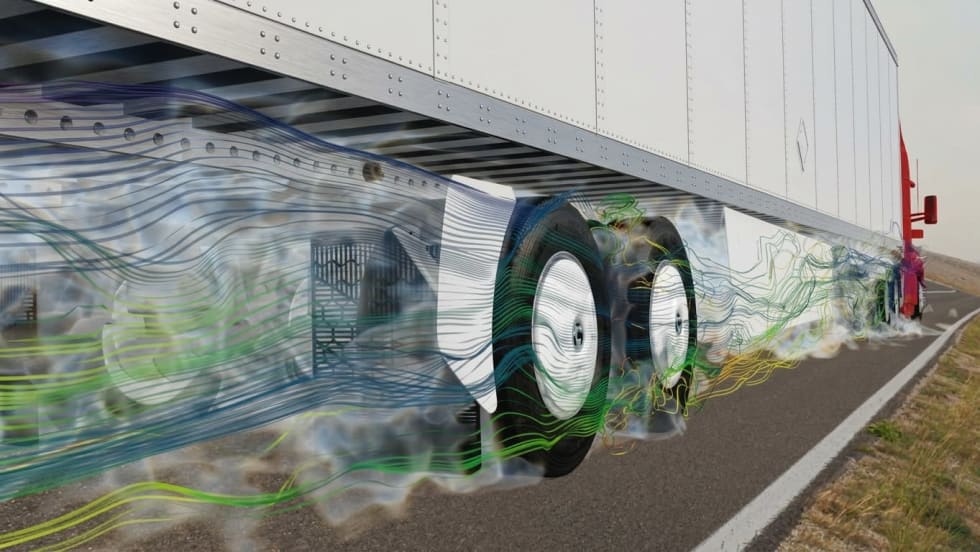
FlowBelow Redesigns Trailer AeroSlider to Cut Fuel Use
The lighter trailer aerodynamic system installs in less than 45 minutes, according to the company, with potential payback in under a year depending on fuel prices and trailer mileage.
Read More →
Why Diesel Price Relief Efforts May Fall Short
Diesel prices have eased from September’s record high, but doubts about additional Russian supply and limits on dyed-diesel tax relief mean trucking fleets still face expensive fuel. And prices could go higher.
Read More →
Why Small Fuel Savings Matter in Trucking
Can better fuel economy help pay for driver raises? In this podcast, GP Transco explains how small efficiency gains create room to reinvest in its people.
Read More →
How GP Transco Cuts Trucking Fuel Costs, a Tenth of a Gallon at a Time
What’s another tenth of a mile per gallon worth? GP Transco shares how equipment upgrades and driver coaching turn small gains into meaningful fuel savings.
Read More →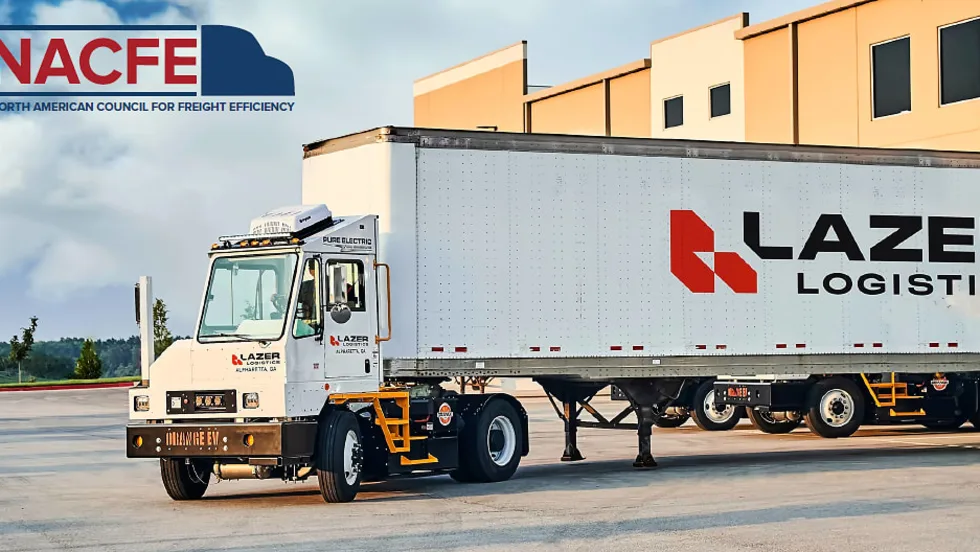
Electric Yard Tractors Move Beyond Pilots
Operating-cost savings have overtaken sustainability goals as the leading reason surveyed fleets are adopting battery-electric terminal tractors, according to new NACFE research.
Read More →
Geotab Links Fleet Card to Vehicle Data
The new card combines fuel discounts with telematics-based purchase controls. Geotab’s analysis also points to potential savings from choosing lower-priced fuel stops.
Read More →
Fleet Economics Shape Electric Truck Outlook
ACT Research expects costs, charging infrastructure, and technology improvements to drive zero-emission commercial vehicle adoption as federal regulations and incentives retreat.
Read More →
Wex Adds Cardless Fuel Payments for Over-the-Road Customers
A new fuel card feature for Wex customers offers convenience and security.
Read More →
New California Law Could Shed Light on Electric Truck Prices
Why do battery-electric Class 8 trucks remain so expensive? A California bill signed by Gov. Gavin Newsom would give fleets and state agencies more visibility into what manufacturers charge.
Read More →