





Similar News: Daimler Tests Fuel Cell Trucks in Swiss Alps
Volvo Conducts VNL Arctic Trials
Cold weather testing in Alaska ensures reliability for drivers everywhere.
July 18, 2025
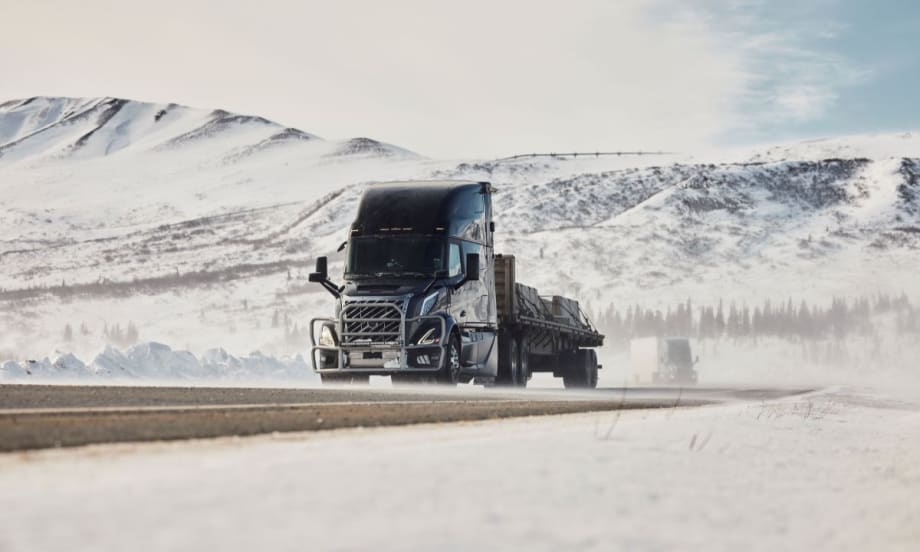
Volvo’s all-new VNL undergoes cold-weather testing in Alaska, where subzero conditions help engineers evaluate real-world performance, durability, and system responsiveness in harsh winter environments.
Photo: Volvo Trucks North America
2 min to read
Volvo Trucks North America recently conducted cold weather testing of its all-new Volvo VNL in Fairbanks, Alaska, where winter temperatures can reach minus 40 degrees Fahrenheit (-40°C). The testing aimed to assess performance, reliability and driver comfort under extreme operating conditions.
“Alaska is one of the harshest places on Earth to operate a truck, and that is exactly why we are here,” said Peter Voorhoeve, president, Volvo Trucks North America. “We test in extreme environments so when our customers face unpredictable conditions, they can count on their Volvo to perform.”
Purpose-Built Testing Program
Each winter, Volvo’s cold weather testing team travels over 3,000 miles from Colorado to Alaska to conduct field testing outside of laboratory environments. The team runs the new VNL through a variety of real-world driving scenarios — from highway travel to urban stop-and-go traffic — to evaluate how the truck performs across a range of operations and environmental conditions.
Driver Feedback and Data Collection
Professional drivers with experience in Alaska’s terrain provide daily operational feedback. This input, combined with vehicle data collected during testing, informs engineering adjustments to components including the powertrain and in-cab systems.
Cold Soak Testing for Startup Reliability
A key part of the evaluation process includes "cold soak" testing, where the vehicle is parked overnight with the engine off until all components reach subzero temperatures. After a 12-hour cold soak, engineers verify whether the vehicle starts and functions as expected in freezing conditions.
“The all-new VNL was designed to change everything and that includes how we approach testing and refinement in real-world conditions — to challenge our trucks and gain insights that would be impossible to replicate in a lab,” said Voorhoeve. “What we learn in Alaska helps us deliver a truck that is not only innovative but proven where it matters most: on the road, in the real world, and in the hands of our customers.”
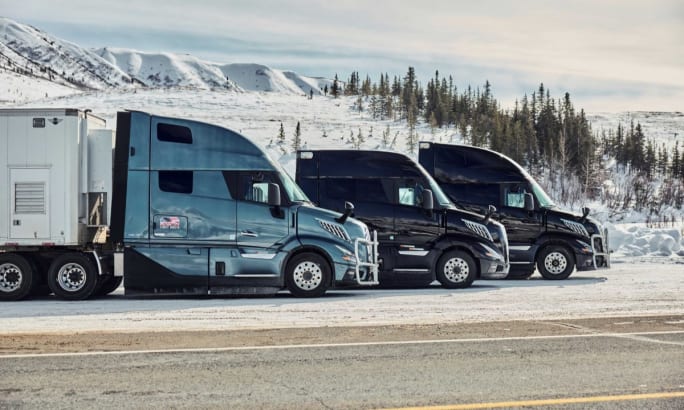
A lineup of all-new Volvo VNL trucks undergoes evaluation in Fairbanks, Alaska, where engineers assess cold-start capability, powertrain performance, and component durability in severe winter conditions.
Photo: Volvo Trucks North America
Continuous Testing to Inform Product Development
The VNL was developed with North American operating environments in mind. Its design incorporates features influenced by five major U.S. landscapes — urban areas, deserts, prairies, coastal forests and Arctic tundra — to support long-distance hauling across varied terrain and climates.
More Equipment

How Volvo Updated Its D13 for EPA 2027 [Watch]
Volvo’s updated D13 promises lower emissions without sacrificing performance or fuel economy. Take a closer look at what changed inside the engine in this HDT Spotlight video.
Read More →
Michelin Tire Improves Efficiency and Durability for Regional Fleets
The Michelin X Multi Energy D2 is a regional haul drive tire engineered to help fleets improve fuel efficiency, durability and traction in demanding stop-and-go operations.
Read More →
ZF Expands Commercial Vehicle Push in North America
ZF is expanding its North American commercial-vehicle presence with new transmission applications, electrification, trailer technology and autonomous-driving systems.
Read More →
Tesla Wants a Self-Driving Semi. Are Cameras Enough?
Could Tesla’s camera-only autonomous driving technology work on an 80,000-pound Semi? In this commentary, HDT's Deborah Lockridge takes a look at Tesla, Cybercab, and how autonomous trucks see the road.
Read More →
Kodiak: Driverless Long-Haul Truck Launch on Track for 2026
Kodiak AI says its driverless long-haul safety case is 93% complete and it remains on track to begin commercial operations by year-end 2026.
Read More →
What DOT’s Automated Vehicle Strategy Means for Trucking
The U.S. Department of Transportation issued a new automated-vehicle strategy that outlines plans for driverless-truck regulations, cross-state freight corridors, and federal safety standards.
Read More →
East Coast Port Launches $45M Electric Truck Push
The Port Authority of New York and New Jersey announced millions in incentives for zero-emission drayage trucks, yard tractors, and new charging hubs near the port.
Read More →
PlusAI Going Public to Fund Autonomous Truck Launch
A SPAC deal could provide PlusAI with up to $300 million as it works toward a 2027 commercial launch of factory-built autonomous trucks.
Read More →
NHTSA Moves to Rewrite Truck Fuel-Economy Rules
The National Highway Traffic Safety Administration says it lacks authority to regulate medium- and heavy-duty truck engines separately from complete vehicles, but the existing standards have not yet been eliminated.
Read More →
Detroit Opens Orders for EPA 2027 Engines
Detroit isn’t starting from scratch to meet EPA 2027 diesel emissions standards. Its Gen 6 DD13 and DD15 engines keep much of today’s platform while updating the fuel and aftertreatment systems.
Read More →