




Orange EV Introduces OptiGrid Fleet Charging Solution
Orange EV’s new OptiGrid’s platform eliminates grid delays and lowers total cost of ownership for commercial fleets.


Orange EV has created and invested in OptiGrid, a new U.S.-based company delivering battery-integrated fast charging solutions for fleets.
Photo: Orange EV
In a logistics world racing to electrify, charging infrastructure remains a massive bottleneck - too slow, too expensive and too dependent on utility timelines.
To tackle this challenge, Orange EV, a manufacturer of purpose-built electric Class 8 trucks, has created and invested in OptiGrid.
OptiGrid is a new U.S.-based company delivering battery-integrated fast charging solutions for fleets.
Ultrafast EV Charging
Headquartered in Kansas City, Kansas, OptiGrid eliminates the need for costly and time-consuming grid upgrades with a drop-in platform that pairs ultrafast EV charging with onboard battery storage.
Designed specifically for fleet operators, OptiGrid’s solution reduces wait times for deployment, offering high uptime, low maintenance and the lowest total cost of ownership of any DC fast charger.
OptiGrid builds on the foundational technology developed by FreeWire Technologies, an early pioneer in battery-buffered fast charging.
FreeWire’s breakthrough was to integrate battery storage, AC-to-DC conversion, power management and fast charger in one self-contained unit.
This makes it possible to deploy ultrafast chargers in power-constrained locations without complex site work or utility delays, the company said.
Despite strong interest, FreeWire struggled to manufacture its product affordably and consistently, leading to downtime and rising support costs that ultimately outpaced the company’s ability to sustain operations.
Trucking industry veteran Wayne Hoovestol recognized the core value of FreeWire’s technology and acquired its assets, including the intellectual property and engineering team, to focus on solving the issues of manufacturing reliability and serviceability while preserving the benefits of rapid, grid-independent deployment.
Orange EV’s Strategic Backing
To operationalize his vision and accelerate commercialization, Hoovestol partnered with Kurt Neutgens and Wayne Mathisen, the founders of Orange EV, to create OptiGrid.
Orange EV provides the U.S. manufacturing foundation and market access needed to bring OptiGrid’s reengineered charging platform to fleets at scale.
“We’ve seen firsthand how infrastructure delays can slow down fleet electrification efforts,” said Kurt Neutgens, founder and president at Orange EV. “OptiGrid gives us a turnkey, fleet-ready system with low cost of ownership and the flexibility of optional leasing to reduce capital barriers.”
Today, OptiGrid has a growing team of 50 employees across California, Colorado and Kansas, and is preparing for commercial launch later this year.
Orange EV is OptiGrid’s first strategic partner and launch customer, enabling the delivery of seamless electrification for industrial fleets with end-to-end solutions, from vehicle to charger, delivered and supported by a U.S. team.
Proven Leadership and U.S. Operations
Tyler Phillipi, a veteran of the EV charging and mobility tech space, was named OptiGrid CEO in April 2025.
Phillipi previously led product and growth at FlexCharging, founded Halo Automotive, a Techstars-backed connected vehicle startup, and served as CEO of two other startups.
With a background spanning hardware, software and energy services, and three successful exits, he brings deep technical and entrepreneurial experience to OptiGrid’s mission.
“Fleet electrification has outpaced infrastructure, creating a gap that legacy utilities and traditional charging solutions can’t fill fast enough,” Phillipi said. “The next era deserves more than promises; it demands performance. OptiGrid delivers a leap forward: rapid installs, high uptime, and true grid independence made here in the U.S.”
Built for the Realities of Fleet Electrification
OptiGrid chargers deliver ultra-fast EV charging anywhere without the need for costly utility or site upgrades, the company said.
Each unit includes a 180-kWh battery that charges slowly from the grid or renewables, enabling rapid deployment. Fleet operators benefit from significantly reduced energy costs by avoiding peak demand charges and other energy services, all while maintaining full flexibility to charge when and where needed.
Benefits include:
Fast deployment: Deployment in days/weeks instead of months/years by avoiding grid upgrades and extensive site construction projects.
Minimal CapEx: Simple and fast installation minimizes upfront costs, and flexible financing structures can convert CapEx to OpEx.
Low OpEx: Highly reliable system with minimal downtime controls energy costs by leveraging an integrated battery to avoid demand charges and peak energy rates.
Flexibility: Deploy charging infrastructure incrementally as the fleet size increases and with the flexibility to relocate charging infrastructure easily if necessary.
Real-World Proven: Both OptiGrid and Orange EV have hundreds of chargers already deployed. This new release is currently undergoing field validation through Orange EV’s fleet network.
Vehicle Compatibility: Launching with support for CCS and NACS and backed by a team with combined decades of experience with EV charging to ensure interoperability.
Smart Management: OptiGrid’s Asset Management Platform (AMP) provides charger station management and monitoring, including data insights available in the platform or via open APIs (OCPP) integrations.
More Fuel Smarts

Why Small Fuel Savings Matter in Trucking
Can better fuel economy help pay for driver raises? In this podcast, GP Transco explains how small efficiency gains create room to reinvest in its people.
Read More →
How GP Transco Cuts Trucking Fuel Costs, a Tenth of a Gallon at a Time
What’s another tenth of a mile per gallon worth? GP Transco shares how equipment upgrades and driver coaching turn small gains into meaningful fuel savings.
Read More →
Electric Yard Tractors Move Beyond Pilots
Operating-cost savings have overtaken sustainability goals as the leading reason surveyed fleets are adopting battery-electric terminal tractors, according to new NACFE research.
Read More →
Geotab Links Fleet Card to Vehicle Data
The new card combines fuel discounts with telematics-based purchase controls. Geotab’s analysis also points to potential savings from choosing lower-priced fuel stops.
Read More →
Fleet Economics Shape Electric Truck Outlook
ACT Research expects costs, charging infrastructure, and technology improvements to drive zero-emission commercial vehicle adoption as federal regulations and incentives retreat.
Read More →
Wex Adds Cardless Fuel Payments for Over-the-Road Customers
A new fuel card feature for Wex customers offers convenience and security.
Read More →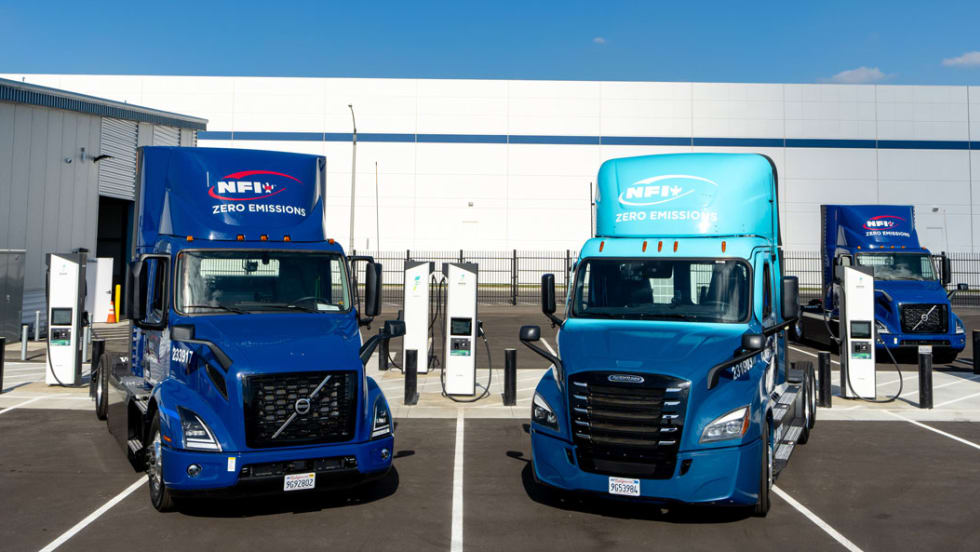
New California Law Could Shed Light on Electric Truck Prices
Why do battery-electric Class 8 trucks remain so expensive? A California bill signed by Gov. Gavin Newsom would give fleets and state agencies more visibility into what manufacturers charge.
Read More →
How Volvo Updated Its D13 for EPA 2027 [Watch]
Volvo’s updated D13 promises lower emissions without sacrificing performance or fuel economy. Take a closer look at what changed inside the engine in this HDT Spotlight video.
Read More →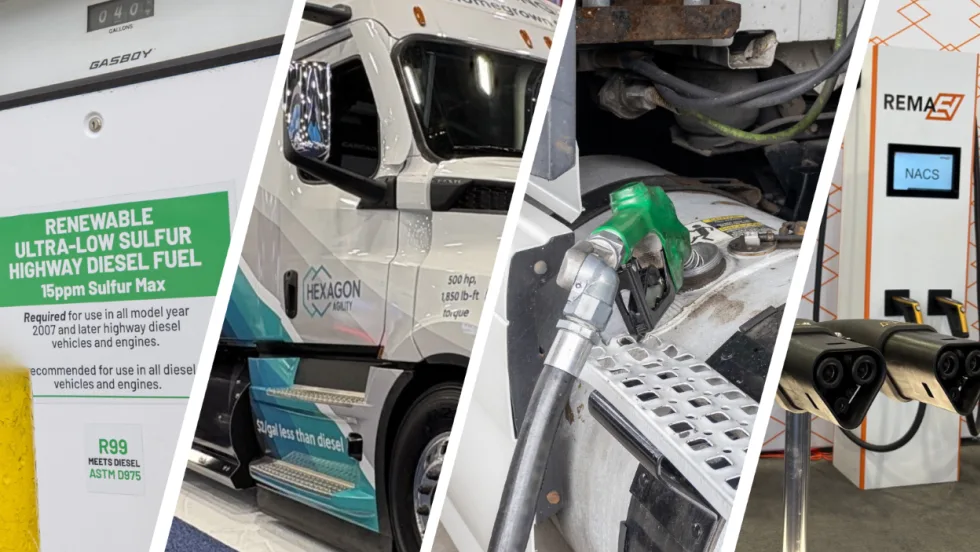
Diesel Price Spike Shortens Payback for Natural Gas Trucks, Report Says
Energy Vision estimates fleets could recover the higher purchase price of an RNG-fueled Class 8 tractor in 1.3 to 2.8 years under current fuel-price scenarios.
Read More →
Calstart Becomes Catalyst Mobility, Reflecting Broader Focus
Calstart is now Catalyst Mobility, reflecting the nonprofit’s growing national role in clean transportation, including zero-emission trucks, infrastructure and incentive programs.
Read More →