




SwRI Unveils Second-Phase Hydrogen Truck Engine
The Southwest Research Institute has released its second phase H2-ICE2 protype hydrogen-fueled truck engine.

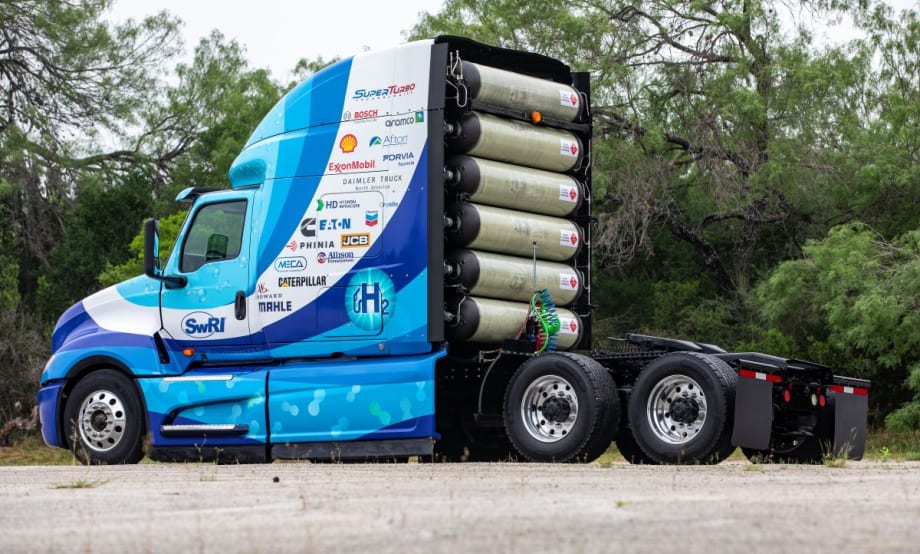
SwRI’s H2-ICE truck has toured the country, demonstrating an alternative heavy-duty fuel option that produces zero greenhouse gas emissions without sacrificing performance.
Photo: SwRI
The Southwest Research Institute (SwRI) has launched the newest iteration of its industry-supported Hydrogen Internal Combustion Engine consortium, H2-ICE2.
In 2024, SwRI’s H2-ICE consortium completed construction of a Class 8, heavy-duty hydrogen-powered vehicle, following 18 months of targeted development.
Hydrogen Power for Heavy Trucks
The demonstration vehicle achieves ultra-low nitrogen oxide and carbon dioxide emissions without sacrificing commercial viability.
The consortium’s next iteration — “H2-ICE2” — will build on its prior success by enhancing and refining the vehicle’s overall performance and efficiency.
H2-ICE2 gathers transportation industry leaders to advance sustainable mobility through innovative hydrogen engine technology. The consortium will continue to prove the potential for H2-ICE vehicles to complement other zero-emission vehicle technologies while supporting engine and truck manufacturers, Tier 1 suppliers, and providers of fuels and lubricants with a realistic roadmap to decarbonization.
“We have been developing internal combustion engines for more than 100 years,” noted Daniel Stewart, vice president of SwRI’s Powertrain Engineering Division. “H2-ICE is a particularly attractive solution because industry can leverage the production lines and component suppliers that are already in place worldwide to manufacture trucks,” “H2-ICE is a viable, zero-emission solution that is available today.”
Diesel-Like Performance
In 2024, SwRI’s H2-ICE truck toured the country, sharing with the long-haul trucking industry an alternative heavy-duty vehicle option that produces zero greenhouse gas emissions without sacrificing performance.
After it launches, H2-ICE2 will spend the next two years refining the demonstration vehicle’s overall performance and efficiency with enhanced testing and systems refinement.
“The first H2-ICE consortium focused on developing the hydrogen-fueled engine and showing what you can do with it in terms of performance and emissions,” said Ryan Williams, a manager in SwRI’s Powertrain Engineering Division. “With H2-ICE2, the team wants to show people that the truck is more than just a showpiece. It’s a functional and practical piece of equipment ready to meet their needs.”
Between now and December 2026, the H2-ICE2 consortium will investigate the vehicle’s capacity to maintain performance, manage heat and sustain efficiency under various real-world conditions.
Real-World Evaluation Trials
The consortium will also evaluate vehicle performance during cold starts, continuous ascent, low-demand or no-load operations, and other conditions commercial trucking vehicles experience.
SwRI plans to test and improve the vehicle’s performance without developing a new engine or significantly changing the hardware.
“This is very much a holistic, vehicle-based consortium, not just an engine research consortium,” said Edward M. Smith III, a principal engineer with SwRI’s Powertrain Systems Engineering Department and H2-ICE2 program manager. “We plan to exercise the existing vehicle to identify challenges and opportunities unique to operating an H2-ICE powered vehicle and engineer their solutions.”
On March 27, SwRI will hold a free launch meeting for current and prospective members to learn more about H2-ICE2’s goals and overarching vision.
Visit the H2-ICE2 consortium webpage to register to attend at SwRI in San Antonio.
“It’s the perfect time for members to join,” Smith added. “We already have seen several aspects of the vehicle that we can adjust or improve. For instance, we are considering strategies for improved torque response and how to institute a rapid warm-up mode to reduce emissions even further. The combined knowledge of our consortium’s membership can help us advance development and overcome technical hurdles, paving the road to net-zero carbon emissions by 2050.”
More Fuel Smarts

New California Law Could Shed Light on Electric Truck Prices
Why do battery-electric Class 8 trucks remain so expensive? A California bill signed by Gov. Gavin Newsom would give fleets and state agencies more visibility into what manufacturers charge.
Read More →
How Volvo Updated Its D13 for EPA 2027 [Watch]
Volvo’s updated D13 promises lower emissions without sacrificing performance or fuel economy. Take a closer look at what changed inside the engine in this HDT Spotlight video.
Read More →
Diesel Price Spike Shortens Payback for Natural Gas Trucks, Report Says
Energy Vision estimates fleets could recover the higher purchase price of an RNG-fueled Class 8 tractor in 1.3 to 2.8 years under current fuel-price scenarios.
Read More →

Calstart Becomes Catalyst Mobility, Reflecting Broader Focus
Calstart is now Catalyst Mobility, reflecting the nonprofit’s growing national role in clean transportation, including zero-emission trucks, infrastructure and incentive programs.
Read More →
Record Diesel Prices Squeeze Trucking Fleets
Average U.S. diesel prices have climbed to nearly $6 a gallon, surpassing the 2022 record as tight refinery capacity and Middle East disruptions keep fuel costs elevated.
Read More →
How Fuel Delivery Shapes Engine Performance
Fuel delivery depends on more than what happens at the injector. For fleet, maintenance and technical professionals, looking at the full path from pump to injector can provide useful context for understanding engine performance.
Read More →
East Coast Port Launches $45M Electric Truck Push
The Port Authority of New York and New Jersey announced millions in incentives for zero-emission drayage trucks, yard tractors, and new charging hubs near the port.
Read More →
Detroit Opens Orders for EPA 2027 Engines
Detroit isn’t starting from scratch to meet EPA 2027 diesel emissions standards. Its Gen 6 DD13 and DD15 engines keep much of today’s platform while updating the fuel and aftertreatment systems.
Read More →
Zero-Emission Truck Corridor Planned for West Coast
California, Oregon, Washington, British Columbia and Baja California are coordinating plans for truck charging and hydrogen fueling from Canada to Mexico.
Read More →
A Closer Look at Kenworth’s Electric T880E Vocational Truck [Video]
Learn more about Kenworth's T880E battery-electric vocational truck at the Paccar Technical Center, including its range, applications, upfitting considerations, and PTO options, in this HDT Spotlight video.
Read More →