




J. J. Keller Launches Virtual Reality Safety & Compliance Training
Customers can enroll learners in new virtual reality training courses and track their performance in the J. J. Keller Training solution alongside online E-Learning, streaming video, and classroom program formats.

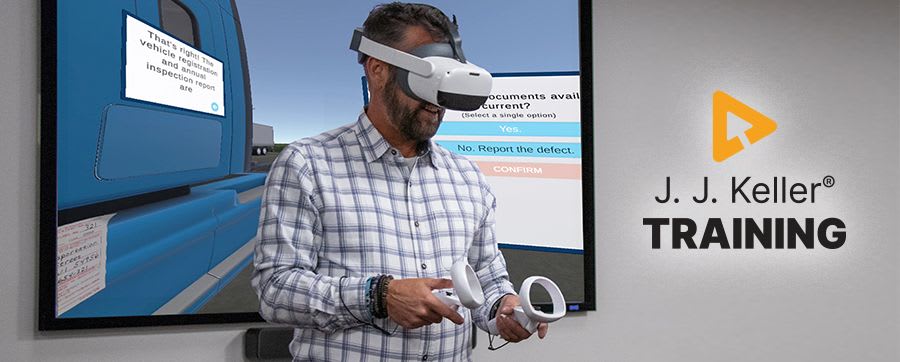
J.J. Keller said VR programs offer a more engaging, immersive training experience that increases the likelihood of employees applying their knowledge and skills in the real world.
Photo: J.J. Keller
J. J. Keller & Associates has announced the release of its virtual reality training platform. The new program is available as part of the J. J. Keller Training online solution.
Accessible with a compatible virtual reality (VR) headset, this new training format allows learners to navigate realistic simulations of safety and compliance situations they may encounter in their jobs.
New Training Benefits
A study conducted last year by the J. J. Keller Center for Market Insights found that 67% of managers surveyed would consider using VR training, representing significant interest and opportunity for this format.
J. J. Keller’s VR training offers various benefits that set it apart from other VR training, the company said.
The program fits into J. J. Keller’s existing training ecosystem. Customers can enroll learners in VR courses and track their performance in the J. J. Keller Training solution alongside online E-Learning, streaming video, and classroom program formats.
Many companies that offer VR training don’t integrate it into their learning management system, the company said. This makes it impossible for customers who use multiple training formats to keep all their recordkeeping centralized on one platform.
Customers can also use J. J. Keller’s standard training enrollments on VR training.
This is the same type of enrollment used on J. J. Keller's other training formats. There is no need to purchase any kind of special enrollment at an increased price to enroll learners in VR courses.
Other key advantages to VR training, according to J.J. Keller, include:
Improved Engagement & Retention: VR programs offer a more engaging, immersive training experience that increases the likelihood of employees applying their knowledge and skills in the “real world.”
“Freedom to Fail”: By navigating dangerous situations in a virtual environment, learners can make mistakes safely while still feeling as though the consequences are real.
Convenience: On-the-go or remote employees may rarely be onsite. VR training ensures employees receive the instruction they need, regardless of their location.
Cost-Effectiveness: No need to fly professional trainers in for training sessions. Virtual programs provide exceptional training while keeping costs down.
New Choices for Effective Training
"Giving customers a choice in format is important to us,” said J. J. Keller President and CEO Rustin Keller. “Innovating in a way that captures the learner's imagination and improves engagement is something we seek constantly. I'm really excited about this new option for trainers. One demonstration and it's clear this changes the way people learn. It's fantastic.”
At launch, J. J. Keller offers 16 VR training programs. These include:
Workplace Safety & Health
Arc Flash (Flashover)
Confined Space Entry
Electrical Safety
Fire Safety (The Office)
Hazard Recognition - Warehouse
Hot Work
Ladder Safety
Lockout/Tagout
Trenching and Excavation Safety
Transportation
Brake System: Pre-Trip Vehicle Inspection
Engine and Front Axle: Pre-Trip Vehicle Inspection
In-Vehicle: Pre-Trip Vehicle Inspection
Lights: Pre-Trip Vehicle Inspection
Walk-Around: Pre-Trip Vehicle Inspection
Road Safety Traffic Accident With Dangerous Goods
Human Resources
Active Shooter Response Training for Civilians (Office)
J. J. Keller will introduce new VR courses to its library regularly for these and other markets, the company said.
“By adding virtual reality training to our offerings, we're providing our customers with an easy way to practice scenarios in a realistic, hands-on environment,” said J. J. Keller Executive Vice President of Technology Solutions Lacie Callan. “Whether in a confined space, working with machinery, or inspecting vehicles, virtual reality allows for self-paced learning in all types of situations that prepare employees to safety do their jobs.”
Learners must use the J. J. Keller Virtual Reality Training Headset (PICO Neo3) to access these VR courses.
The headset is available for purchase from J. J. Keller and provides everything needed to get started.
To learn more about J. J. Keller’s virtual reality training and take a free trial, click here.
More Safety & Compliance

FMCSA Pauses Biennial-Update Enforcement Amid Motus Transition
Carriers whose updates were due on or after June 1 have more time, while FMCSA works to stabilize its new registration system and warns of phishing sites impersonating its new carrier registration system, Motus.
Read More →
ZF Expands Commercial Vehicle Push in North America
ZF is expanding its North American commercial-vehicle presence with new transmission applications, electrification, trailer technology and autonomous-driving systems.
Read More →
Truck Drivers Need More Than Another Alert
Fleets have more visibility into truck health, safety events, and driver activity than ever. The next challenge is turning all that information into useful guidance for the person who has to decide what to do next.
Read More →
Tesla Wants a Self-Driving Semi. Are Cameras Enough?
Could Tesla’s camera-only autonomous driving technology work on an 80,000-pound Semi? In this commentary, HDT's Deborah Lockridge takes a look at Tesla, Cybercab, and how autonomous trucks see the road.
Read More →
What DOT’s Automated Vehicle Strategy Means for Trucking
The U.S. Department of Transportation issued a new automated-vehicle strategy that outlines plans for driverless-truck regulations, cross-state freight corridors, and federal safety standards.
Read More →
NYC Expands Speed, Pedestrian Safety Tech Across Fleet
New York City is expanding intelligent speed assistance and pedestrian-alert systems across its municipal fleet, moving the technologies from pilot programs into vehicle procurement and retrofit requirements.
Read More →
FMCSA Removes 110 Truck Driver Training Schools from Certified ELDT List
Federal regulators also are targeting more than 160 additional training providers and launching a nationwide audit of third-party CDL skills testers as part of a broader crackdown on trucking fraud.
Read More →
Beyond DOT Compliance: What Makes a Trucking Fleet Truly Safe?
A trucking fleet can follow every rule and still make unsafe decisions. The real test comes when safety conflicts with freight, productivity, or cost.
Read More →
Hours of Service Pilot Programs: FMCSA Readies for 2027 Rollout
Two pilot programs could eventually reshape hours-of-service rules, giving truck drivers options to pause their 14-hour clock or use longer split sleeper rest periods.
Read More →
New Guide Offers Pet Safety Tips for Truck Drivers
Hundreds of thousands of pets travel in truck cabs. A new safety guide from Volvo Trucks and the Center for Pet Safety offers practical advice for truck drivers who bring dogs and cats along for the ride.
Read More →