




Transtex Acquisition of DClimate Offers New Idle Reduction Technology
DClimate says it has a new solution to the challenge of keeping truck drivers comfortable in their sleepers when they stop for the night without idling the main truck engine.

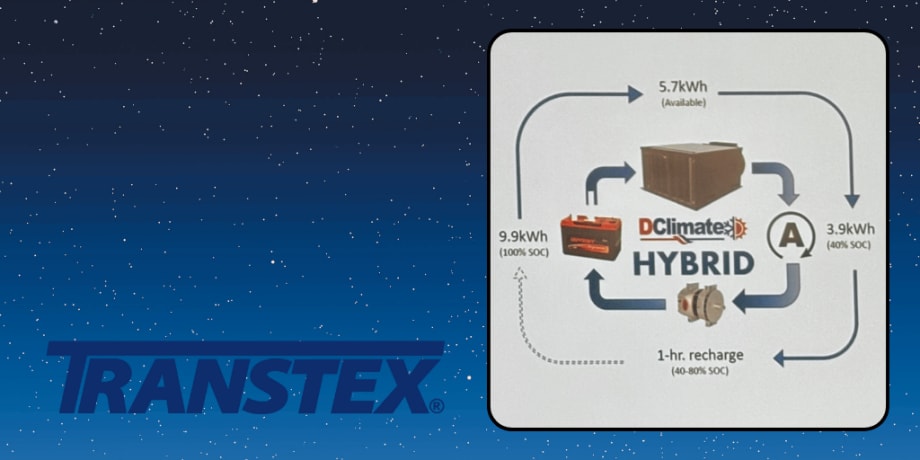
Transtex's acquisition of DClimate brings a new APU offering to the market.
Image: HDT Graphic
DClimate says it has a new solution to the challenge of keeping truck drivers comfortable in their sleepers when they stop for the night without idling the main truck engine.
“Our team set out to change the way the industry looks at APUs,” explained Martin Duffy, CEO of the DClimate division of Transtex, during a news conference at the American Trucking Associations' management conference in Nashville.
DClimate was founded in 2016 and acquired by Transtex earlier this year, with the goal of developing an auxiliary power system to cut idling while keeping drivers comfortable and not stressing the truck’s batteries.
Transtex has made a name for itself providing fuel-saving aerodynamic solutions. The acquisition of DClimate offers its customers another way to save fuel and cut operating costs.
The DClimate system is quiet and vibration free, designed to deliver tight temperature control regardless of outside conditions, Duffy said, while also providing power for needs such as powering CPAP machines or watching television.
There are currently over 6,000 units currently in operation, according to the company, which said the system meets all EPA and California Air Resources Board requirements.
Rethinking the Auxiliary Power Unit
“Traditional diesel APUs have been the industry workhorse for years,” Duffy said, but they have problems: They still use some fuel; they are not known for reliability; and in some areas they are against emissions regulations.
Meanwhile, traditional electric APUs, he said, face their own challenges, including limited run times and compromised cooling capacity.
“Electric units often struggle with inefficient battery management that limits run time, capacity, and battery life.”
DClimate’s answer was a hybrid system, made up of:
Battery management system.
High efficiency alternator.
Under-bunk unit with both air conditioning and a small diesel-fired bunk heater.
Auto start/stop feature that ensures continuous APU availability and automatically activates under extreme conditions to protect battery health and truck starting capability.
“A big part of the value proposition is reliability,” Duffy said. “We really focus on extending battery life, minimizing total cost of ownership for that first fleet buyer.”
What's the Future for APUs?
“One of the things we looked at when developing our product, we asked, ‘What does the industry look like in the long term?’” Duffy said.
He noted that while APUs originally were all about saving fuel, that has evolved.
“We think the adoption rate on APUs in general will increase over the next two to five years, because of a number of factors,” he said. “Some of it is regulatory, but there are also other pressures. More and more shippers are wanting to know what fleets are doing to reduce their carbon footprint.”
In addition, he said, “If you look forward to next generation trucks, 2027, these trucks are less and less tolerant of idle. The more complex the emissions systems become, the more we believe that’s going to be the case.
“I think 2027 is going to be a big transition point where fleets are going to have to make those decisions.”
More Fuel Smarts

How Volvo Updated Its D13 for EPA 2027 [Watch]
Volvo’s updated D13 promises lower emissions without sacrificing performance or fuel economy. Take a closer look at what changed inside the engine in this HDT Spotlight video.
Read More →
Diesel Price Spike Shortens Payback for Natural Gas Trucks, Report Says
Energy Vision estimates fleets could recover the higher purchase price of an RNG-fueled Class 8 tractor in 1.3 to 2.8 years under current fuel-price scenarios.
Read More →
Calstart Becomes Catalyst Mobility, Reflecting Broader Focus
Calstart is now Catalyst Mobility, reflecting the nonprofit’s growing national role in clean transportation, including zero-emission trucks, infrastructure and incentive programs.
Read More →

Record Diesel Prices Squeeze Trucking Fleets
Average U.S. diesel prices have climbed to nearly $6 a gallon, surpassing the 2022 record as tight refinery capacity and Middle East disruptions keep fuel costs elevated.
Read More →
How Fuel Delivery Shapes Engine Performance
Fuel delivery depends on more than what happens at the injector. For fleet, maintenance and technical professionals, looking at the full path from pump to injector can provide useful context for understanding engine performance.
Read More →
East Coast Port Launches $45M Electric Truck Push
The Port Authority of New York and New Jersey announced millions in incentives for zero-emission drayage trucks, yard tractors, and new charging hubs near the port.
Read More →
California Bill Could Shed Light on Electric Truck Prices
Why do battery-electric Class 8 trucks remain so expensive? A California bill headed to Gov. Gavin Newsom would give fleets and state agencies more visibility into what manufacturers charge.
Read More →
Detroit Opens Orders for EPA 2027 Engines
Detroit isn’t starting from scratch to meet EPA 2027 diesel emissions standards. Its Gen 6 DD13 and DD15 engines keep much of today’s platform while updating the fuel and aftertreatment systems.
Read More →
Zero-Emission Truck Corridor Planned for West Coast
California, Oregon, Washington, British Columbia and Baja California are coordinating plans for truck charging and hydrogen fueling from Canada to Mexico.
Read More →
A Closer Look at Kenworth’s Electric T880E Vocational Truck [Video]
Learn more about Kenworth's T880E battery-electric vocational truck at the Paccar Technical Center, including its range, applications, upfitting considerations, and PTO options, in this HDT Spotlight video.
Read More →