




FMCSA Wants Authority to Enforce Freight Broker Violations Amid Rising Fraud
The Federal Motor Carrier Safety Administration has asked Congress to give the agency the statutory authority to assess civil penalties for unauthorized freight brokerage violations — both double-brokering and broker fraud problems as well as a significant increase in household goods consumer complaints.

FMCSA said assessing civil penalties for freight broker fraud is a convoluted process.
Image: HDT Graphic
The Federal Motor Carrier Safety Administration has asked Congress to give the agency the statutory authority to assess civil penalties for unauthorized brokerage violations — both the double-brokering and fraud problems as well as a significant increase it has seen in household goods consumer complaints.
The report to Congress was in response to the Joint Explanatory Statement accompanying the 2023 Consolidated Appropriations Act, which required FMCSA to report on efforts to enforce regulations regarding unlawful broker activities.
The agency noted that a 2019 DOT Administrative Law Judge decision, Darlene Riojas et al., put a hamper on its enforcement efforts.
That decision found that the FMCSA does not have the statutory authority to assess civil penalties for violations of U.S. code regarding regulation of motor carriers, brokers, and freight forwarders. Instead, the FMCSA now must go through the U.S. District Court to pursue civil penalties, including the broker and household goods consumer protection regulations.
“Unless a regulated entity that violates FMCSA’s commercial regulations voluntarily resolves its noncompliance, FMCSA must refer cases to DOJ for enforcement of those regulations," the agency said in its report.
“The need to refer cases to DOJ for the assessment of civil penalties for violations of commercial regulations creates a significant barrier to enforcement, including for unauthorized brokerage violations."
FMCSA saw household goods consumer complaints more than double between 2019 and 2021 (receding in 2022 and 2023 but still well above 2019 levels), coinciding with the start of the Covid-19 pandemic and the impact of the Riojas decision.
FMCSA’s inability to assess civil penalties administratively not only for unauthorized brokerage, but also for these HHG violations, has significantly undermined its ability to combat HHG moving and brokering fraud, according to the report.
How the Riojas Decision Changed the Way FMCSA Enforces Broker Regulations
Prior to the Riojas decision, FMCSA assessed civil penalties for unauthorized brokerage violations via Notices of Claim (NOCs). Between 2014 and 2019, FMCSA issued approximately 20 NOCs for unlawful brokerage violations.
Since the Riojas decision in 2019, however, FMCSA has two alternative enforcement mechanisms available for unauthorized brokerage enforcement: Notices of Violation and Letters of Probable Violation.
Notices of Violation: FMCSA may issue an NOV to a non-registered entity performing brokerage operations without broker operating authority registration. The NOV will state the violations and the corrective actions the broker must take to comply.
The broker has 30 days to acknowledge receipt of the NOV and submit proof of the corrections. No further action is needed if the broker takes sufficient corrective action within 30 days of the NOV issue date. FMCSA does not propose civil penalties as part of an NOV.
Letter of Probable Violation: An LOPV identifies areas of non-compliance and proposes a civil penalty. The agency said the LOPV can encourage brokers and carriers to enter into settlement arrangements and take corrective actions. Once the LOPV is issued, the broker has 30 days to respond.
If the broker fails to respond or its response is insufficient, FMCSA may refer the case to DOJ for judicial enforcement of FMCSA’s commercial regulations, including the assessment of civil penalties, in federal court.
Recent Efforts by FMCSA to Address Broker Non-Compliance
FMCSA did outline actions it has taken recently to address broker non-compliance.
The agency completed a rulemaking on broker financial responsibility in 2023, finalizing regulations regarding:
The composition of broker trust funds.
Immediate suspension of broker/freight forwarder operating authority registration.
Surety or trust responsibilities in cases of broker/freight forwarder financial failure or insolvency.
FMCSA enforcement authority.
Entities eligible to provide trust funds for broker financial responsibility.
A related issue has been addressing household goods scams. FMCSA’s 2023 Operation Protect Your Move was in response to a significant uptick in complaints against movers and brokers for extorting exorbitant additional charges from consumers.
In addition, in 2023, FMCSA conducted HHG broker investigations in Nevada, New Jersey, New York, and Florida, reviewing 35 HHG and property brokers in total. The agency found 166 violations, closed 544 complaints, and issued 17 Letters of Probable Violation. The agency also conducted four property broker investigations in New York. FMCSA expects to continue its expanded broker enforcement efforts in 2024.
Is Unlawful Brokerage a Safety Issue?
FMCSA said it’s still assessing the relationship between motor carrier safety and unlawful brokerage.
While the agency has received multiple expressions of concern from stakeholders regarding fraud related to “double brokering,” it said it doesn’t have the data to quantify or confirm a safety impact.
“The agency does acknowledge an association between motor carriers with poorer safety performance and carriers that lack a verifiable ‘brick and mortar’ principal place of business,” it said in its report.
FMCSA has received comments and other information asserting that use of a virtual principal place of business is more common among entities that engage in unauthorized brokerage.
“As brokers do not typically engage in the actual transportation of goods, however, the direct safety impact of failing to register with FMCSA as a broker is unclear.”
FMCSA said it is considering additional research into the relationship between motor carrier safety and unlawful brokerage.
More Fleet Management
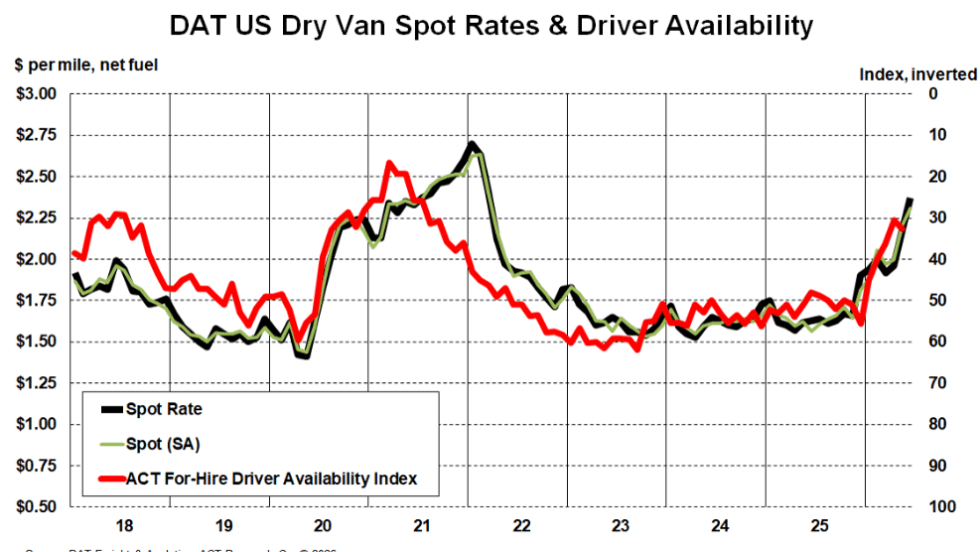
Truckload Rates Keep Rising as Tight Capacity Fuels Freight Market Recovery
Spot and contract rates continued climbing in May and June, not because freight demand is surging, but because fewer trucks and drivers are available.
Read More →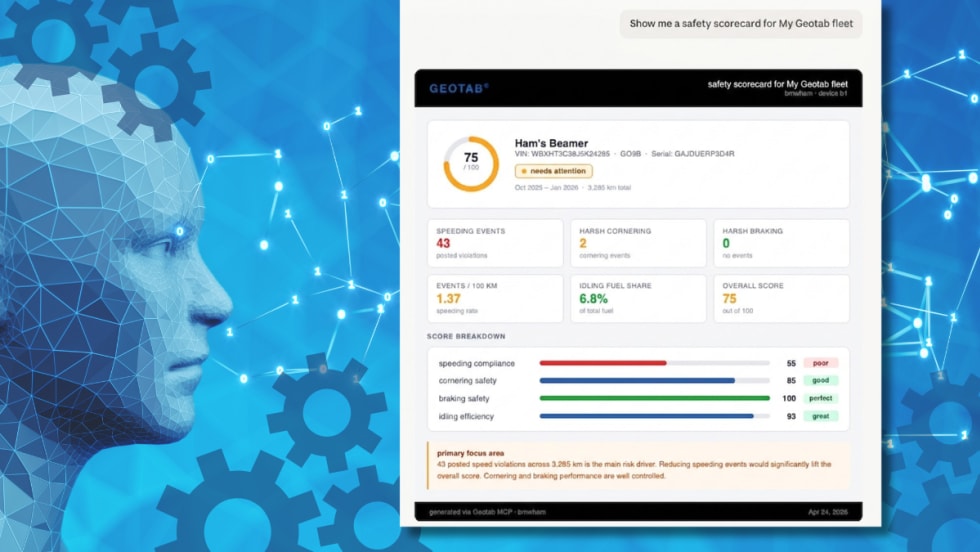
What Geotab's New AI Connector Means for Fleets
Fleets can now ask their usual AI assistants questions about maintenance, safety, fuel use, and vehicle performance, using their live Geotab data, and take action on the answers without leaving their preferred AI tool.
Read More →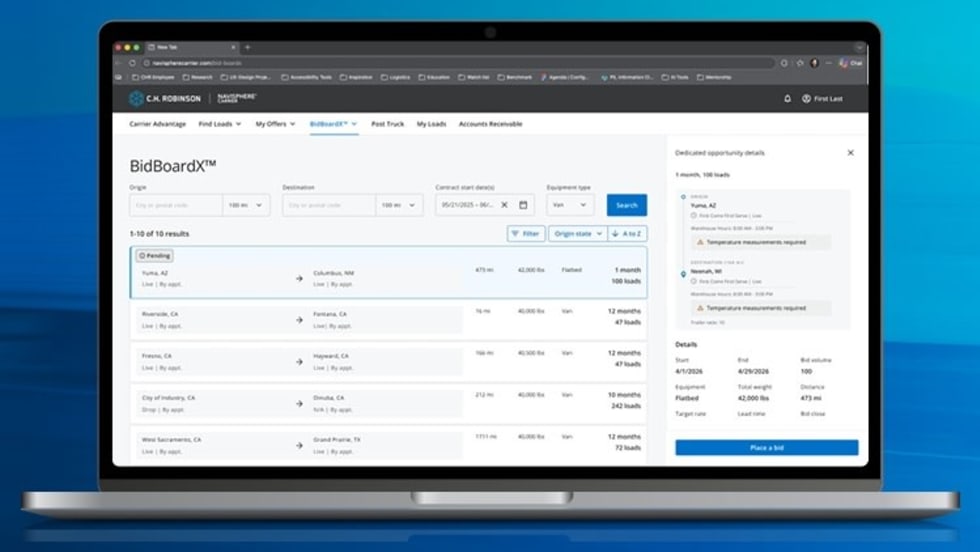
New C.H. Robinson Tool Opens Door to More Predictable Freight
BidBoardX lets carriers search, bid on, and secure committed freight opportunities through a single digital marketplace.
Read More →

New York City's Microhub Project is Delivering Results
Trucking, last-mile delivery companies, and environmental advocates like what they are seeing so far with New York's microhub program.
Read More →
Why Truck Detention Keeps Costing Fleets Time and Money
A 2024 ATRI study found detention affects nearly 40% of truckload stops and costs the industry more than $15 billion annually. Despite the toll on drivers, fleets, and supply chains, the problem remains stubbornly persistent.
Read More →
Time is Running Out to Apply for Exclusive HDT Event
Heavy Duty Trucking Exchange brings fleet managers and suppliers together for the deeper conversations that lead to ideas, partnerships, and solutions. Time is running out to apply for the September event.
Read More →
Amazon Launches Less-Than-Truckload Freight Offering for All Businesses
This launch is the latest addition to Amazon Supply Chain Services, a portfolio of supply chain capabilities from Amazon, including freight, distribution, fulfillment, and parcel shipping.
Read More →
Import Cargo Volume to See Year-Over-Year Gain Again in June, Then Remain Below 2025 Levels Into Fall
After July, the report predicts a weakening in import volume as consumer uncertainty remains high and the impact of increasing inflation takes its toll.
Read More →
AUCTION OF EQUITY INTEREST IN HEAVY HAUL TRUCKING COMPANY!!
Mark your calendar: June 30, 2026 (10:00 a.m. PDT). A 37.5% ownership interest in MagnaTrans, LLC, a California limited liability company doing business as Magna Transportation Group, will be sold in an in-person and online auction to the highest bidder or bidders under Article 9 of the Uniform Commercial Code. The Rancho Cucamonga-based heavy haul and over-dimensional trucking company operates across California, Oregon, and Arizona.
Read More →
Volvo Trucks Adds Unattended Over-the-Air Software Update Capabilities
The latest evolution of Volvo’s over-the-air update technology allows software updates to run while trucks are parked, helping fleets keep vehicles current without disrupting operations.
Read More →