




Safety Fitness Determination Changes: FMCSA to Hold Listening Sessions
Should the way motor carrier safety fitness determinations are made be updated? The Federal Motor Carrier Safety Administration is continuing to gather input on ideas for improvement.

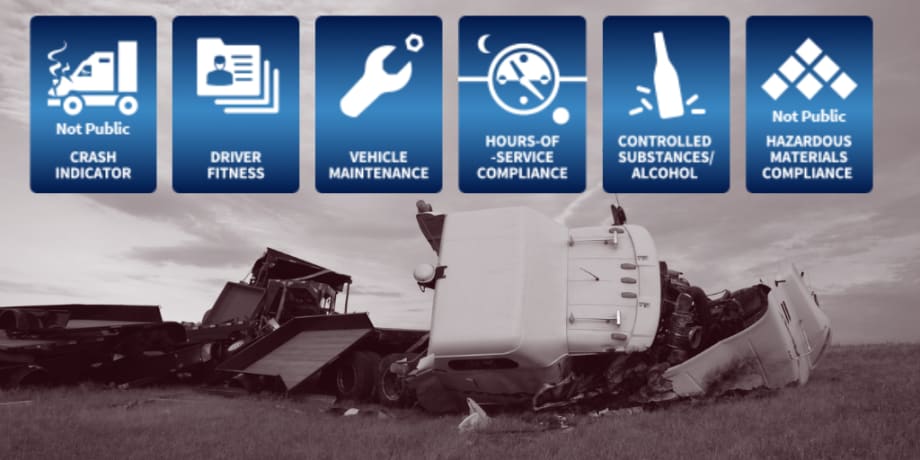
The FMCSA is considering changes to its Safety Fitness Determination program, including using SMS data.
Image: HDT Graphic
The Federal Motor Carrier Safety Administration has scheduled an in-person listening session as it continues to gather information about possible changes to the way the agency rates motor carrier safety fitness.
FMCSA is contemplating changes to its Safety Fitness Determination process. Last year, the agency published an advanced notice of proposed rulemaking asking for public input on changes to the system, including using SMS (Safety Measurement System) data.
Why Change Motor Carrier Safety Fitness Determinations?
Motor carrier safety fitness ratings of Satisfactory, Unsatisfactory, and Conditional currently are determined by a compliance review, also called a DOT audit.
These look at existing motor carrier data plus data collected during the investigation and analyses it based on six factors:
General
Driver
Operational
Vehicle
Hazmat
Accident factor (recordable accident rate per million miles)
The process has been criticized because it’s resource-intensive and reaches only a small percentage of motor carriers.
In Fiscal Year 2019, FMCSA and its state partners conducted 11,671 compliance reviews out of a population of more than 567,000 active interstate motor carriers. Of those, 306 received a safety rating of Unsatisfactory, 1,842 were rated Conditional, and 2,701 were Satisfactory. (A small percentage of carriers with safety management control deficiencies are required to submit corrective action to continue operating and avoid a final unfit determination based on an unsatisfactory rating.)
Ditching the Three-Tier SFD Rating System?
One of the changes the agency is contemplating is moving to a single rating, only when a carrier is found to be Unfit, instead of the current three-tiered rating system.
The agency has said that a carrier getting a Satisfactory safety rating may be misconstrued as an FMCSA approval of the current operations of a motor carrier. But what it actually reflects is FMCSA’s evaluation of a motor carrier’s operations at the time of the investigation.
And under the current SFD process, a motor carrier with a Conditional rating is not prohibited from operating, even if a review reveals breakdowns in safety management controls in multiple areas.
The agency has long hoped to link its Compliance, Safety, Accountability program and its Safety Measurement System to fitness reviews. The SMS is FMCSA’s prioritization system to identify motor carriers for investigation, which went into effect in 2010.
But trucking companies have opposed the use of SMS to determine safety fitness, saying the SMS data has problems that need to be fixed first.
FMCSA's SMS currently is not used in any way to generate SFDs. SMS is FMCSA's prioritization system to identify motor carriers for investigation. SMS organizes inspection and crash data into seven categories of violations known as Behavior Analysis and Safety Improvement Categories (BASICs). These are commonly referred to as CSA scores, for the Compliance, Safety, Accountability program.
The Texas Listening Session
The June 29 public listening session will be held from 1-2:30 pm CDT in conjunction with the Texas Trucking Show in Houston. All comments will be transcribed and placed in the public docket for the regulatory action.
The agency wants to hear from members of the public on issues of concern relating to the current Safety Fitness Determination, including:
The three-tiered rating system (Satisfactory, Unsatisfactory, Conditional) versus changing to a proposed single rating only when a carrier is found to be Unfit.
Using inspection data and FMCSA’s Safety Measurement System (SMS).
Incorporating driver behavior into SFD ratings.
Revising the list of safety violations used to calculate the rating.
Adjusting the weights allocated to particular violations, including increasing the weight for unsafe driving violations.
The meeting will be held at the NRG Center, 1 NRG Parkway, Houston, TX 77054, in the Seminar Area next to the Trucking Exhibition. Attendees do not need to preregister for the listening session but are required to register for the Texas Trucking Show at https://texastruckingshow.com/register.
FMCSA also said it is planning two virtual listening sessions on the same topics to be held in June and July.
The agency is accepting written comments to the docket through August 7, 2024.
More Safety & Compliance

FMCSA Pauses Biennial-Update Enforcement Amid Motus Transition
Carriers whose updates were due on or after June 1 have more time, while FMCSA works to stabilize its new registration system and warns of phishing sites impersonating its new carrier registration system, Motus.
Read More →
ZF Expands Commercial Vehicle Push in North America
ZF is expanding its North American commercial-vehicle presence with new transmission applications, electrification, trailer technology and autonomous-driving systems.
Read More →
Truck Drivers Need More Than Another Alert
Fleets have more visibility into truck health, safety events, and driver activity than ever. The next challenge is turning all that information into useful guidance for the person who has to decide what to do next.
Read More →
Tesla Wants a Self-Driving Semi. Are Cameras Enough?
Could Tesla’s camera-only autonomous driving technology work on an 80,000-pound Semi? In this commentary, HDT's Deborah Lockridge takes a look at Tesla, Cybercab, and how autonomous trucks see the road.
Read More →
What DOT’s Automated Vehicle Strategy Means for Trucking
The U.S. Department of Transportation issued a new automated-vehicle strategy that outlines plans for driverless-truck regulations, cross-state freight corridors, and federal safety standards.
Read More →
NYC Expands Speed, Pedestrian Safety Tech Across Fleet
New York City is expanding intelligent speed assistance and pedestrian-alert systems across its municipal fleet, moving the technologies from pilot programs into vehicle procurement and retrofit requirements.
Read More →
FMCSA Removes 110 Truck Driver Training Schools from Certified ELDT List
Federal regulators also are targeting more than 160 additional training providers and launching a nationwide audit of third-party CDL skills testers as part of a broader crackdown on trucking fraud.
Read More →
Beyond DOT Compliance: What Makes a Trucking Fleet Truly Safe?
A trucking fleet can follow every rule and still make unsafe decisions. The real test comes when safety conflicts with freight, productivity, or cost.
Read More →
Hours of Service Pilot Programs: FMCSA Readies for 2027 Rollout
Two pilot programs could eventually reshape hours-of-service rules, giving truck drivers options to pause their 14-hour clock or use longer split sleeper rest periods.
Read More →
New Guide Offers Pet Safety Tips for Truck Drivers
Hundreds of thousands of pets travel in truck cabs. A new safety guide from Volvo Trucks and the Center for Pet Safety offers practical advice for truck drivers who bring dogs and cats along for the ride.
Read More →