




Uber Freight Rolls Out Emissions Dashboard
Uber Freight said shippers can monitor total emissions across the entirety of their logistics network, accounting for all modes of transportation across the globe — road to sea to sky — with its new Emissions Dashboard.

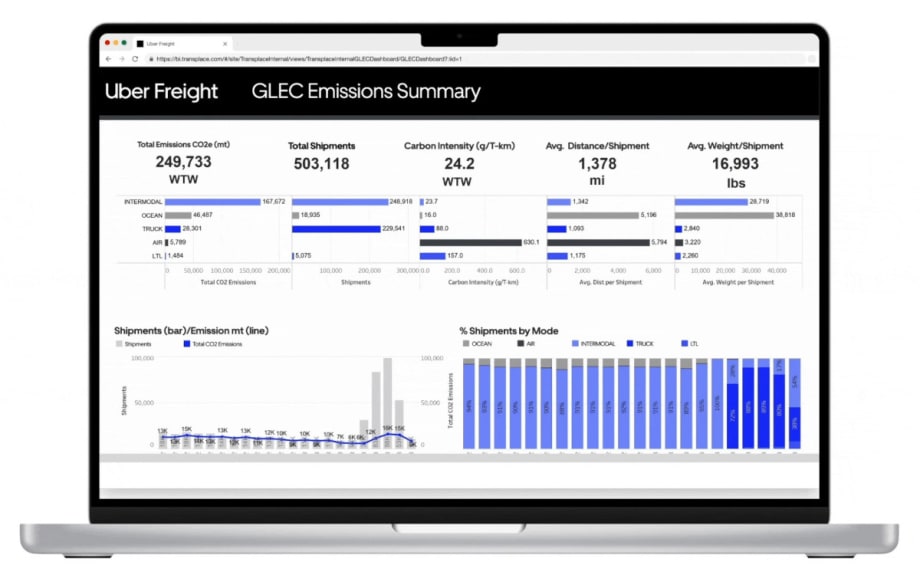
Uber Freight said its Emissions Dashboard gives shippers insight into emissions across the entire logistics network.
Uber Freight is now offering a new Emissions Dashboard that it says can give shippers comprehensive insight into their network’s emissions across all modes quantified using the Global Logistics Emissions Council (GLEC) framework.
Uber Freight said the Emissions Dashboard equips its customers with a holistic view of their operations. Accessible in both the Uber Freight TMS and as a standalone tool, shippers can monitor total emissions across the entirety of their logistics network, accounting for all modes of transportation across the globe — road to sea to sky. Customers can also port over freight managed outside of the Uber Freight network to ensure all transportation is accounted for within a single view.
Tracking Carbon Emissions
The dashboard also tracks carbon intensity performance, which represents the amount of carbon emissions released per metric tonne per kilometer traveled. It provides customers with a reflection of their mode distribution, the company said. Each mode of transportation has an emissions factor assigned to it based on the general efficiency of the mode.
Emissions Overview
By providing increased visibility into this ecosystem, shippers can identify and begin addressing carbon hotspots in their network. Uber Freight can also work directly with them to help strategize a roadmap for decarbonization, with a portfolio of tools including mode electrification, network optimization, intermodal optimization, specialized consulting projects, and more.
Actionable Emissions Insights
The new Emissions Dashboard builds on Uber Freight’s commitment to help decarbonize supply chains. Uber Freight said providing companies with all relevant emissions data in one intuitive tool empowers them with actionable insights that elevate sustainability into key decision-making frameworks.
The dashboard also simplifies the ability to identify and implement more sustainable practices and capacity options to optimize their network, electrify lanes, and transition to more efficient modes of transportation.
More Fuel Smarts

Fleet Economics Shape Electric Truck Outlook
ACT Research expects costs, charging infrastructure, and technology improvements to drive zero-emission commercial vehicle adoption as federal regulations and incentives retreat.
Read More →
Wex Adds Cardless Fuel Payments for Over-the-Road Customers
A new fuel card feature for Wex customers offers convenience and security.
Read More →
New California Law Could Shed Light on Electric Truck Prices
Why do battery-electric Class 8 trucks remain so expensive? A California bill signed by Gov. Gavin Newsom would give fleets and state agencies more visibility into what manufacturers charge.
Read More →

How Volvo Updated Its D13 for EPA 2027 [Watch]
Volvo’s updated D13 promises lower emissions without sacrificing performance or fuel economy. Take a closer look at what changed inside the engine in this HDT Spotlight video.
Read More →
Diesel Price Spike Shortens Payback for Natural Gas Trucks, Report Says
Energy Vision estimates fleets could recover the higher purchase price of an RNG-fueled Class 8 tractor in 1.3 to 2.8 years under current fuel-price scenarios.
Read More →
Calstart Becomes Catalyst Mobility, Reflecting Broader Focus
Calstart is now Catalyst Mobility, reflecting the nonprofit’s growing national role in clean transportation, including zero-emission trucks, infrastructure and incentive programs.
Read More →
Record Diesel Prices Squeeze Trucking Fleets
Average U.S. diesel prices have climbed to nearly $6 a gallon, surpassing the 2022 record as tight refinery capacity and Middle East disruptions keep fuel costs elevated.
Read More →
How Fuel Delivery Shapes Engine Performance
Fuel delivery depends on more than what happens at the injector. For fleet, maintenance and technical professionals, looking at the full path from pump to injector can provide useful context for understanding engine performance.
Read More →
East Coast Port Launches $45M Electric Truck Push
The Port Authority of New York and New Jersey announced millions in incentives for zero-emission drayage trucks, yard tractors, and new charging hubs near the port.
Read More →
Detroit Opens Orders for EPA 2027 Engines
Detroit isn’t starting from scratch to meet EPA 2027 diesel emissions standards. Its Gen 6 DD13 and DD15 engines keep much of today’s platform while updating the fuel and aftertreatment systems.
Read More →