





2024 Update: Will Side-Underride Guards be Required for Trailers in the U.S.?
NHTSA Mulls Mandating Side Underride Guards for Trailers
The National Highway Traffic Safety Administration published the results of its research on costs and benefits of mandated side underride guards for truck trailers. But in the advance notice of proposed rulemaking, the agency acknowledged that it lacks information on a large number of factors that could affect those calculations.
April 19, 2023
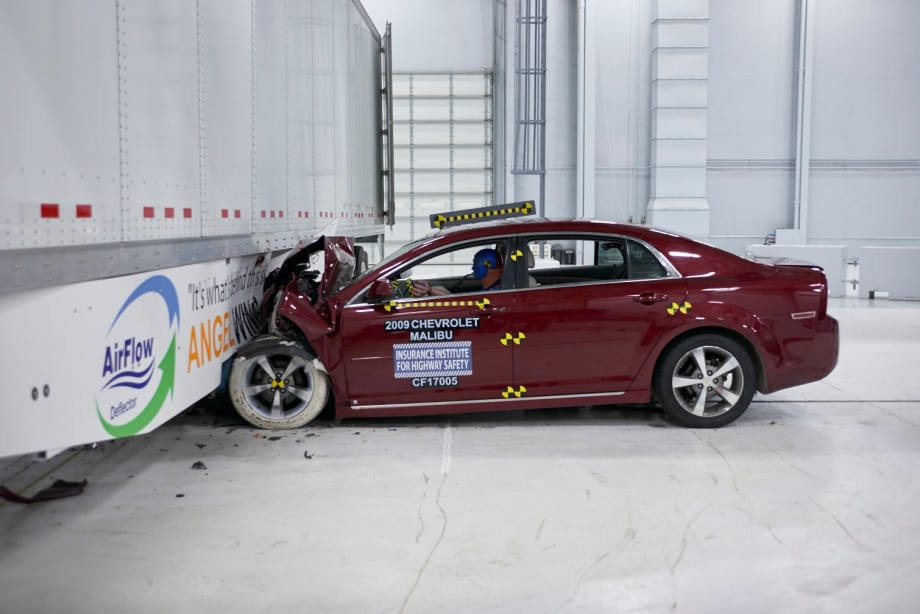
In 2017, the Insurance Institute for Highway Safety tested how well a side underride guard could prevent a car underriding the trailer.
Photo: IIHS
5 min to read
The National Highway Traffic Safety Administration has started the rulemaking process on side underride guards for trailers.
In an advance notice of proposed rulemaking, it outlined the results of its research on costs and benefits of mandated side underride guards — but the agency acknowledged that it lacks information on a large number of factors that could affect those calculations.
Side underride guards are designed to prevent a passenger vehicle involved in a crash with a large truck or trailer from sliding underneath.
There are currently no federal requirements for side underride guards on trailers in the U.S.
NHTSA said that in fact, no country requires side underride guards on trailers to prevent vehicle underride. Some countries have a requirement for “lateral protection devices,” which are intended to prevent pedestrians or cyclists from falling in front of the trailer’s rear wheels, not to keep a car from underriding the trailer.
However, cities such as Boston, Chicago, New York, Philadelphia, Seattle, and San Francisco already require side underride guards on city-owned truck fleets.
NHTSA initiated research on side underride guards following a March 2019 Government Accountability Office recommendation. Then the November 2021 Infrastructure Investment and Jobs Act, commonly referred to as the Bipartisan Infrastructure Law, required the DOT to research side underride guards, report its findings, and seek public comment. The result is this advance notice of proposed rulemaking.
Cost-Benefit Analysis of Side Underride Guards
The report estimates that 17.2 lives would be saved and 69 serious injuries would be prevented each year once all trailers are equipped with side underride guards.
After analyzing police reports, NHTSA concluded that there are 78% more fatalities associated with side underride than reported in the Fatality Analysis Reporting System (FARS).
NHTSA’s analysis only looked at crashes under 40 mph, because that’s the maximum impact speed that the side underride guard used in its analysis has been tested to provide passenger vehicle occupant protection. Only about 20% of side underride fatalities occurred at these speeds, it said.
To outfit an estimated 260,000 new trailers sold annually with mandated side underride guards, NHTSA estimates the total annual initial cost would be approximately $778 million.
However, the agency said, this cost estimate does not include any additional costs associated with factors such as extra weight, reinforcing trailers to accommodate the guards, changes to trailer loading patterns, and other factors. It’s asking for more information on these and other effects of side underride guards on trailer operations and logistics.
How Much Would Side Underride Guards Cost?
Estimating costs is complicated by the fact that NHTSA’s analysis was based on only one side underride guard system: the AngelWing guard manufactured by AirFlow Deflector.
In 2017, the Insurance Institute for Highway Safety tested the effectiveness of this guard.
Based on AngelWing numbers, NHTSA estimates the average total cost of installing side underride guards on a trailer, including hardware and labor, at $2,990 in 2020 dollars. Adding in incremental fuel costs because of the additional weight these guards would add (the AngelWing weights 450 to 800 pounds), NHTSA’s final estimate of the cost per trailer was between $3,740 and $4,630.
NHTSA is asking for information on other side underride guards available in the U.S.
What NHTSA Wants to Know
In addition to seeking out any other side underride guards that are available, NHTSA is asking for more information on a number of factors that were not included in its cost-benefit analysis, including:
The effects of side underride guards on trailer operations. For instance, could side underride guards scrape or snag on the road surface when the vehicle travels over humped surfaces such as a highway-rail crossing, or when the vehicle enters a steep loading dock ramp?
Additional wear and tear on equipped trailers. Side underride guards may impose non-uniform loads on trailer floors, adding stresses that decrease trailer lifetimes in the absence of repair.
It is possible that side underride guards would obstruct proper safety inspections of the underside of the trailer.
Side underride guards might strike or entangle with road structures and loading area components, leading to additional repair costs or restricted access to destinations.
There also could be restrictions on trailer axle configurations. The rear axles of trailers are commonly able to be moved fore and aft to adjust to loading conditions; losing this capability would add to operating costs.
The potential effects of side underride guards on port and loading dock operations and freight capacity, and on increased greenhouse gases and other pollutants resulting from increased fuel consumption.
The practicability and feasibility of side underride guards in intermodal
operations.The cost and weight of strengthening the beams, frame rails, and floor of the trailer to accommodate side underride guards.
The Owner-Operator Independent Drivers Association, which opposes a side underride guard mandate, was quick to point out that NHTSA’s own research shows that the cost of a mandate would outweigh the benefits.
“NHTSA’s latest research once again indicates there is absolutely no reason to mandate side underride guards on commercial trucks,” OOIDA President Todd Spencer said in a statement. “Proponents of side underride guards have never demonstrated how these devices will perform in highway conditions, yet we’re wasting more time reviewing another potential regulatory mandate where the costs outweigh the benefits.”
Underride Advisory Committee
Spencer also criticized the new Advisory Committee on Underride Protection, which will make recommendations to the Secretary of Transportation on safety regulations related to underride crashes.
“To make matters worse, we now have an advisory panel in place that gives more influence to representatives who have no clue how to operate a heavy vehicle than those who understand the serious operational challenges and hazards created by side underride guards,” he said.
NHTSA announced the committee members, which it said were selected for their expertise, training or experience in related trucking and transportation safety areas, as well as law enforcement:
Marianne Karth and Jane Mathis to represent families of underride crash victims.
Harry Adler and Jennifer Tierney to represent truck safety organizations.
Lee Jackson and Aaron Kiefer to represent motor vehicle crash investigators.
Adrienne Gildea to represent law enforcement.
Daniel McKisson to represent labor organizations.
Jeff Bennett and Jeff Zawacki to represent motor vehicle engineers.
Matthew Brumbelow and Claire Mules to represent the insurance industry.
Dan Horvath and Doug Smith to represent motor carriers, including independent owner-operators.
John Freiler and Kristin Glazner to represent truck and trailer manufacturers.
Comments close 60 days after publication in the Federal Register. To view the full ANPRM and to comment, go to www.regulations.gov; the docket number is NHTSA-2023-0012.
More Safety & Compliance
More Trailer Data Through the Same Seven-Way [Video]
Can trucking’s standard seven-way connector handle more cameras and trailer data? Grote’s Adam Slade shows HDT how the company is using new technology with its 4See trailer system, not only to add a new backup camera but also to expand other capabilities — without adding another connection.
Read More →
PrePass Intelligence Mines Fleet Bypass, Toll and Safety Data
PrePass Intelligence helps fleets measure bypass savings, flag potential toll overcharges, and spot suspicious transactions by combining data from separate systems.
Read More →
Fatal Crash Exposes Toll Plaza Risks
An NTSB investigation found that last-minute lane changes and large speed differences at an Ohio toll plaza created a hazard the truck driver couldn't avoid in time.
Read More →
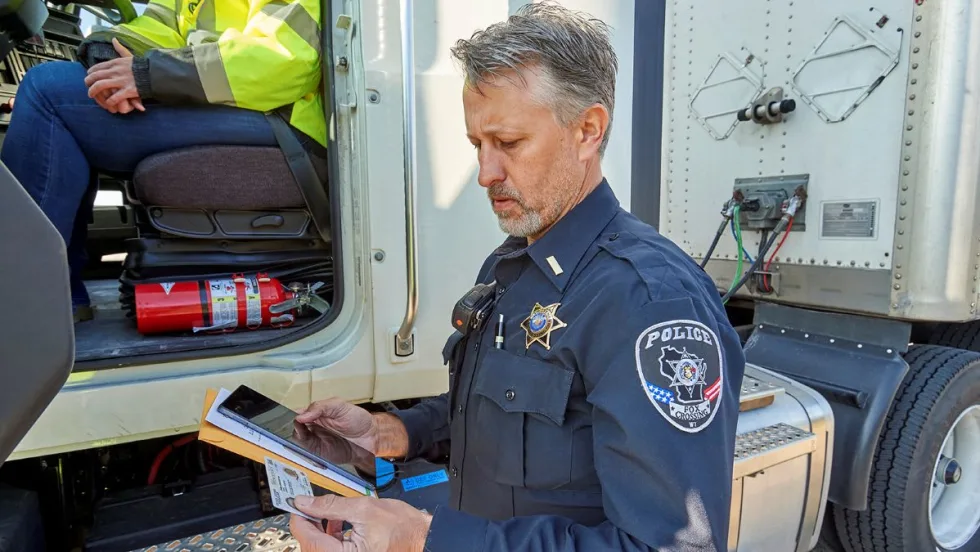
When Language Stops the Truck: The Return of ELP Out-of-Service Orders
English language proficiency rules for commercial drivers aren’t new, but renewed out-of-service enforcement has raised the stakes. Here’s what carriers need to know before a driver reaches a roadside inspection.
Read More →
Sponsored•October 6, 2026
A Camera Isn't a Safety Program. Here's What Brokers Are Screening for Now
Footage alone may not be enough to pass broker vetting processes. Here's what counts as a defensible safety program now.
Read More →
Marijuana and Trucking’s Drug-Testing Dilemma
Marijuana is getting stronger, laws are changing, and drug tests still can’t reliably establish impairment. What does that mean for truck drivers and the fleets that employ them?
Read More →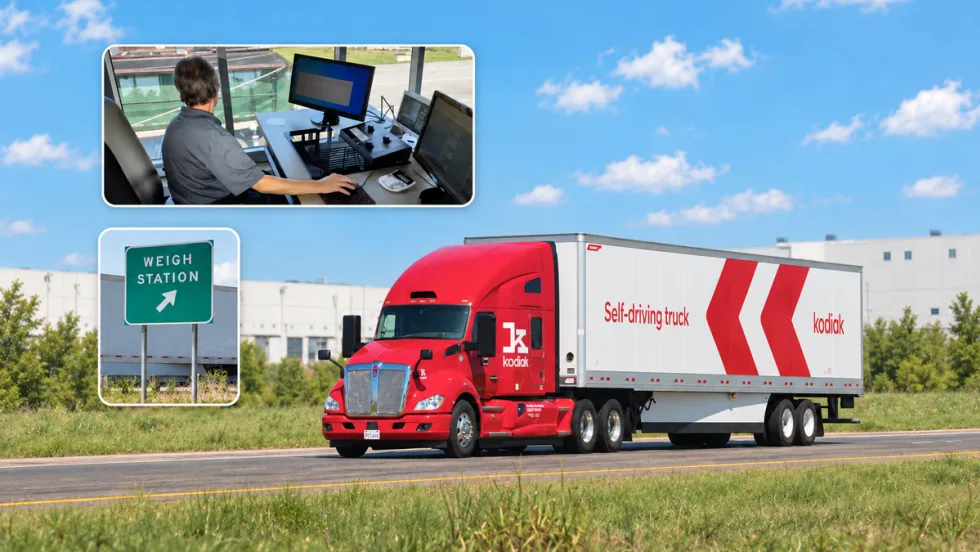
PrePass, Kodiak Connect Driverless Trucks to Roadside Enforcement
The system will allow enforcement agencies to verify Enhanced Inspection information and decide whether Kodiak’s autonomous trucks can bypass roadside screening sites.
Read More →
From One Generation to the Next: How Mentorship Builds Safer Truck Drivers
After three decades in trucking, Harold Perry shares what he's learned about driver safety, mentorship, and helping the next generation build confidence behind the wheel.
Read More →
FMCSA Pauses Biennial-Update Enforcement Amid Motus Transition
Carriers whose updates were due on or after June 1 have more time, while FMCSA works to stabilize its new registration system and warns of phishing sites impersonating its new carrier registration system, Motus.
Read More →
ZF Expands Commercial Vehicle Push in North America
ZF is expanding its North American commercial-vehicle presence with new transmission applications, electrification, trailer technology and autonomous-driving systems.
Read More →