




Ascend Reserves Spot in Volvo's Hub-to-Hub Autonomous Lane
Ascend is one of the first asset-based truckload carriers to reserve capacity for Volvo Autonomous Solutions’ hub-to-hub autonomous transportation offering in Texas.

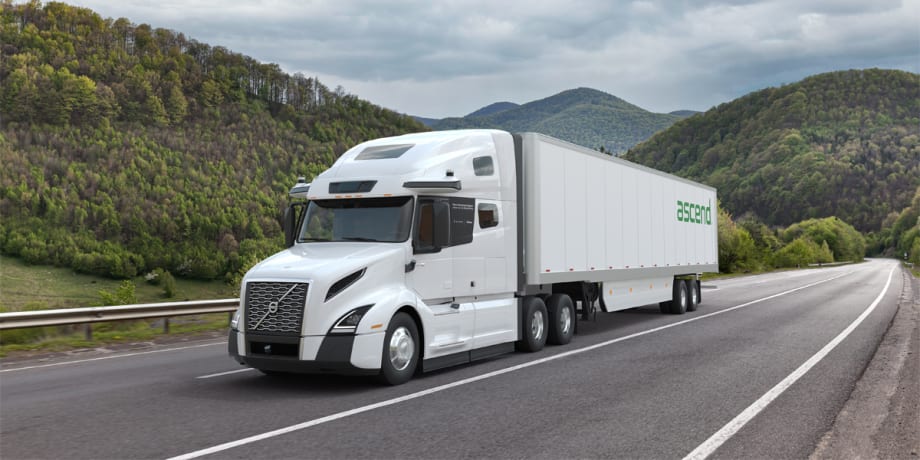
Ascend Dedicated will pick up customer loads and transport them to V.A.S. hubs in Dallas and Houston, Texas. From there, V.A.S. will complete the onward linehaul movement to its destination hub.
Photo: Ascend
Ascend will become one of the first asset-based truckload carriers to reserve capacity for Volvo Autonomous Solutions’ hub-to-hub autonomous transportation offering.
Under the partnership, Ascend Dedicated — the firm's newest division — will pick up customer loads and transport them to V.A.S. hubs in Dallas and Houston, Texas. From there, V.A.S. will complete the onward linehaul movement to its destination hub from which Ascend drivers will transport loads to their final destinations.
Benefits of Hub-to-Hub Autonomous Transportation
According to V.A.S. Preisdent Nils Jaeger, the "autonomy holds enormous potential to transform the transportation industry" including through:
Additional capacity
Keeping drivers closer to home
Improving road safety
"Many of today’s drivers seek job opportunities that align with lifestyle factors that they prioritize, including schedules that enable them to spend more time with their families, improved nutrition enjoyed through home-cooked meals, and regular exercise," Ascend officials said. "Long-haul drivers often find these goals challenging to attain while traveling through the interstate highway system for days or weeks. Autonomous linehaul solutions bracketed with experienced drivers providing expert care on the origin and destination ends of a shipment’s path is one possible way to address the needs of drivers in the future."
According to Ascend officials, autonomous transportation capabilities also have the potential to improve transit time, fuel economy, and safety.
"Autonomous vehicles will not require rest periods as today’s driver piloted vehicles, thereby enabling faster delivery schedules via 24/7 operations," according to the company. "Additionally, computer guided synchronization and optimization of vehicle operation enables performance gains not previously possible which are expected to improve fuel efficiency. Lastly, safety is arguably the most exciting frontier for autonomous transportation and certainly the area of greatest development."
By working with V.A.S. and supporting the real-world development of this technology, Ascend seeks to accelerate the advancement of autonomous driving technology. Central to this is ensuring vehicles have comprehensive capabilities to safely operate in their intended operational domain and for the foreseeable future all vehicles operated autonomously have a qualified driver on board, Ascend officials said.
Ascend's Integration of Dedicated Transportation Solutions
Ascend Dedicated built upon the foundation of Dedicated Transportation Solutions, which was acquired in 2022.
“We are excited to initiate the integration of DTS into Ascend as we seek to grow our dedicated contract carriage business,” Ascend CEO Michael McLary said. “[Ascend Dedicated President Scott] Stowers, the founder of DTS, and his staff bring vital experience and creativity to Ascend’s growth and innovation plans, as exemplified by this new partnership with Volvo."
More Fleet Management

How MFA Helps Protect Trucking Fleets
Multi-factor authentication adds protection when passwords are stolen. Here’s how it works and where fleets should start.
Read More →
How Better Freight Data Helps Trucking Teams Get Ahead of Disruption
Trucking and logistics teams have plenty of data. The problem is getting the right information in front of the right people soon enough to act. Better-connected data can help teams spot trouble earlier and make smarter decisions before small problems become big ones.
Read More →
Trimble: Taking Artificial Intelligence in Trucking Beyond Faster Tasks
At Insight 2026, Trimble executives argued that fleets may need to redesign workflows to get more from AI as it introduced new products and enhancements. AI’s value will depend on how fleets combine automation with their people's knowledge.
Read More →
Build a bulletproof fleet: Uniting ELDs and dash cams for total compliance
An ELD can prove compliance, but it cannot always prove what happened on the road. Discover how uniting accurate ELD data with AI-powered dash cam video can help your fleet strengthen compliance, defend against liability, protect drivers and reduce operational costs.
Read More →
Nominations Open for HDT Emerging Leaders
Heavy Duty Trucking is looking for accomplished trucking fleet professionals under 40 who are making an impact and helping lead the industry forward.
Read More →
Why Private Fleets Are Taking More Freight
Private fleets are putting their own trucks on demanding customers and high-cost lanes as companies seek greater control over service, costs, and capacity.
Read More →
Color Match Smarter: Tools That Restore & Perform
For fleet managers and collision repair professionals keeping heavy-duty trucks on the road, getting the color right the first time isn't just about appearance — it's about efficiency, turnaround time, and bottom-line results. Discover how today's digital color tools are transforming the repair process from guesswork to precision.
Read More →
FMCSA Pauses Biennial-Update Enforcement Amid Motus Transition
Carriers whose updates were due on or after June 1 have more time, while FMCSA works to stabilize its new registration system and warns of phishing sites impersonating its new carrier registration system, Motus.
Read More →
2026 Blueprint for Countering Smarter Supply Chain Theft
Cargo theft is no longer just the cost of doing business. It's a multi-billion-dollar criminal enterprise exploiting vulnerabilities across your fleet, drivers, and supply chain.
Read More →
What the U.S.-Canada Trade War Means for Trucking
Escalating U.S.-Canada tariffs could disrupt cross-border freight, reduce truck volumes, raise costs, and create new uncertainty for carriers on both sides of the border.
Read More →