Amazon to Bring Low-Carbon Electrofuels to Trucking Fleet
An agreement with Infinium will help Amazon reduce carbon emissions for roughly 5 million miles of travel per year, a step toward reaching its goal of net-zero carbon by 2040.
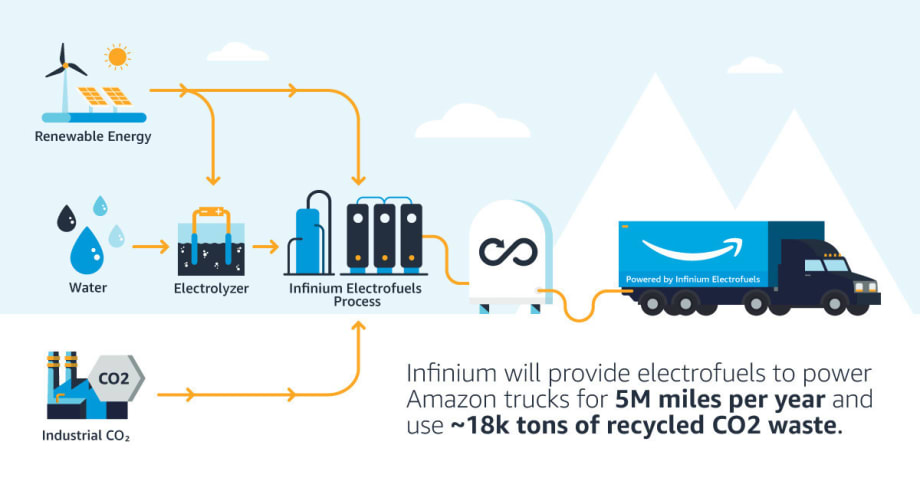
The Infinium Electrofuels process for Amazon's trucking fleet.
Image: Infinium
3 min to read
Amazon took another step toward reaching its goal of net-zero carbon by 2040, signing an agreement with renewable fuels technology company Infinium to begin powering the retailer's middle-mile fleet with ultra-low carbon electrofuels.
Infinium is expected to initially supply enough electrofuels, which are a fossil-based fuel alternative created with carbon waste and renewable power, to begin powering Amazon trucks in lieu of diesel fuel for approximately 5 million miles of travel per year. Amazon plans to initially use the electrofuels in trucks in its middle mile fleet in Southern California, responsible for moving customer orders from its vendors and fulfillment centers to its network of sortation and delivery stations, beginning in 2023.
Ad Loading...
According to the United Nations, the transportation sector currently accounts for approximately 25% of all carbon emissions globally, and Infinium is working to change that by developing ultra-low carbon fuels that can be used in truck and other engines without modifications. Infinium plans to build its electrofuels-production facility in Texas, using renewable-power-generated green hydrogen and about 18,000 tons of recycled carbon waste per year — which would otherwise be released into the atmosphere — to create the electrofuels.
Amazon previously invested in Infinium through The Climate Pledge Fund, Amazon’s $2 billion venture investment program that invests in companies building technologies, products, and services that can help Amazon and others accelerate the path toward a net-zero carbon future. Amazon has announced investments in a total of 18 companies through The Climate Pledge Fund to date.
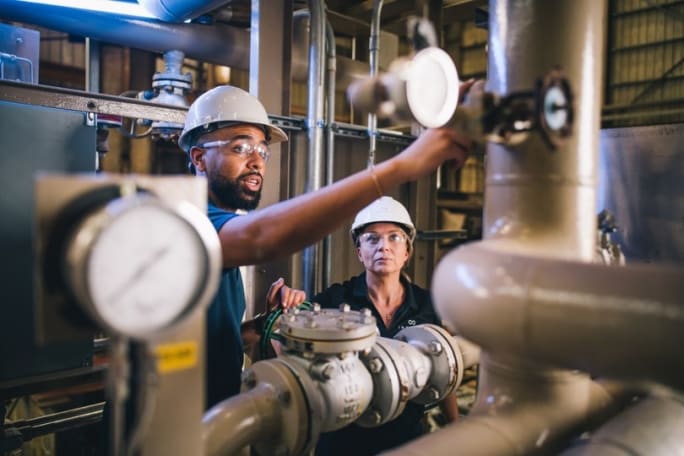
Infinium engineers working at one of the world’s first electrofuels production facilities in Texas. The Infinium facility is due to begin production in 2023.
Photo: Infinium
“Infinium’s electrofuels can help Amazon reduce carbon emissions across our transportation fleet, which is important to both us and our customers, and will help us move closer to our goal of net-zero carbon by 2040,” said Kara Hurst, vice president of Worldwide Sustainability at Amazon, in a statement. “We’ve supported Infinium’s technology through our Climate Pledge Fund, and it’s exciting to see our investment turning into usable fuel that will help us, and others across the industry, decarbonize transportation in the long run.”
Ad Loading...
“Our agreement with Amazon to provide Infinium electrofuels for use in the company’s transportation network is a significant moment for all of us,” added Infinium CEO Robert Schuetzle. “We’ve been developing this technology for the better part of a decade, and we expect our electrofuels to reduce greenhouse gas emissions by approximately 95% over traditional fossil fuels. We’re thrilled to have the first fleet of Amazon trucks powered by electrofuels starting next year, which will mark the beginning of a major shift for the entire transportation sector.”
Electrofuel Technology
Infinium electrofuels technology converts renewable power into green hydrogen, then uses the green hydrogen and waste CO2 to produce ultra-low carbon fuels. This approach offers an integrated end-to-end process to produce fuels directly on-site. These fuels are an instant replacement for traditional jet fuel and diesel, and can be directly used in planes, ships, and truck fleets without changes in infrastructure or engine design.
Amazon's Other Steps Toward Net-Zero Carbon
Amazon signed an agreement with Plug Power to supply about 10,950 tons per year of green hydrogen for its transportation and building operations starting in 2025. Amazon will start to use green hydrogen to replace grey hydrogen, diesel, and other fossil fuels as it works to decarbonize its operations, and this green hydrogen supply contract will provide enough annual power for 30,000 forklifts or 800 heavy-duty trucks used in long-haul transportation.
Through The Climate Pledge Fund, Amazon invested in Electric Hydrogen and Sunfire, developers of electrolyzers, a key technology that makes emissions-free green hydrogen for use in heavy duty transportation.
Amazon has also ordered 100,000 electric delivery vehicles from Rivian, which started to hit the road this summer in the U.S., and thousands are expected to be making deliveries in about 100 major U.S. cities by the end of this year.
Volvo’s updated D13 promises lower emissions without sacrificing performance or fuel economy. Take a closer look at what changed inside the engine in this HDT Spotlight video.
Energy Vision estimates fleets could recover the higher purchase price of an RNG-fueled Class 8 tractor in 1.3 to 2.8 years under current fuel-price scenarios.
Calstart is now Catalyst Mobility, reflecting the nonprofit’s growing national role in clean transportation, including zero-emission trucks, infrastructure and incentive programs.
Average U.S. diesel prices have climbed to nearly $6 a gallon, surpassing the 2022 record as tight refinery capacity and Middle East disruptions keep fuel costs elevated.
Fuel delivery depends on more than what happens at the injector. For fleet, maintenance and technical professionals, looking at the full path from pump to injector can provide useful context for understanding engine performance.
The Port Authority of New York and New Jersey announced millions in incentives for zero-emission drayage trucks, yard tractors, and new charging hubs near the port.
Why do battery-electric Class 8 trucks remain so expensive? A California bill headed to Gov. Gavin Newsom would give fleets and state agencies more visibility into what manufacturers charge.
Detroit isn’t starting from scratch to meet EPA 2027 diesel emissions standards. Its Gen 6 DD13 and DD15 engines keep much of today’s platform while updating the fuel and aftertreatment systems.
California, Oregon, Washington, British Columbia and Baja California are coordinating plans for truck charging and hydrogen fueling from Canada to Mexico.
Learn more about Kenworth's T880E battery-electric vocational truck at the Paccar Technical Center, including its range, applications, upfitting considerations, and PTO options, in this HDT Spotlight video.