





Dig Deeper: ZF on New CVS Division, Intelligent ABS Production
ZF Highlights Progress on Automated, Electric Vehicle Technology Future
ZF’s vision of the commercial truck of the future is automated, connected, and electrified, and it's unveiling technology such as steer-by-wire and a new more compact electric drivetrain to get there.
July 19, 2022
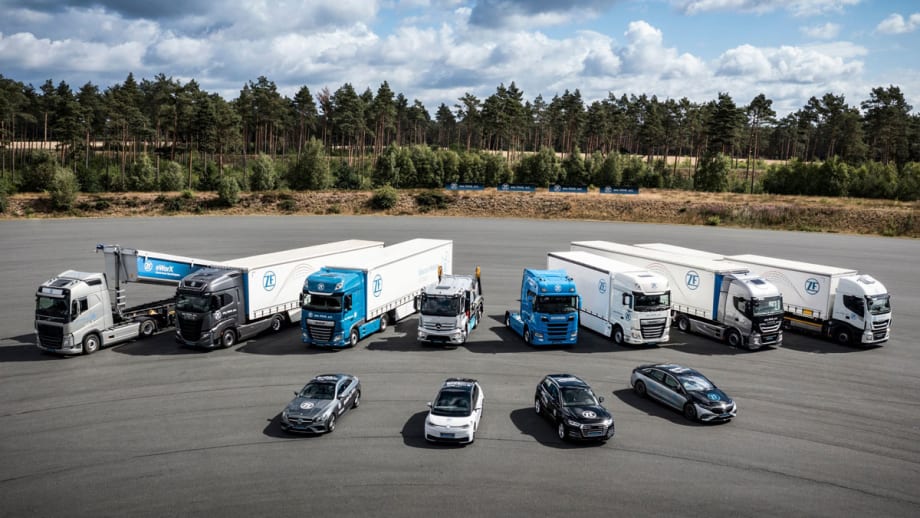
ZF showed off its portfolio of electrified and automated technologies for cars and trucks.
Photo: ZF
5 min to read
ZF’s vision of the commercial truck of the future is automated, connected, and electrified, and it shared its latest advancements toward what it calls its Next-Generation Mobility strategy during its Global Technology Day July 19 at its testing facility in Jeversen, Germany.
With its 2020 purchase of Wabco and the melding of that with its existing commercial-vehicle operation into the Commercial Vehicle Solutions division earlier this year, ZF said it’s now the largest supplier with the broadest portfolio to the commercial vehicle industry.
With both commercial vehicle and passenger-car businesses, as well as a global footprint, ZF said it can transfer technologies and competencies across vehicle segments in areas such as automation and electric drivetrains. That means even if the technologies showcased here aren’t yet available in North America, eventually they may be.
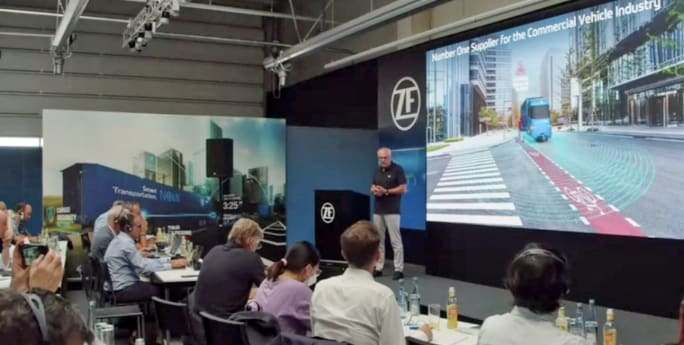
Rehm said that ZF's commercial vehicle division “can quickly take over innovations in e-mobility from passenger cars into the truck.”
Photo: Screen capture from ZF virtual press conference
Steer by Wire Marks Progress on Path to Self-Driving Trucks
An example of that is ZF’s latest announcement for its passenger car offerings, a new electric steer-by-wire system that will be launched by a major global automaker within the next year.
Steer-by-wire technology transmits driver commands to the steering system entirely through electrical signals, removing the mechanical link between the steering wheel and front axle.
“ZF’s smart by-wire systems end the era of mechanical connections and enable a new era of vehicle control,” said ZF CEO Wolf-Henning Scheider. “ZF’s steer-by-wire technology enables new safety and comfort features, like autonomous emergency evasive maneuvers or parking in very confined spaces. It marks a breakthrough on the way to fully self-driving cars and trucks by adding new design and engineering freedom.
“ZF’s new steer-by-wire technology is an important precondition for advanced automation in passenger cars and, true to our ‘develop once, deploy anywhere’ guiding philosophy, will also be applied to commercial vehicle automation,” added Scheider.
By-wire is the perfect fit for future electric and automated vehicles, according to ZF, which also offers brake-by-wire with Integrated Brake Control and electronically controlled active suspensions.
With by-wire technologies, the amount of steering assist or brake torque can be tuned to mimic the typical feel that drivers expect but can also be instantly adjusted to enhance brake force to reduce stopping distances or steer around an obstacle more expertly than drivers can do themselves.
In response to a reporter’s question, officials noted that steer-by-wire eventually would replace the company’s ReAx electric steering assist, which currently is being tested for autonomous-truck applications.
“Thanks to our expertise with supercomputers and smart actuators… we are in a unique position to control all dimensions of the driving dynamics of a car or a truck,” Scheider told reporters. “We can network all these components with each other and control them electronically. It’s a new world.”
A step in that direction on the commercial vehicle side is ZF’s EPS, electronic power steering, which “is an important prerequisite for future driving systems and a higher degree of automation,” said Wilhelm Rehm, head of ZF’s Commercial Vehicles Solutions division.
Next-Generation eMobility for Commercial Vehicles
Rehm also said that the CV division “can quickly take over innovations in e-mobility from passenger cars into the truck.”
Scheider explained that ZF’s commercial vehicle business benefits from the economies of scale of its passenger-car sector. “It’s clear to us at ZF that the future of mobility is going to be electric, for cars and trucks,” he told reporters.
Specific to commercial vehicles, ZF unveiled a new integrated, modular electric driveline, CeTrax 2, for vehicles up to 44 tons gross vehicle weight. The new system combines a favorable power-to-weight ratio and a highly integrated, compact design. This enables a high, sustained output of 360 kW and improved efficiency through powershift gear changes, according to the company.
It also features high-end technologies such as an innovative cooling system and a silicon carbide-based inverter, adapted from ZF’s passenger car expertise. Production with a global vehicle manufacturer will start next year.
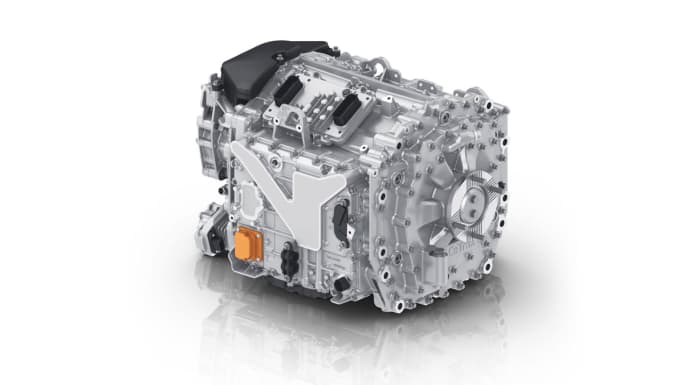
The CeTrax 2 electric drive for trucks features high-end technologies such as an innovative cooling system and a silicon carbide-based inverter, adapted from ZF’s passenger car expertise.
Photo: ZF
A new electric power take-off, eWorkX, was announced a few weeks ago.
ZF officials also said the company can take a holistic approach to sustainability by combining smart technologies and control systems for both truck and trailer. Rehm said the company is focusing on benefits that can be achieved by looking at the tractor and trailer as a whole. Improved efficiency yields improve fuel economy now, and in the future can help extend the range of electric trucks.
“By integrating our individual solutions into a complete system even across trucks and trailers,” Rehm said, the company can offer increased efficiency, safety and security.
Equipping innovation trucks and semi-trailers with a suite of its latest safety and efficiency technologies, ZF is also demonstrating how its complete vehicle approach represents a significant step towards the industry aim of ‘zero accidents’ and next level efficiency.
End-to-End Automated Commercial Vehicle Solutions
ZF is also working on commercial vehicle automation with the next generations of its Adopt (Autonomous Driving Open Platform Technology) platform. Adopt translates driving instructions from Virtual Driver applications (Autonomous Driving Artificial Intelligence) to real vehicle motion commands by enabling the control of all the relevant vehicle actuation systems.
Adopt 2.0 focuses on low-speed yard automation applications up to 20 km/h. In addition, ZF demonstrated ADOPT 3.0, which enables hub-to-hub highway applications at speeds up to 80 km/h.
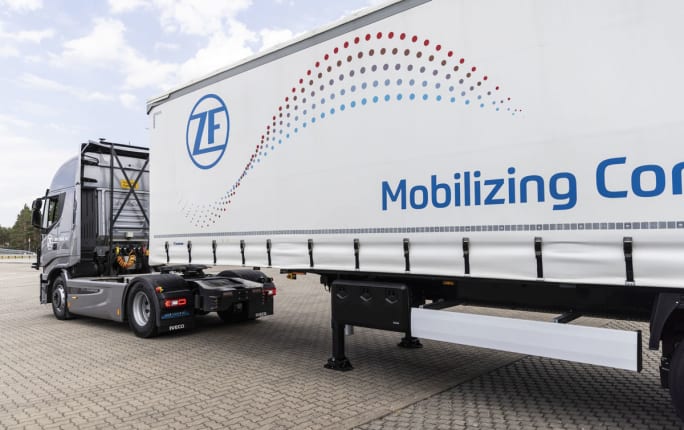
Adopt 2.0 focuses on automating low-speed yard applications up to 20 kph, or about 12 mph.
Photo: ZF
Company officials emphasized the ever-increasing importance of computers and software in its business. At the Global Technology Day, the company unveiled Scalar, a digital solutions platform for commercial vehicle fleets that enables efficient Transport-as-a-Service. It is a fully automated, artificial-intelligence-based planning, routing and dispatching solution.
ZF Scalar combines and connects technologies on board commercial vehicles and third-party systems with artificial intelligence. The platform will help fleet operators increase operational efficiency, sustainability, planning reliability, and cargo and passenger safety.
More Equipment

How Volvo Updated Its D13 for EPA 2027 [Watch]
Volvo’s updated D13 promises lower emissions without sacrificing performance or fuel economy. Take a closer look at what changed inside the engine in this HDT Spotlight video.
Read More →
Michelin Tire Improves Efficiency and Durability for Regional Fleets
The Michelin X Multi Energy D2 is a regional haul drive tire engineered to help fleets improve fuel efficiency, durability and traction in demanding stop-and-go operations.
Read More →
ZF Expands Commercial Vehicle Push in North America
ZF is expanding its North American commercial-vehicle presence with new transmission applications, electrification, trailer technology and autonomous-driving systems.
Read More →
Tesla Wants a Self-Driving Semi. Are Cameras Enough?
Could Tesla’s camera-only autonomous driving technology work on an 80,000-pound Semi? In this commentary, HDT's Deborah Lockridge takes a look at Tesla, Cybercab, and how autonomous trucks see the road.
Read More →
Kodiak: Driverless Long-Haul Truck Launch on Track for 2026
Kodiak AI says its driverless long-haul safety case is 93% complete and it remains on track to begin commercial operations by year-end 2026.
Read More →
What DOT’s Automated Vehicle Strategy Means for Trucking
The U.S. Department of Transportation issued a new automated-vehicle strategy that outlines plans for driverless-truck regulations, cross-state freight corridors, and federal safety standards.
Read More →
East Coast Port Launches $45M Electric Truck Push
The Port Authority of New York and New Jersey announced millions in incentives for zero-emission drayage trucks, yard tractors, and new charging hubs near the port.
Read More →
PlusAI Going Public to Fund Autonomous Truck Launch
A SPAC deal could provide PlusAI with up to $300 million as it works toward a 2027 commercial launch of factory-built autonomous trucks.
Read More →
NHTSA Moves to Rewrite Truck Fuel-Economy Rules
The National Highway Traffic Safety Administration says it lacks authority to regulate medium- and heavy-duty truck engines separately from complete vehicles, but the existing standards have not yet been eliminated.
Read More →
Detroit Opens Orders for EPA 2027 Engines
Detroit isn’t starting from scratch to meet EPA 2027 diesel emissions standards. Its Gen 6 DD13 and DD15 engines keep much of today’s platform while updating the fuel and aftertreatment systems.
Read More →