





From the archives: California Bill Means 'End for Independent Trucking' in State
Will Supreme Court Rule on California's Controversial AB5 Law?
California’s AB5 law, which would largely eliminate the traditional owner-operator model for trucking in the state, could go into effect as soon as sometime in June — if the Supreme Court takes the advice of the U.S. solicitor general.
May 27, 2022
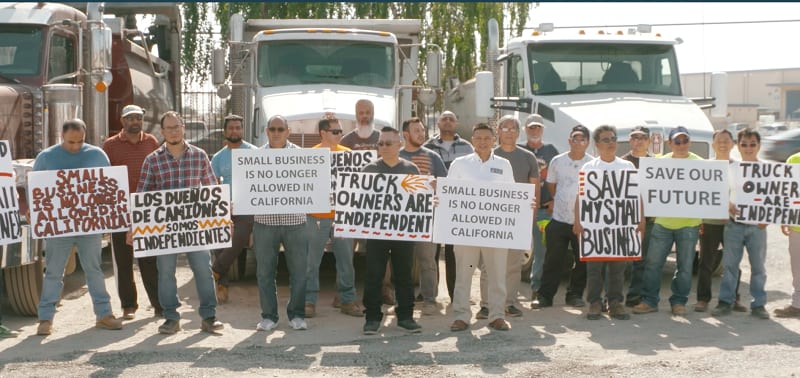
California owner-operators protest the state's AB5 law.
HDT File Photo: California Trucking Association
4 min to read
California’s controversial AB5 law, which would largely eliminate the traditional owner-operator model for trucking in the state, could go into effect as soon as sometime in June — if the Supreme Court takes the advice of the U.S. solicitor general and declines to hear a California Trucking Association lawsuit challenging it.
Assembly Bill 5, passed in 2019, established a establishing a strict ABC test to determine whether a worker is an employee or an independent contractor. The California Trucking Association challenged it and obtained a preliminary injunction, but that was overturned on appeal. The injunction remains in place, however, pending CTA’s appeal to the Supreme Court.
The case may have hit a stumbling block in the form of the U.S. solicitor general, who on May 24 filed a brief recommending the Supreme Court deny review of the case. (The solicitor general is the federal government’s representative before the Supreme Court.)
The court could still decide to take up the case, and it could make that decision before it recesses for the summer at the end of June.
More About AB5
Assembly Bill 5 took a 2018 state Supreme Court decision and turned it into law. That decision said that certain workers should be presumed employees instead of independent contractors when evaluating wage and hour classification in class-action cases.
The ruling required companies to use a newly adopted ABC test to determine who is an independent contractor, which consists of certifying:
A That the worker is free from the control and direction of the hiring entity in connection with the performance of the work, both under the contract for the performance of the work and in fact;
B That the worker performs work that is outside the usual course of the hiring entity’s business; and
C That the worker is customarily engaged in an independently established trade, occupation, or business of the same nature as the work performed.
Most legal analysis of the ruling agrees the ABC test, in particular the “B” prong, sets an impossible standard for most motor carriers using independent contractor owner-operators to meet.
California Trucking Association’s lawsuit contends that the AB5 legislation is pre-empted by a federal law, known as FAAAA or F4A, that forbids state laws relating to prices, routes, and services of motor carriers.
The court agreed and granted an injunction prohibiting enforcement of AB 5 with respect to the trucking industry.
But that decision was reversed on appeal by a divided panel of the U.S. Court of Appeals for the Ninth Circuit, using “a narrow test unique to the Ninth Circuit,” according to a May 24 email “law alert” from Scopelitis, Garvin, Light, Hanson & Feary. The 2-1 panel concluded that the FAAAA does not preempt generally applicable labor laws like AB5.
The injunction was allowed to remain in place pending CTA’s appeal to the Supreme Court.
Last November, the Supreme Court invited the solicitor general's office of the Department of Justice to express the views of the federal government on the case — “a solid indication that several of the Justices have an interest in taking the case up,” said American Trucking Associations General Council Rich Pianka in an email to ATA members.
On May 24, the solicitor general finally issued her opinion — and it was a disappointing one for the trucking industry.
“Although the circuits have reached differing outcomes with respect to FAAAA preemption of the ABC test as codified under the laws of various states, those case-specific decisions do not create a conflict warranting this court’s review,” said the solicitor-general. “Moreover, the interlocutory posture of this case and the need to resolve a threshold issue of state law —namely, whether motor carriers and owner-operators may fall within the business-to-business exemption under California law — make this case a poor vehicle in which to address the question presented. Further review is unwarranted.”
What's Next for California's Independent Contractors?
“While disappointing, the recommendation was not a surprise, given the policy priorities of the administration,” said ATA’s Planka. “The court itself is free to disagree with the solicitor general, and often does — for example, when ATA brought its Los Angeles Port challenge to the Supreme Court, the court granted review despite the solicitor general's contrary recommendation.”
Scopelitis attorneys said that “although the SG’s brief is very influential and often tracks the court’s ultimate determination, the ultimate decision remains with the court and takes four Justices to vote to hear the case. Nevertheless, this is not a positive development in the effort to reverse the Ninth Circuit opinion.”
ATA expects the Supreme Court to take up CTA's petition in the next couple of weeks and decide whether it’s going to take up the case by the end of June.
The Scopelitis attorneys, however, said it could take longer. CTA and the State of California had 14 days from the SG’s May 24 brief to file supplemental briefs.
“Given the timing, it is possible that the petition will not be considered before the Court recesses for the summer at the end of June, in which case the next currently scheduled conference is Oct. 6,” they said.
Meanwhile, the preliminary injunction will remain in effect until the Supreme Court either rules on the merits or denies review.
More Drivers

Driver Trust Can Make or Break the Success of Fleet Safety Technology
New Teletrac Navman research suggests that onboarding, transparency about driver data, and positive feedback can play a significant role in how commercial drivers respond to safety and coaching technology.
Read More →
EEOC Sues KLLM Over Alleged Sex Discrimination in Driver Training
KLLM is facing a federal sex-discrimination lawsuit over policies the EEOC alleges put female truck driver trainees at a disadvantage.
Read More →
FMCSA Moves to Codify English Language Requirements for Commercial Drivers
By changing regulations on English-language proficiency requirements for commercial drivers, rather than relying on a guidance memo, the FMCSA said future administrations won't be able to walk back the Trump administration's stricter enforcement with just a memo.
Read More →
Drivers Put Western Star Trucks to the Test at Star Nation Experience
Watch to get an inside look at the Western Star trucks, technology, and community behind the Star Nation Experience 2026!
Read More →
Trump Administration Looks to Put More Veterans Behind the Wheel
The Freedom Haulers program pulls together existing and expanded programs at several federal agencies to recruit veterans to drive commercial heavy-duty trucks and cut the red tape for them to get a CDL, training, and employment.
Read More →
Putting Mack’s Command Steer to the Test
A test drive of Mack’s Command Steer active steering system evaluates how it can make truck driving easier and less tiring.
Read More →
Competition Heating Up for Truck Drivers
New report reveals rising driver hiring costs, the return of sign-on bonuses, growing AI advantages, and the operational factors shaping driver retention.
Read More →
How Fraley & Schilling Improved Logbook Compliance by Over 50%
Fraley & Schilling needed a way to close a compliance workflow gap in its ELD system without adding more work from driver training, reminders, and back-office follow-ups. It found the answer in a custom driver app.
Read More →
Volvo Goes Gaming
Volvo has roared into American Truck Simulator with two new flagship trucks.
Read More →
What the Best Fleets to Drive For Teach About Driver Retention
Survey fatigue, AI-powered routing, owner-operator expectations, and the decline of social media all emerged as themes from this year's Best Fleets to Drive For program.
Read More →