




Kodiak Develops Failsafe to Guide Autonomous Trucks Out of Traffic
Should any of critical components fall outside the acceptable performance parameters, the Kodiak Driver automatically executes a fallback plan, safely pulling the truck over to the side of the road.

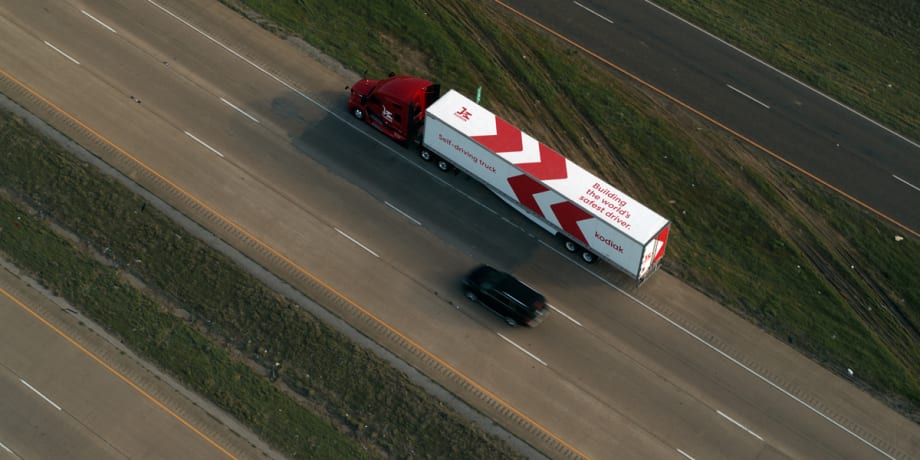
Should any of critical components fall outside the acceptable performance parameters, the Kodiak Driver automatically executes a fallback plan, safely pulling the truck over to the side of the road.
Photo: Kodiak
Kodiak Robotics publicly demonstrated its “fallback” system, which guides an autonomous truck out of traffic over to the side of the road in the event of a truck or system failure.
Ten times each second, Kodiak’s autonomous driving system, Kodiak Driver, evaluates the performance of more than 1,000 safety-critical processes and components. These include both truck-related components such as the engine, oil levels, and tire pressure, as well as autonomous vehicle system components such as sensors and software processes.
Should any of these critical components fall outside the acceptable performance parameters, the Kodiak Driver automatically executes a fallback plan, safely pulling the truck over to the side of the road. For example, if flying roadway debris were to damage one of the autonomous truck’s sensors, the Kodiak Driver would detect the damage and safely pull the truck over.
In the demonstration, a cable to the AV system is cut, triggering the fallback action.
The ability to perform a safe, reliable fallback, otherwise known as having the vehicle assume a minimal risk condition, is critical to safely deploying driverless trucks on public roads, Kodiak officials said in a press release.
“We are the first autonomous trucking company to demonstrate this capability on public roads,” said Kodiak Founder and CEO Don Burnette. “We have integrated fallback technology into the Kodiak Driver’s architecture from the beginning — it would be incredibly hard to add this capability as an afterthought.”

In the demo, the Kodiak Driver completes a fallback after a cable to the AV system is cut.
Photo: Kodiak
Kodiak’s ability to perform safe fallbacks depends on the company’s custom-designed safety computer, the Actuation Control Engine, or ACE.
“One of the many crucial functions the Kodiak ACE is responsible for is ensuring that our autonomous system can guide the truck to a safe stop when necessary,” Burnette explained.
Kodiak’s ACE safety computer executes a fallback without input from the Kodiak Driver’s main computer. Kodiak’s fourth generation of trucks includes two ACE units for redundancy and additional safety. Should the ACEs lose connection with the Kodiak Driver’s main computer for any reason, from a communications failure to a loose cable, the system will automatically execute a fallback.
The ACE is a universal interface to all truck platforms, and Kodiak is currently working to certify the safety computer to the highest automotive-grade standard.
More Equipment

ZF Expands Commercial Vehicle Push in North America
ZF is expanding its North American commercial-vehicle presence with new transmission applications, electrification, trailer technology and autonomous-driving systems.
Read More →
Tesla Wants a Self-Driving Semi. Are Cameras Enough?
Could Tesla’s camera-only autonomous driving technology work on an 80,000-pound Semi? In this commentary, HDT's Deborah Lockridge takes a look at Tesla, Cybercab, and how autonomous trucks see the road.
Read More →
Kodiak: Driverless Long-Haul Truck Launch on Track for 2026
Kodiak AI says its driverless long-haul safety case is 93% complete and it remains on track to begin commercial operations by year-end 2026.
Read More →
What DOT’s Automated Vehicle Strategy Means for Trucking
The U.S. Department of Transportation issued a new automated-vehicle strategy that outlines plans for driverless-truck regulations, cross-state freight corridors, and federal safety standards.
Read More →
East Coast Port Launches $45M Electric Truck Push
The Port Authority of New York and New Jersey announced millions in incentives for zero-emission drayage trucks, yard tractors, and new charging hubs near the port.
Read More →
PlusAI Going Public to Fund Autonomous Truck Launch
A SPAC deal could provide PlusAI with up to $300 million as it works toward a 2027 commercial launch of factory-built autonomous trucks.
Read More →
NHTSA Moves to Rewrite Truck Fuel-Economy Rules
The National Highway Traffic Safety Administration says it lacks authority to regulate medium- and heavy-duty truck engines separately from complete vehicles, but the existing standards have not yet been eliminated.
Read More →
Detroit Opens Orders for EPA 2027 Engines
Detroit isn’t starting from scratch to meet EPA 2027 diesel emissions standards. Its Gen 6 DD13 and DD15 engines keep much of today’s platform while updating the fuel and aftertreatment systems.
Read More →
Carrier Transicold Adds All-Electric TRU for Stationary Cold Storage
Carrier Transicold’s new Vector 8200 all-electric transport refrigeration unit gives fleets a diesel-free option for temporary refrigerated and frozen trailer storage.
Read More →
A Closer Look at Kenworth’s Electric T880E Vocational Truck [Video]
Learn more about Kenworth's T880E battery-electric vocational truck at the Paccar Technical Center, including its range, applications, upfitting considerations, and PTO options, in this HDT Spotlight video.
Read More →