





Achates Gets DOE Award to Develop Next-Gen Medium-Duty Engine
Walmart Deploys Near-Zero Opposed-Piston Diesel Engine
Achates Power’s heavy-duty opposed-piston diesel engine is capable of meeting CARB’s 2027 regulation.
April 6, 2022
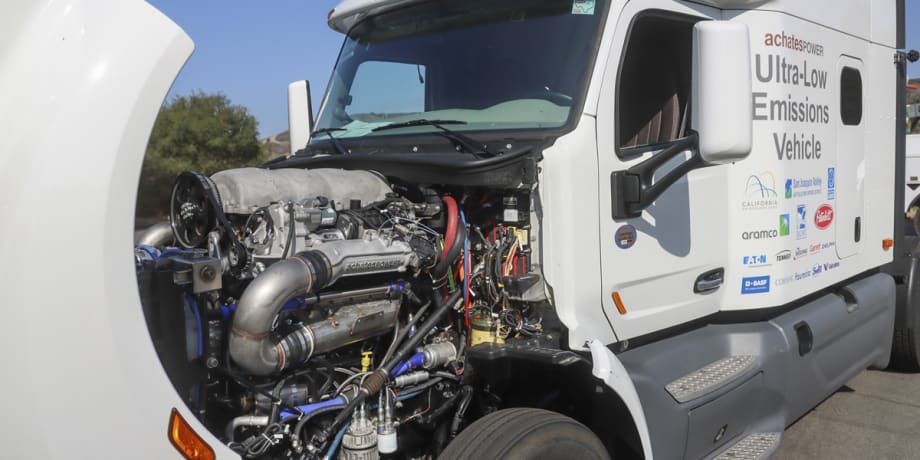
Achates Power’s heavy-duty opposed-piston diesel engine is the only diesel engine operating on the road capable of meeting CARB’s 2027 regulation.
File Photo: Achates Power
3 min to read
Achates Power’s cleaner, heavy-duty diesel engine it developed in a project funded by the California Air Resources Board and several partners has entered fleet service with Walmart in a Peterbilt 579 tractor.
The diesel engine meets CARB’s 2027 regulation, which requires a 90% reduction in emissions of nitrogen oxide compared to current standards.
The project team demonstrated that the heavy-duty opposed-piston diesel engine reduces carbon dioxide by 10%. The Achates Power ultra-low-NOx engine is engineered to achieve superior fuel efficiency because of its lower heat losses, improved combustion and reduced pumping losses, according to the company.
The cleaner engine is able to deliver ultra-low NOx by managing exhaust gas temperatures to ensure rapid catalyst light off and by maintaining aftertreatment temperatures at optimum operating conditions in all driving conditions.
“It is particularly noteworthy that we were able to achieve the extremely stringent state NOx limits without any additional emissions control devices, reducing cost, complexity, and compliance risk of ultralow NOx powertrain solutions,” said Dave Crompton, President and CEO of Achates Power.
Opposed-piston engines have two pistons per cylinder, facing each other, and a central combustion chamber. Explosive fuel burn pushes the pistons apart, and their connecting rods twist separate crankshafts at each end of the cylinder. Through pulleys and gears, the crankshafts transfer their power to a single output shaft. Ports in the cylinders allow entry of air and expulsion of exhaust gases, and pistons compress and fire every time they meet — a two-stroke design, made famous by General Motors and Detroit diesels starting in the 1930s. Advocates for the technology claim it is a simpler design that can deliver as much as a 30% improvement in fuel economy over conventional diesel engine configurations.
The technology has been touted as a possible alternative to conventional engine designs for years. Back in 2014, Achates first thought opposed-piston diesels were about five years away.
“Reducing emissions from heavy-duty vehicles is critically needed to clean the air,” said Wayne Nastri, executive officer of the South Coast Air Quality Management District. “This type of innovative, cleaner engine design is what we need not only here locally in the South Coast, but across the country to protect communities nationwide suffering from pollution associated with goods movement.”
The opposed-piston engine can use existing manufacturing facilities, processes, and materials to allow rapid time-to-market and deployment, according to the company. It also uses existing components and supply chains. It is expected to cost less than current engines, even as it meets much more stringent environmental regulations. It does not require any additional emissions control devices and has a reduced part count compared to conventional engines.
Achates Power is conducting further testing with a fully aged catalyst (the equivalent of 800,000 miles of operation) to demonstrate continued ability to meet CARB’s stringent standards.
Calstart leads the extensive demonstration project team, which includes Aramco Americas, BASF, Corning, Southwest Research Institute, Borg Warner, Eaton, Faurecia, Tenneco, Eberspaecher and SuperTurbo. In addition to CARB, the South Coast Air Quality Management District, San Joaquin Valley Air Pollution Control District, and the Sacramento Metro Air Quality Management District provided funding for the project.
More Equipment

How Volvo Updated Its D13 for EPA 2027 [Watch]
Volvo’s updated D13 promises lower emissions without sacrificing performance or fuel economy. Take a closer look at what changed inside the engine in this HDT Spotlight video.
Read More →
Michelin Tire Improves Efficiency and Durability for Regional Fleets
The Michelin X Multi Energy D2 is a regional haul drive tire engineered to help fleets improve fuel efficiency, durability and traction in demanding stop-and-go operations.
Read More →
ZF Expands Commercial Vehicle Push in North America
ZF is expanding its North American commercial-vehicle presence with new transmission applications, electrification, trailer technology and autonomous-driving systems.
Read More →
Tesla Wants a Self-Driving Semi. Are Cameras Enough?
Could Tesla’s camera-only autonomous driving technology work on an 80,000-pound Semi? In this commentary, HDT's Deborah Lockridge takes a look at Tesla, Cybercab, and how autonomous trucks see the road.
Read More →
Kodiak: Driverless Long-Haul Truck Launch on Track for 2026
Kodiak AI says its driverless long-haul safety case is 93% complete and it remains on track to begin commercial operations by year-end 2026.
Read More →
What DOT’s Automated Vehicle Strategy Means for Trucking
The U.S. Department of Transportation issued a new automated-vehicle strategy that outlines plans for driverless-truck regulations, cross-state freight corridors, and federal safety standards.
Read More →
East Coast Port Launches $45M Electric Truck Push
The Port Authority of New York and New Jersey announced millions in incentives for zero-emission drayage trucks, yard tractors, and new charging hubs near the port.
Read More →
PlusAI Going Public to Fund Autonomous Truck Launch
A SPAC deal could provide PlusAI with up to $300 million as it works toward a 2027 commercial launch of factory-built autonomous trucks.
Read More →
NHTSA Moves to Rewrite Truck Fuel-Economy Rules
The National Highway Traffic Safety Administration says it lacks authority to regulate medium- and heavy-duty truck engines separately from complete vehicles, but the existing standards have not yet been eliminated.
Read More →
Detroit Opens Orders for EPA 2027 Engines
Detroit isn’t starting from scratch to meet EPA 2027 diesel emissions standards. Its Gen 6 DD13 and DD15 engines keep much of today’s platform while updating the fuel and aftertreatment systems.
Read More →