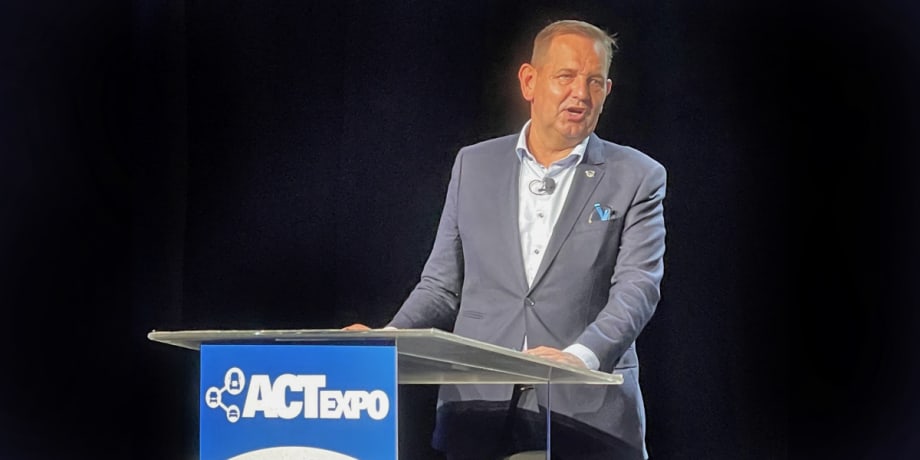
Citing a “sense of urgency,” Volvo Trucks took a leadership position in the fight against climate change at the 2021 Advanced Clean Transportation Expo, pushing for more adoption of zero-emission electric and hydrogen trucks.
There is a definite feeling in the air at the Advanced Clean Transportation Expo in Long Beach, California, this week. It’s not electricity, exactly. More like the feeling that electricity — or battery power, to be precise — has finally arrived in trucking.
For several years, OEMs and tech start-ups have been touting battery-powered trucks as a reliable alternative to gasoline- and diesel-powered trucks. But until now, it seemed those discussions were mostly theoretical and focused on a time that was always hovering just over the horizon.
Now, the sense in Long Beach is that that time has arrived.
Erik Neandross, CEO of Gladstein, Neandross and Associates, the company that owns and operates ACT Expo, opened the show the morning of Aug. 31 by speaking to attendees about the accelerating technology timeline for electric trucks, and concluded his session with a one-on-one discussion with Peter Voorhoeve, president and CEO of Volvo Trucks North America.
Voorhoeve said the Swedish truck maker is aggressively speeding up its electric truck initiatives. Citing a new “sense of urgency,” he said Volvo is committing to having a 100% zero-emissions product line of commercial vehicles by 2040.
Neandross started the discussion off by setting the stage of the electric truck movement as it stands in the closing months of 2021.
He noted that across North America, the regulatory front for electric trucks is ramping up quickly, citing a new internal engine combustion ban in Canada, which would also take effect in 2040.
“The second piece is the incredible commitments we’re seeing from by major corporations like Pepsi Cola, Amazon and Walmart, all of which are making huge commitments to move toward zero-emissions supply chains by 2050,” Neandross added.
Additionally, Neadross said, the massive amounts of investment money — billions and billions of dollars, now — can’t be ignored and is already showing results displayed in the new technology and products on display at the exhibition.
“In all, we’re seeing electric trucks starting to become a reality,” Neandross said. “This, to me, feels like the beginning of the end of the petroleum-based transportation era.”
Growing Transport Within the Boundaries of the Planet
Volvo’s Voorhoeve pointed out that the post-pandemic global economy is rebounding much faster than many experts predicted. Changing consumer buying patterns, spurred on by COVID-19 crisis, have created even more transportation demand over the past couple of years.
“The good news is there is now more demand for the services and products OEMs like Volvo offer,” Voorhoeve said. “At the same time, however, the resources on our planet are limited. The question now is, how do we grow more transportation for our industry and economies within the resource boundaries of our planet?”
Voorhoeve said Volvo was already stepping up to answer that question with real-world products and corporate commitments.
“By the year 2030, 35% of all new Volvo trucks built will be battery-electric vehicles,” he said. “And — since we all have a responsibility to take care of this planet and hand it over to our children, Volvo is also committing to building 100% zero emissions vehicle by 2040.”
Voorhoeve also noted a theme that would come to dominate ACT Expo 2021: the charging infrastructure issue that electric fleets now face.
“We have electric trucks today,” Voorhoeve said. “But electric charging infrastructure remains a significant challenge. As we shift away from diesel to zero emissions, Volvo is working with electric infrastructure providers to understand what the right kinds of charging equipment are, how much it costs to install those systems, route optimization for fleets and suitable locations to place charging stations.”
Noting that longer-haul routes would likely require hydrogen fuel cell technology in order to move to zero emissions, Voorhoeve said that Volvo Trucks and Daimler Truck partnered on founding a new company, called cellcentric, that is focusing on the development of hydrogen fuel cell technology for heavy trucks. Both Volvo and Daimler will have access to the new technologies once they are ready, with Voorhoeve adding that he expected to see the first prototype vehicles on the road before the close of this decade.
A larger question, Voorhoeve noted, is how the new electric vehicles on the road in Southern California can make the jump to having a more national and international presence across the U.S. and North America.
“We are ready to go national with our electric truck products now,” he said. “And we are working with our dealers — who play a very important role in all of this — to ready other U.S. states to prepare for zero-emissions vehicles. But not all states are ready to take these next steps. The issue is largely linked to the government incentives needed to help early customers move to electric trucks. And the fact is that incentives currently are very much based on the willingness of individual states to provide them.”
Voorhoeve said that like growing numbers of people, he agrees with scientists and other climate experts who note that climate change is not only real, but accelerating rapidly as more and more weather crisis events occur all over the planet.
“There is an awareness now that private companies have to step up to do something about this,” he said. “And Volvo is answering that call. It is very clear now that things are happening, and there is a sense of urgency now about the need to move to zero-emission trucks, buses and vans.”