




Mobile App Allows On-Site Fuel Contamination Testing
The Fuelstat Result mobile app allows users to verify fuel test results and create a report that can be immediately printed or emailed from the user’s phone or tablet.

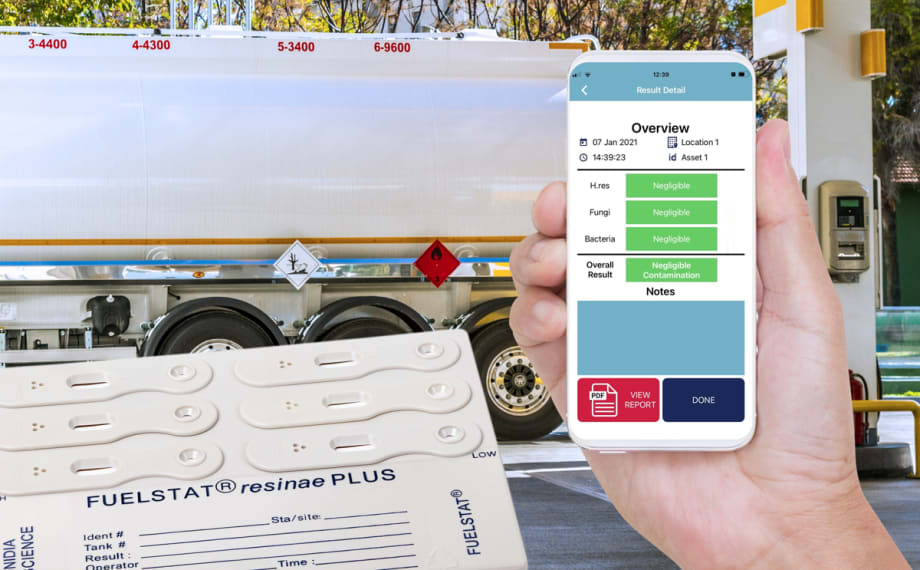
The Fuelstat Result mobile app allows users to verify fuel test results and create a report that can be immediately printed or emailed from the user’s phone or tablet.
Photo: Conidia
Conidia has launched a digital verification tool to improve the speed of on-site testing for microbial fuel contamination.
The Fuelstat Result mobile application allows operators to complete compliance testing on-site without paper and without the need to register. The app allows users to verify fuel test results and create a report that can be immediately printed or emailed from the user’s phone or tablet.
The app works alongside the Fuelstat test kit. Once samples have been taken and results are ready, the app uses the phone’s camera to read and interpret the results. The user lines up the test kit with the outline provided on screen. When aligned, the outline will turn green and the app will verify the results, giving a clear and instant indication of levels of microbial contamination within the fuel using a traffic light system. An additional alert will be given if the results are close to a threshold, giving the operator the information required to determine the next test interval.
The app further includes an integrated guide to using the test kit, taking the user through each stage step by step and automatically starting a 12-minute timer to notify when the results should be read. Even if the user moves away from the app to do other things, they will receive an alert notifying them they need to read the test results.
“From taking fuel samples to having the test report ready to send can be completed on site in as little as 15 minutes compared with sending samples to a laboratory, which can take up to 10 days,” said Myrsini Chronopoulou, research and development manager at Conidia, in a press release. “There are no special skills necessary and, even if the user is not familiar with the test process, the app will guide them.”
A record of the last 10 results is kept locally on the phone and the user can add information about location, asset and any additional notes. If the user chooses to register on the app, details of the user are automatically entered on the report and results are transferred to a secure portal to enable collaborative access. An image of the test results and actual readings are included and supervisors can review, identify any trends and add notes.
More Fuel Smarts
Electric Yard Tractors Move Beyond Pilots
Operating-cost savings have overtaken sustainability goals as the leading reason surveyed fleets are adopting battery-electric terminal tractors, according to new NACFE research.
Read More →
Geotab Links Fleet Card to Vehicle Data
The new card combines fuel discounts with telematics-based purchase controls. Geotab’s analysis also points to potential savings from choosing lower-priced fuel stops.
Read More →
Fleet Economics Shape Electric Truck Outlook
ACT Research expects costs, charging infrastructure, and technology improvements to drive zero-emission commercial vehicle adoption as federal regulations and incentives retreat.
Read More →

Wex Adds Cardless Fuel Payments for Over-the-Road Customers
A new fuel card feature for Wex customers offers convenience and security.
Read More →
New California Law Could Shed Light on Electric Truck Prices
Why do battery-electric Class 8 trucks remain so expensive? A California bill signed by Gov. Gavin Newsom would give fleets and state agencies more visibility into what manufacturers charge.
Read More →
How Volvo Updated Its D13 for EPA 2027 [Watch]
Volvo’s updated D13 promises lower emissions without sacrificing performance or fuel economy. Take a closer look at what changed inside the engine in this HDT Spotlight video.
Read More →
Diesel Price Spike Shortens Payback for Natural Gas Trucks, Report Says
Energy Vision estimates fleets could recover the higher purchase price of an RNG-fueled Class 8 tractor in 1.3 to 2.8 years under current fuel-price scenarios.
Read More →
Calstart Becomes Catalyst Mobility, Reflecting Broader Focus
Calstart is now Catalyst Mobility, reflecting the nonprofit’s growing national role in clean transportation, including zero-emission trucks, infrastructure and incentive programs.
Read More →
Record Diesel Prices Squeeze Trucking Fleets
Average U.S. diesel prices have climbed to nearly $6 a gallon, surpassing the 2022 record as tight refinery capacity and Middle East disruptions keep fuel costs elevated.
Read More →
How Fuel Delivery Shapes Engine Performance
Fuel delivery depends on more than what happens at the injector. For fleet, maintenance and technical professionals, looking at the full path from pump to injector can provide useful context for understanding engine performance.
Read More →