




Embark Pursues OEM Integration of Autonomous Tech, Rolls out Carrier Program
Embark is taking steps to commercialize its autonomous truck technology, making it easier for truck makers to integrate the system and setting up a development program with major trucking fleets.

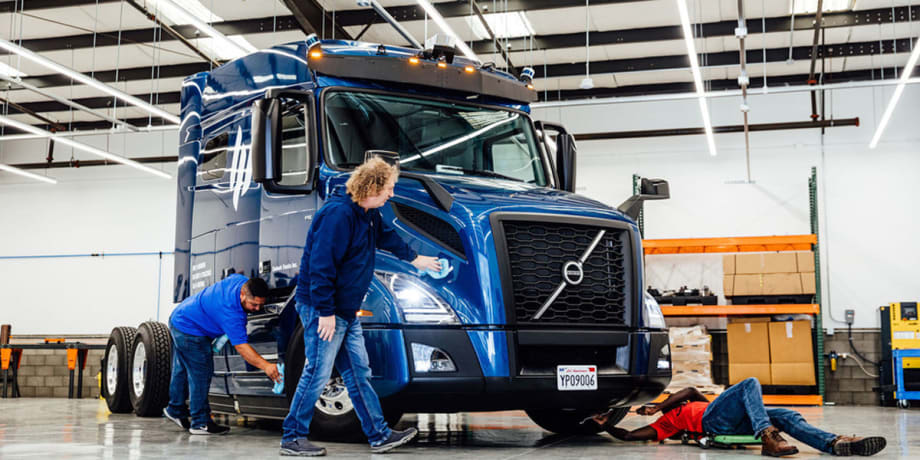
Embark aims to refine and scale the software and support services necessary to enable carriers to own and operate Embark-equipped OEM trucks.
Photo: Embark
Embark is taking steps to commercialize its autonomous truck technology, making it easier to integrate for truck makers and setting up a development program with several major trucking fleets.
The company announced it has created a set of standardized components and the interfaces necessary for major truck manufacturers to more easily integrate Embark's autonomous technology onto their vehicle platforms.
The launch of the Embark Universal Interface (EUI) makes the company the first autonomous developer to pursue integration with all four major U.S. OEMs, Embark officials said in a press release.
Instead of designing to a single OEM platform, Embark is building a universal system that is designed to integrate into any platform. The decision to work across platforms has required an “immense amount” of upfront investment and thoughtfulness around cross-platform trade-offs, officials said.
The EUI achieves its universality through a two-part design. Part one consists of a standardized components package – sensors and computer system. Part two of the EUI design is a set of physical, electrical, and software interfaces that enable the standardized components package to connect to and communicate with any OEM platform's steering, braking, throttle, telematics, power, chassis and HVAC systems.
Embark's long-term vision is for OEMs to integrate Embark's technology with their truck platforms, which the OEMs will then sell with the maintenance and warranty support carriers demand.
"We absolutely believe that integrating with OEMs is the path to market for self-driving trucks," said Alex Rodrigues, co-founder and chief executive officer of Embark, in a release. "We also believe that being cross-compatible and easy to integrate into all OEM's vehicles as their Level 4 [autonomous] platforms continue to develop gives us a competitive advantage."
Werner, MVT, Bison to Test Autonomous Tech
Embark has also launched a Partner Development Program with Werner Enterprises, Mesilla Valley Transportation and Bison Transport. The carriers with work with Embark on testing and refining its autonomous trucking technology.
Through this program, Embark aims to refine and scale the software and support services necessary to enable carriers to own and operate Embark-equipped OEM trucks on select freight lanes.
As part of the program, carriers will work alongside Embark to test and refine various facets of the overall operating model, including remote vehicle monitoring, vehicle maintenance procedures, teleoperations, autonomous vehicle dispatching rules, and transfer hub logistics.
Embark’s software offerings include Embark Driver, a per-mile software license that can navigate a carrier-owned, Embark-equipped OEM truck from its origin to destination. Embark also will provide carriers an autonomous fleet management solution, Embark Guardian, that provides remote vehicle monitoring, dispatching, and access to real-time data such as weather and construction.
Together, Embark Driver and Embark Guardian will enable carriers to deploy and manage a fleet of autonomous trucks within their existing networks, Embark officials said.
"Embark's commitment to having carriers purchase and operate our autonomous trucks, while Embark provides a software subscription and support services, is a win-win because it leverages the logistical expertise of the carrier, allows the technology to scale more quickly through existing shipper-carrier relationships and enables Embark to focus on delivering a safe and reliable autonomous truck," said Rodrigues. "The learnings Embark has gained from hundreds of hauls with shippers and carriers over the years has helped us shape this new business model, and we are excited to announce it today."
In addition to preparing carriers to operate autonomous trucks, the program is engaging OEMs, real estate developers, and maintenance providers to coordinate the set of products and services carriers will need to operate a nationwide network of autonomous freight lanes, according to the company.
More Equipment

How Volvo Updated Its D13 for EPA 2027 [Watch]
Volvo’s updated D13 promises lower emissions without sacrificing performance or fuel economy. Take a closer look at what changed inside the engine in this HDT Spotlight video.
Read More →
Michelin Tire Improves Efficiency and Durability for Regional Fleets
The Michelin X Multi Energy D2 is a regional haul drive tire engineered to help fleets improve fuel efficiency, durability and traction in demanding stop-and-go operations.
Read More →
ZF Expands Commercial Vehicle Push in North America
ZF is expanding its North American commercial-vehicle presence with new transmission applications, electrification, trailer technology and autonomous-driving systems.
Read More →
Tesla Wants a Self-Driving Semi. Are Cameras Enough?
Could Tesla’s camera-only autonomous driving technology work on an 80,000-pound Semi? In this commentary, HDT's Deborah Lockridge takes a look at Tesla, Cybercab, and how autonomous trucks see the road.
Read More →
Kodiak: Driverless Long-Haul Truck Launch on Track for 2026
Kodiak AI says its driverless long-haul safety case is 93% complete and it remains on track to begin commercial operations by year-end 2026.
Read More →
What DOT’s Automated Vehicle Strategy Means for Trucking
The U.S. Department of Transportation issued a new automated-vehicle strategy that outlines plans for driverless-truck regulations, cross-state freight corridors, and federal safety standards.
Read More →
East Coast Port Launches $45M Electric Truck Push
The Port Authority of New York and New Jersey announced millions in incentives for zero-emission drayage trucks, yard tractors, and new charging hubs near the port.
Read More →
PlusAI Going Public to Fund Autonomous Truck Launch
A SPAC deal could provide PlusAI with up to $300 million as it works toward a 2027 commercial launch of factory-built autonomous trucks.
Read More →
NHTSA Moves to Rewrite Truck Fuel-Economy Rules
The National Highway Traffic Safety Administration says it lacks authority to regulate medium- and heavy-duty truck engines separately from complete vehicles, but the existing standards have not yet been eliminated.
Read More →
Detroit Opens Orders for EPA 2027 Engines
Detroit isn’t starting from scratch to meet EPA 2027 diesel emissions standards. Its Gen 6 DD13 and DD15 engines keep much of today’s platform while updating the fuel and aftertreatment systems.
Read More →