




Buttigieg: Fuel Tax Not a Long-Term Funding Solution
Transportation Secretary Pete Buttigieg spoke about the Federal Highway Trust Fund and climate change during his keynote address at the American Association of State Highway and Transportation Officials’ Washington Briefing.

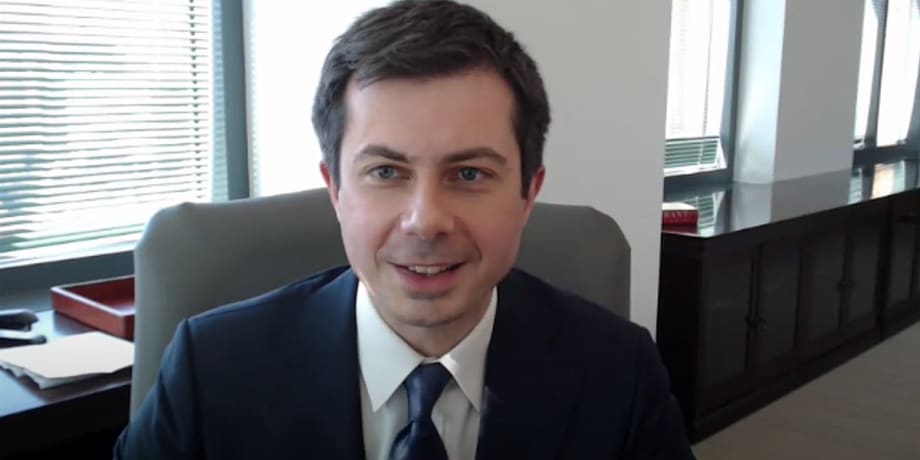
U.S. Department of Transportation Secretary Pete Buttigieg gave the keynote address at the American Association of State Highway and Transportation Officials’ annual Washington Briefing.
Screenshotof AASHTO Washington Briefing Recording
Department of Transportation Secretary Pete Buttigieg said he doesn’t believe the Biden administration will put energy into the federal fuel tax as a long-term solution for funding transportation and infrastructure.
“What we do know is that we've got to come up with revenue,” Buttigieg said Feb. 25 during a virtual keynote address at the American Association of State Highway and Transportation Officials’ annual Washington Briefing.
When answering a question about the Highway Trust Fund, Buttigeg acknowledged that it hasn’t been fully solvent the way government officials want it to be since 2008.
Buttigieg suggested that a vehicle road usage assessment would be necessary, and that the DOT would be very open-minded.
“What we know is that it's got to be sustainable, that it’s got to be predictable,” he said. “And in an evolving transportation system, you've got to set it up in a way that's affordable and doesn't place unfair burdens on low income population or on rural areas where residents may need to drive more frequently.”
The secretary also reiterated his commitment to combating climate change.
“We know that the transportation sector is the largest source of greenhouse gas emissions," he said. "That also means it's the largest place where we can be part of this. That's why we'll be acting at the DOT to achieve outcomes. And we know that we will be measured in how we achieve those outcomes."
He added: “We need to create a network that meets the less pollution [goals], that is more resilient for the challenges that climate change is already laying at our feet. And we've got to take the opportunity to transform our deteriorating infrastructure into a 21st-century system that creates more of those opportunities and accelerates equitable growth, and critically increases the global competitiveness of our country at a moment when there's no time to lose."
Committment to a Zero-Emission Future
Buttigieg also recently released a joint statement with the Canadian Transportation Minister committing to cooperate in a fight against climate change and to limit the environmental impacts of their transportation networks.
The statement was released in support of the ‘Roadmap for a Renewed U.S.-Canada Partnership,’ a blueprint that outlines the countries’ commit toward a zero-emission vehicle future through ambitious vehicle standards to improve fuel efficiency and reduce greenhouse gases from light- and heavy-duty vehicles.
“We intend to work together to help accelerate the achievement of 100% zero-emission vehicle sales for light-duty vehicles and increase the supply of and demand for zero-emission medium- and heavy-duty vehicles,” according to the joint statement.
The roadmap also calls for the countries to explore best practices on how to help incentivize the installation of electric charging stations and refuelling stations for clean fuel.
More Fuel Smarts

FlowBelow Redesigns Trailer AeroSlider to Cut Fuel Use
The lighter trailer aerodynamic system installs in less than 45 minutes, according to the company, with potential payback in under a year depending on fuel prices and trailer mileage.
Read More →
Why Diesel Price Relief Efforts May Fall Short
Diesel prices have eased from September’s record high, but doubts about additional Russian supply and limits on dyed-diesel tax relief mean trucking fleets still face expensive fuel. And prices could go higher.
Read More →
Why Small Fuel Savings Matter in Trucking
Can better fuel economy help pay for driver raises? In this podcast, GP Transco explains how small efficiency gains create room to reinvest in its people.
Read More →
How GP Transco Cuts Trucking Fuel Costs, a Tenth of a Gallon at a Time
What’s another tenth of a mile per gallon worth? GP Transco shares how equipment upgrades and driver coaching turn small gains into meaningful fuel savings.
Read More →
Electric Yard Tractors Move Beyond Pilots
Operating-cost savings have overtaken sustainability goals as the leading reason surveyed fleets are adopting battery-electric terminal tractors, according to new NACFE research.
Read More →
Geotab Links Fleet Card to Vehicle Data
The new card combines fuel discounts with telematics-based purchase controls. Geotab’s analysis also points to potential savings from choosing lower-priced fuel stops.
Read More →
Fleet Economics Shape Electric Truck Outlook
ACT Research expects costs, charging infrastructure, and technology improvements to drive zero-emission commercial vehicle adoption as federal regulations and incentives retreat.
Read More →
Wex Adds Cardless Fuel Payments for Over-the-Road Customers
A new fuel card feature for Wex customers offers convenience and security.
Read More →
New California Law Could Shed Light on Electric Truck Prices
Why do battery-electric Class 8 trucks remain so expensive? A California bill signed by Gov. Gavin Newsom would give fleets and state agencies more visibility into what manufacturers charge.
Read More →
How Volvo Updated Its D13 for EPA 2027 [Watch]
Volvo’s updated D13 promises lower emissions without sacrificing performance or fuel economy. Take a closer look at what changed inside the engine in this HDT Spotlight video.
Read More →