




C.A.T.’s Natural Gas Trucks Get Boost with Hyliion E-axles
C.A.T. Transport is taking a new step in its natural gas propulsion approach, as the company’s first hybrid truck recently hit the road.
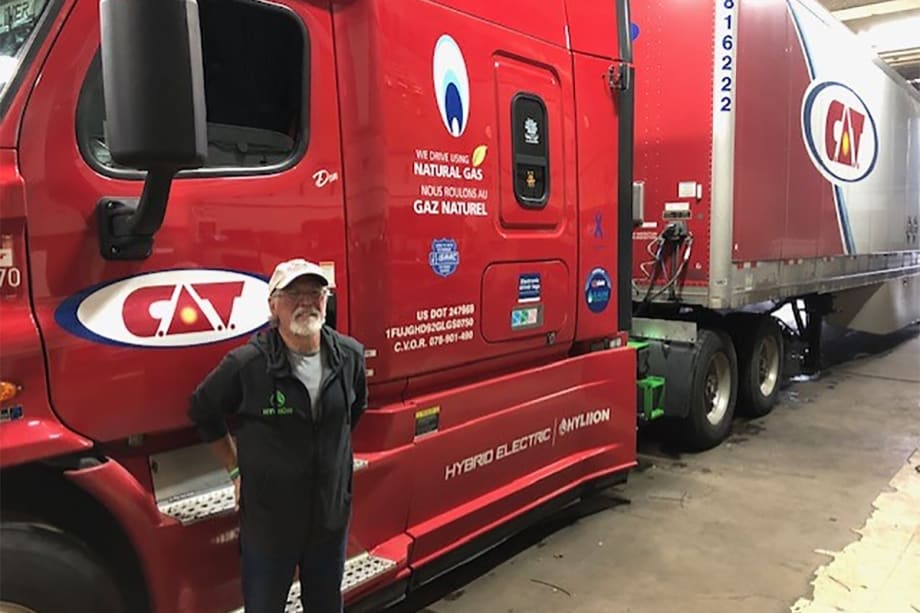
Photo: C.A.T.
C.A.T. Transport is taking a new step in its natural gas propulsion approach, as the company’s first hybrid truck recently hit the road.
The Freightliner Cascadia, already powered by a Cummins ISX 12G compressed natural gas (CNG) engine, has had the addition of Hyliion’s CNG hybrid solution, which includes an 8 kWh battery, a 120 hp/1,500 lb.-ft. electric axle, and a thermal management system. The hybrid system can be installed on most heavy Class 8 natural gas vehicles. The electric axle is said to provide more power for natural gas vehicles to help with big hills and heavy loads.
The Hyliion system caught the attention of Daniel Goyette, CEO of C.A.T., at a show held in California three years ago. Hyliion representatives, whose system was initially aimed at diesel trucks, later visited C.A.T. and realized that the benefits could possibly be even greater with natural gas trucks as a hybrid system.
In 2014, C.A.T. announced its intention to convert its fleet to CNG and signed a long-term lease agreement with Ryder.
“The drawbacks that we have seen, what the drivers criticized CNG trucks for, is lacking in power. Also, the return on investment did not allow the installation of auxiliary on-board units. We found that these trucks idled a lot, and that was damaging to those engines that use a spark plug for ignition. Finally, the fact that the engine was more subject to (overworking) on a hill increased the internal heat,” explains Goyette.
Hyliion’s product prevents the engine from working too hard on hills and provides additional power on demand. Software is used to store energy when the vehicle rolls on flat terrain or down a hill. The system also includes an auxiliary power unit, at the heart of which are additional batteries providing up to 12 hours of cabin cooling, eliminating engine idling.
“All of this together gives us the added value we lacked in these trucks,” says Goyette.
Initially, C.A.T. intends to equip five trucks with the Hyliion hybrid system in order to evaluate its performance.
“If things are going well, the goal would be to equip the 100 or so trucks in the fleet. It all depends on the results that the product will give,” says Goyette.
The additional cost of the Hyliion hybrid system is some CDN$40,000. The CEO of C.A.T. hopes that the technology will be approved under the Quebec Ecocamionnage subsidy program. He also hopes to extend the lifespan of trucks equipped with this technology by three years. They will continue to serve the same routes, namely Quebec, Ontario and Texas.
CAT is also interested in Hyliion’s Hypertruck ERX solution, a fully electric Class 8 truck powertrain that recharges itself while traveling, using a downsized natural gas generator.
Steve Bouchard is the editor of Quebec's leading French-language trucking magazine, Transport Routier. This article appears under a cooperative editorial sharing agreement between HDT and Transport Routier parent company Newcom Media, which also publishes Today's Trucking and other business-to-business titles.
More Fuel Smarts

Wex Adds Cardless Fuel Payments for Over-the-Road Customers
A new fuel card feature for Wex customers offers convenience and security.
Read More →
New California Law Could Shed Light on Electric Truck Prices
Why do battery-electric Class 8 trucks remain so expensive? A California bill signed by Gov. Gavin Newsom would give fleets and state agencies more visibility into what manufacturers charge.
Read More →
How Volvo Updated Its D13 for EPA 2027 [Watch]
Volvo’s updated D13 promises lower emissions without sacrificing performance or fuel economy. Take a closer look at what changed inside the engine in this HDT Spotlight video.
Read More →

Diesel Price Spike Shortens Payback for Natural Gas Trucks, Report Says
Energy Vision estimates fleets could recover the higher purchase price of an RNG-fueled Class 8 tractor in 1.3 to 2.8 years under current fuel-price scenarios.
Read More →
Calstart Becomes Catalyst Mobility, Reflecting Broader Focus
Calstart is now Catalyst Mobility, reflecting the nonprofit’s growing national role in clean transportation, including zero-emission trucks, infrastructure and incentive programs.
Read More →
Record Diesel Prices Squeeze Trucking Fleets
Average U.S. diesel prices have climbed to nearly $6 a gallon, surpassing the 2022 record as tight refinery capacity and Middle East disruptions keep fuel costs elevated.
Read More →
How Fuel Delivery Shapes Engine Performance
Fuel delivery depends on more than what happens at the injector. For fleet, maintenance and technical professionals, looking at the full path from pump to injector can provide useful context for understanding engine performance.
Read More →
East Coast Port Launches $45M Electric Truck Push
The Port Authority of New York and New Jersey announced millions in incentives for zero-emission drayage trucks, yard tractors, and new charging hubs near the port.
Read More →
Detroit Opens Orders for EPA 2027 Engines
Detroit isn’t starting from scratch to meet EPA 2027 diesel emissions standards. Its Gen 6 DD13 and DD15 engines keep much of today’s platform while updating the fuel and aftertreatment systems.
Read More →
Zero-Emission Truck Corridor Planned for West Coast
California, Oregon, Washington, British Columbia and Baja California are coordinating plans for truck charging and hydrogen fueling from Canada to Mexico.
Read More →