




Yokohama Celebrates Launch of U.S. Truck Tire Production
The first Yokohama tire plant—which will exclusively produce truck and bus tires-- built in the U.S. from the ground up is now up and running, a scant two years after the company broke ground on a greenfield site within Mississippi’s Golden Triangle business-development region.

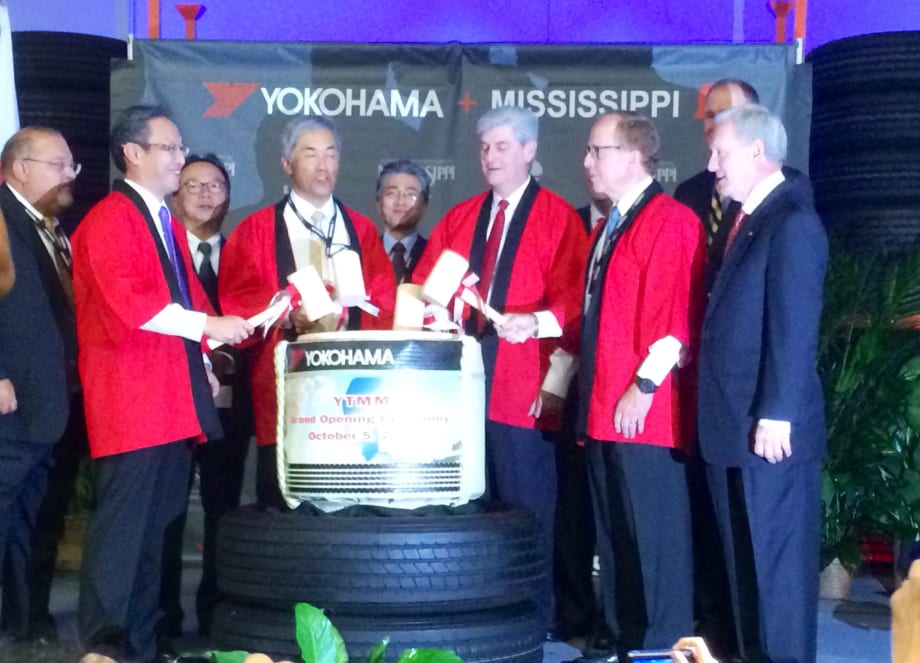
Government and company officials take part in a traditional Japanese ceremony at grand opening of new Yokohama truck-tire plant in West Point, Miss. Photo: David Cullen

Government and company officials take part in a traditional Japanese ceremony at grand opening of new Yokohama truck-tire plant in West Point, Miss.Photo: David Cullen
The first Yokohama tire plant—which will exclusively produce truck and bus tires-- built in the U.S. from the ground up is now up and running, a scant two years after the company broke ground on a greenfield site within Mississippi’s Golden Triangle business-development region.
The company celebrated that feat with grand opening ceremonies at the facility on Oct. 5. Attending were over 300 persons, including delegations of state and local officials headed by Gov. Phil Bryant (R) and company officials led by Hikomitsu Noji, President and Representative Director of Japan-based parent firm, Yokohama Rubber Co., Ltd.
It was noted by company executives that Noji’s presence at the event underscored the importance of the new plant to growing the tire maker’s presence in the North American truck-tire market.
“It is no longer sufficient to source tires from existing plants around the world,” Noji said at a news conference held ahead of the grand opening. He explained that the tire maker is projecting continued growth for truck tires in North America and said the company had determined that the necessary “supply will have to come from where our customers are."
Producing truck tires in the U.S. indicates that Yokohama is “committed to the commercial market,” said Takaharu Fushimi, CEO of Yokohama Corp. of North America (YCNA) and Yokohama Tire Corp. (YTC). “What this modern plant means to our customers is they will get what they want when they want it.”
“We’re in a very healthy market environment for trucking, especially in terms of Class 8 truck growth,” observed Rick Phillips, Vice President of Sales for YTC. “We’re seeing the demand for long-lasting, fuel-efficient tires increasing.”
Along with meeting rising demand, producing truck tires stateside will slash shipment time to dealers and customers, he pointed out. “Our speed to market is going to improve greatly, with our lead time going from months to just days by manufacturing here” instead of overseas.
Phillips also said that building tires in Mississippi will “give us a lot more flexibility to adapt to changes in the market quickly.”
Currently, most of the commercial truck tires Yokohama sells in North America are sourced from its plant in Thailand. Some production is drawn from Japan as well as from the GTY Tire Co. plant in Mount Vernon, Ill., that was set up back in 1988 to jointly produce General, Toyo and Yokohama truck tires. Production of Yokohama tires at that plant will “draw down as production at our new plant here ramps up,” Fred Koplin, YTC’s Senior Director of Marketing & Motorsports, told HDT.
Koplin also advised that the genesis for the new plant dates back to 2008, when Yokohama “projected sales and manufacturing capacity out to 2017— there then was the recognition that this [plant] had to be done.” He also told HDT that while Yokohama “does not release [sales] figures, the company could be said to be a ‘tier one-and-a-half’ supplier of truck tires in the U.S.”

Mississippi Gov. Phil Bryant, Takaharu Fushimi, CEO of Yokohama Corp. of North America & Yokohama Tire Corp., Tadaharu Yamamoto, president of YTMM, and Hikomitsu Noji, president of Yokohama Rubber Co., Ltd., pose with the first tire produced at the company’s new U.S. plant. Photo: Yokohama
The plant, which is operated by Yokohama Tire Manufacturing Mississippi (YTMM), houses manufacturing, warehousing and operations facilities and represents a $300-million investment to date.
Sited on over 500 acres of what Gov. Bryant characterized as “pastureland” in West Point, Miss., the one-million square foot plant is slated to produce one-million truck and bus tires annually— primarily in 22.5- and 24.5-inch sizes-- by the time it is fully ramped up in 2018. By then, it will employ 500; currently more than 260 associates are on board.
Those figures pertain only to the current “Phase 1” configuration of the plant. Company officials explained that the plant can be expanded with up to three additional phases, which could ultimately quadruple production and employment.
The YTTM location in eastern Mississippi’s Clay County was ultimately chosen by Yokohama after a year-long search in 2012 that looked at sites in over 3,000 counties in the Lower 48. In April 2013, the Mississippi Legislature approved an inital $70 million package to assist wth the purchase of the site, site preparation, infrastructure needs and workforce training.
A groundbreaking ceremony was held in West Point on Sept. 23, 2013. The installation of production machinery began in 2014. By this March, construction was nearly completed and the first production tire rolled out of the plant on April 21— roughly six months ahead of schedule.
“The grand opening of our first U.S.-built plant is truly a historic day for Yokohama,” said Tadaharu Yamamoto, president of YTMM. “Thanks to Gov. Bryant, the great state of Mississippi, the entire community of West Point, the Golden Triangle Region and the incredible Mississippi workforce, the plant site was developed to a fully operational state-of-the-art facility in record time.”
“The opening of Yokohama’s manufacturing facility in West Point brings full circle a project that broke ground just two short years ago,” Gov. Bryant said. “I appreciate the Yokohama team, the Mississippi Legislature and state and local officials who have worked hard from day one to expedite this project and create so many jobs for the residents of West Point and the Golden Triangle region.”
The grand opening concluded in high spirits with government and company officials participating in a traditional Japanese Kagami Baraki “saki-barrel opening” ceremony.
More Fleet Management

Public Wi-Fi Cybersecurity Risks: How Truck Drivers and Fleets Can Protect Their Data
Public Wi-Fi can expose truck drivers and fleets to credential theft, malware, and other cyber threats. Here’s how to reduce the risk on the road.
Read More →
For Nicky Cupp, Fleet Innovation Starts With Frustration
HDT Truck Fleet Innovator Nicky Cupp turns everyday pain points at Fraley & Schilling into opportunities for better technology and smarter processes.
Read More →
Adam Buttgenbach’s Approach to Electric Trucks: Start With Where They Fit
HDT Truck Fleet Innovator Adam Buttgenbach helped PepsiCo build one of North America’s largest EV fleets by focusing on where electric trucks make operational sense.
Read More →
Deen Albert: Let Automation Do the Math, People Make the Decisions
HDT Truck Fleet Innovator Deen Albert makes sure people are still at the heart of operations at Grand Island Express, even while adopting artificial intelligence tools. AI-assisted dispatch helped boost revenue 25% with the same number of trucks.
Read More →
Trimble’s New AI Agent Takes Aim at Fleet Back-Office Busywork
Arc Agent works across Trimble TMS products to automate repetitive tasks such as freight orders, maintenance, invoices, fuel costs and more.
Read More →
How HDT’s 2026 Truck Fleet Innovators Are Rethinking Fleet Operations
Meet five trucking leaders who are challenging assumptions, solving operational problems, and putting innovative ideas to work.
Read More →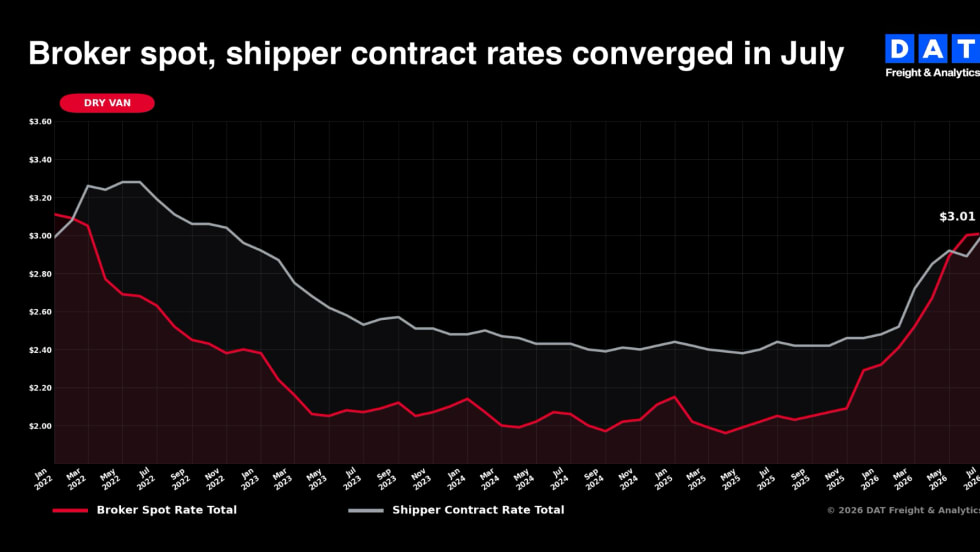
Tight Trucking Capacity Pushes Rates Higher Even as Freight Volumes Fall
“Spot rates moving ahead of contract rates have historically signaled a tightening market, but we haven’t seen a capacity-driven market quite like this one,” said DAT's Dean Croke.
Read More →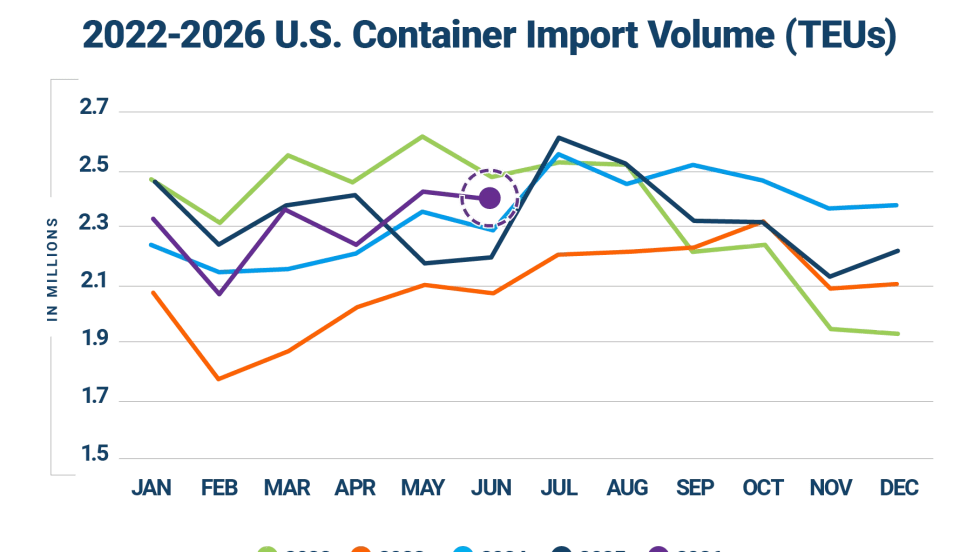
Import Cargo’s Early Peak Season is Winding Down
There was an early start to peak season this year at the nation's gateway ports, as retailers brought in merchandise ahead of tariff changes in late July and responded to other supply chain uncertainties,
Read More →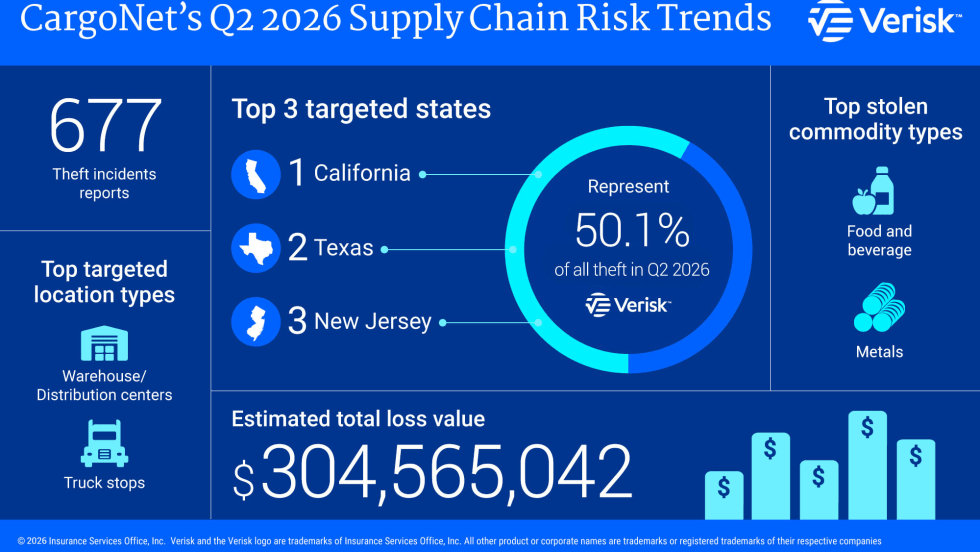
Fewer Cargo Thefts, Bigger Losses: Criminals Target Higher-Value Loads
CargoNet says organized theft rings are stealing fewer shipments but choosing more valuable freight, including metals and technology, resulting in record losses.
Read More →
How Innovative Trucking Leaders Turn Change Into an Advantage
As the pace of change accelerates in trucking, the fleets that adapt best have more than the latest technology. They have cultures that embrace improvement.
Read More →