





Related: FTR Ups Class 8 Truck and Trailer Forecasts for 2019
Will Truck Sales Momentum Continue Through 2019?
Despite an overall positive truck sales forecast for 2019, tariffs and trade wars could be stumbling blocks that trip up the economy and send freight and truck sales downward, said two longtime industry analysts.
November 9, 2018
Credit:
Slide courtesy FTR
4 min to read
Tariffs and trade wars could be stumbling blocks that trip up the economy and send freight and truck sales downward, according to two longtime industry analysts.
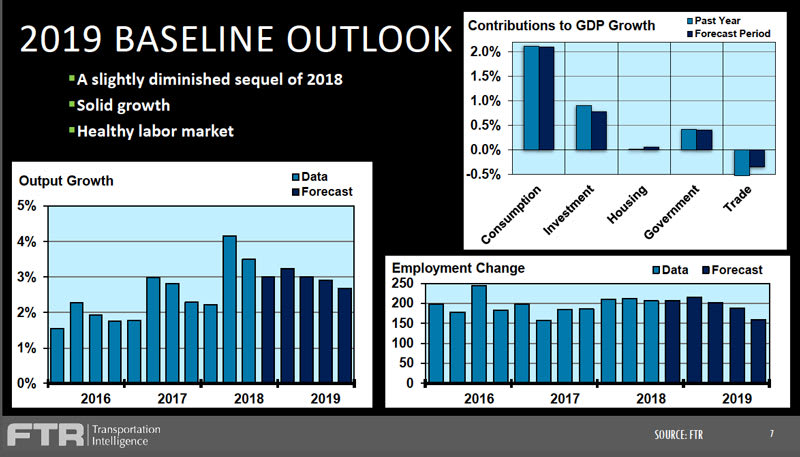
Although FTR recently upped its 2019 Class 8 truck and trailer forecasts, in a State of Freight webinar looking at potential risks for next year, FTR senior economist Bill Witte noted that he’s changed his terminology from “potential” trade war with China to “continuing” trade war with China.
“I think one of the things about the trade situation is it’s creating a lot of uncertainty, and uncertainty by itself is a negative, and a strong negative,” Witte said. He believes that trade policy and the resulting uncertainty is keeping the corporate tax cuts from having as much of a stimulative effect as history might predict. “Business investment in things like equipment is not as strong as my model thinks it should be,” he said, saying he believes uncertainty about trade policy is causing businesses to be cautious.
“Trade wars are like shooting yourself in the head,” Witte said. “It usually doesn’t turn out too well.”
In an interview, ACT Research President and Senior Analyst Kenny Vieth also cited tariffs as one reason his company issued a news release saying it is not raising its forecasts for 2019. He told HDT the firm is leaving its Class 8 production expectations around 335,000.
FTR raised its North American Class 8 truck factory shipments forecast to 350,000 units, for a year-over-year increase of 8%, but Vieth told HDT that while ACT expects “2019 is going to be the best year since 2006, we’re as yet unwilling to take the forecast up to its logical conclusion.”

Kenny Vieth, ACT Research president and senior analyst
Photo courtesy ACT Research
In a statement, Vieth said, “Given indications of moderating freight activity and the unknown aspects of trade policy, we are maintaining heavy vehicle forecasts near current levels.”
September marked the second consecutive month of moderating freight-related industry metrics, and early indications suggest the trend continued in October, according to ACT Research’s latest release of the ACT North American Commercial Vehicle Outlook.
“This is not to suggest that the market is poised for a near-term rollover, but it does appear that forward momentum is slowing,” said Vieth. “Continued strength in freight markets is necessary to support the significant Class 8 population growth expected in 2019.”
Vieth explained that ACT thinks caution may be warranted: “We are on the cusp of significant capacity additions coming online as today’s orders are converted into tomorrow’s capacity, so the rate of freight growth is a critical factor when considering cycle longevity.”
On top of that, he told HDT, “you’ve got the trade situation, and I think uncertainty on how that’s going to play out. And if you’re looking at tariffs on $200 billion of Chinese goods going from 10% to 25% and perhaps more Chinese goods being subject to tariffs, it would make 2019 a less robust environment for freight.”
Both Witte and Vieth suggested that there’s enough momentum in the economy to take current levels of freight and truck sales through at least the first half of next year.
"My model is that 2019 is essentially going to be a sequel of 2018," Witte said in the webinar – with two caveats.
"One, sequels are almost never as good as the original. Two, more uncertainties.
"The reason I think next year will be similar is the economy has a lot of momentum right now, and that will carry us through at least the first part of the year," he continued. "Things could get a little dicey after that, but my best bet is we're going to have another pretty good year in the economy."
Some of the other potential risks Witte cited include:
Significantly higher or significantly lower oil prices. If prices are too high, that's inflationary and a drag on consumer spending. If they're too low, it hurts the U.S. oil industry.
If Congress can't reach a deal on a budget, as government shutdowns are bad for sentiment and the overall economy.
Trouble in the financial markets, which have been turbulent this year.
More Fleet Management

Sponsored•September 16, 2026
Color Match Smarter: Tools That Restore & Perform
For fleet managers and collision repair professionals keeping heavy-duty trucks on the road, getting the color right the first time isn't just about appearance — it's about efficiency, turnaround time, and bottom-line results. Discover how today's digital color tools are transforming the repair process from guesswork to precision.
Read More →
FMCSA Pauses Biennial-Update Enforcement Amid Motus Transition
Carriers whose updates were due on or after June 1 have more time, while FMCSA works to stabilize its new registration system and warns of phishing sites impersonating its new carrier registration system, Motus.
Read More →
Sponsored•September 14, 2026
2026 Blueprint for Countering Smarter Supply Chain Theft
Cargo theft is no longer just the cost of doing business. It's a multi-billion-dollar criminal enterprise exploiting vulnerabilities across your fleet, drivers, and supply chain.
Read More →


Sponsored•September 1, 2026
How Telematics Improves Visibility, Control, and Performance in Refrigerated Fleets
Explore how telematics help refrigerated fleets improve visibility, uptime, efficiency, compliance, and cargo protection across connected cold chain operations.
Read More →
What the U.S.-Canada Trade War Means for Trucking
Escalating U.S.-Canada tariffs could disrupt cross-border freight, reduce truck volumes, raise costs, and create new uncertainty for carriers on both sides of the border.
Read More →
What Are Trucking’s Top Concerns for 2026?
The American Transportation Research Institute wants to know what's worrying trucking fleet managers, drivers, and other stakeholders in its annual Industry Issues survey.
Read More →
American Trucking Associations Looks for a New Leader
ATA President and CEO Chris Spear abruptly left his job at the association on August 21, at a pivotal time for the trucking industry.
Read More →
Public Wi-Fi Cybersecurity Risks: How Truck Drivers and Fleets Can Protect Their Data
Public Wi-Fi can expose truck drivers and fleets to credential theft, malware, and other cyber threats. Here’s how to reduce the risk on the road.
Read More →
For Nicky Cupp, Fleet Innovation Starts With Frustration
HDT Truck Fleet Innovator Nicky Cupp turns everyday pain points at Fraley & Schilling into opportunities for better technology and smarter processes.
Read More →
Adam Buttgenbach’s Approach to Electric Trucks: Start With Where They Fit
HDT Truck Fleet Innovator Adam Buttgenbach helped PepsiCo build one of North America’s largest EV fleets by focusing on where electric trucks make operational sense.
Read More →