




Why This Economic Cycle is Different for Trucking
A recession during the first half of 2023 is looking more likely, but the unusual nature of this economic and trucking cycle should help keep trucking from feeling the brunt of it.

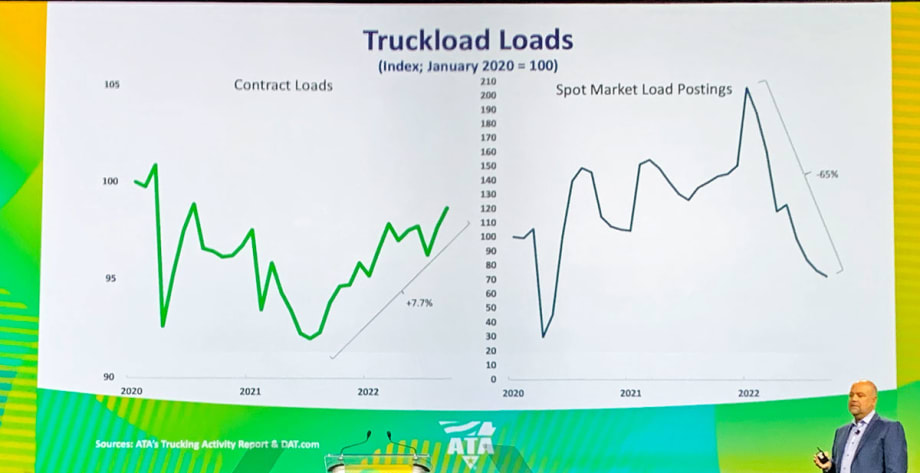
The truckload market is shifting back to a more normal split between the spot market and contract freight.
Photo: Deborah Lockridge
A recession during the first half of 2023 is looking more likely, but the unusual nature of this economic and trucking freight cycle should help keep trucking from feeling the brunt of it, according to an update on the economy at the American Trucking Associations’ Management Conference and Exhibition in San Diego Oct. 25.
The Macroeconomic Picture: Unprecedented Global Synchronization
Looking at the global economy through a banking and investment lens, Tom Joyce, managing director and global head of investment banking capital market strategy, Mufo Bank, said a unique aspect of this economic cycle is synchronicity.
“Every major economy in the world is slowing at the same time,” he said. And we likely haven’t seen the bottom of it yet.
Inflation, too, is affecting the world’s major economies, and governments and banks are using fiscal policy to try to slow it at a pace he has never seen in his career.
Monetary policy works with a lag, he explained. You don’t feel the full effects of an increase in interest rates until about six months later. “I think early next year we’ll see the impact of bank tightening, energy prices, and the maximum impact of peak inflation. The consumer can handle high inflation for a handful of months but it’s harder for 12 to 18 months, and that’s where we are.”
“I do believe the global and U.S. economy is going into recession in the first half of next year,” he said. It’s happening in Europe and the UK already, because the Russia-Ukraine war is having a more direct effect there.
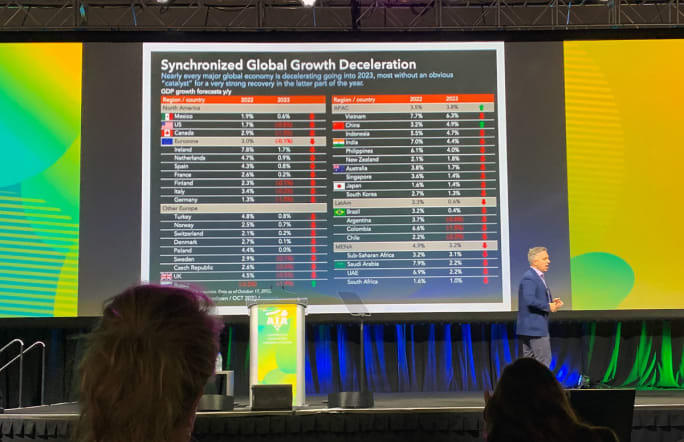
The global economy is more synchronized than in the past, said Mufo Bank's Tom Joyce.
Photo: Deborah Lockridge
Joyce also stressed that recessions are reasonably rare. “And more rare than a U.S. recession is a global recession. We’ve had only six since World War II. I think it will be mild for the global economy and we hope for the U.S., and a deeper one for Europe and the U.K.”
He predicted the low point would be in the next six to nine months. Even though the economic decline has been largely synchronized across the globe, he said, the recovery will be desynchronized, with some economies coming back sooner than other.
“I think we’re going to have a desynchronized recovery in the latter part of next year. But the U.S. is more resilient (so should come back sooner).”
A 'Really Different' Trucking Cycle
“Every cycle’s different, but this one’s really different,” said ATA Chief Economist Bob Costello. Costello also predicted that we will have a mild recession early next year, with the U.S. likely to fare better than many other economies — trucking even more so. “I think there are some unique things going on in our industry that will isolate many of us in this room,” he said, although smaller fleets will likely have a harder time.
While there has been a lot of attention to how the spot market has fallen this year, Costello said in reality it’s about returning to a more typical balance between the spot market and the contract market rather than a freight recession.
“I’ve been hearing people talk about how the truck freight market is collapsing,” he said. “Lets’ go back to 2020 and 2021.”
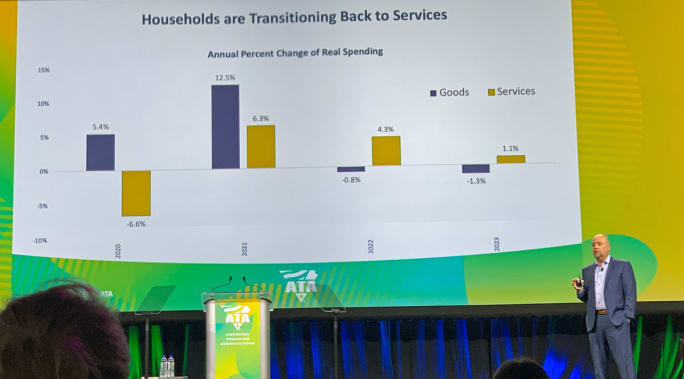
The pandemic caused more spending on goods and less on services, explained ATA Chief Economist Bob Costello.
Photo: Deborah Lockridge
During the COVID-19 pandemic, he explained, consumer spending on services shifted to goods. More goods spending meant more truck freight.
Many shippers found out their contract carriers didn’t have the trucks or the drivers to handle the extra freight, so they were forced to go into the spot market. “We saw incredible increase in spot market load postings; it went up over 100%. We’ve seen load postings this year fall 65%. But contract freight is growing. It actually contracted in 2020, bottomed out in 2021 and has since come back.”
For one thing, he said, U.S. households are transitioning back to a more typical distribution of spending on goods vs services. “We are now transitioning back to more normal spending on services vs. goods,” he said.
Although he predicts that the number of loads will be down almost 1% this year and 1.3% next year, he said, “if you look at the level of that spending, we’re still going to be the second and third highest ever. We’re not falling over a cliff.”
Breaking the Capacity Cycle
In a typical economic cycle, what happens in trucking as the amount of freight goes up, capacity tightens and rates increase. So trucking companies add trucks to take advantage of the opportunity. Eventually the economy softens, all those new trucks now equal over-capacity and rates drop.
In this cycle, one of the biggest post-COVID frustrations for fleets has kept the industry from adding capacity. Global supply-chain problems meaning trouble obtaining parts and components have kept truck makers from being able to deliver as many trucks as fleets wanted to order.
Capacity is loosening, Costello said, as the supply-chain problems have started to ease. At the same time, with the goods-vs-service spending tilting back toward normal, demand is softening as well.
“I think it will level off or not grow as quickly, but in no means has the freight market collapsed on us. We’re just going back to more normal split of contract vs. spot market.”
More Fleet Management

Why Private Fleets Are Taking More Freight
Private fleets are putting their own trucks on demanding customers and high-cost lanes as companies seek greater control over service, costs, and capacity.
Read More →
Color Match Smarter: Tools That Restore & Perform
For fleet managers and collision repair professionals keeping heavy-duty trucks on the road, getting the color right the first time isn't just about appearance — it's about efficiency, turnaround time, and bottom-line results. Discover how today's digital color tools are transforming the repair process from guesswork to precision.
Read More →
FMCSA Pauses Biennial-Update Enforcement Amid Motus Transition
Carriers whose updates were due on or after June 1 have more time, while FMCSA works to stabilize its new registration system and warns of phishing sites impersonating its new carrier registration system, Motus.
Read More →


2026 Blueprint for Countering Smarter Supply Chain Theft
Cargo theft is no longer just the cost of doing business. It's a multi-billion-dollar criminal enterprise exploiting vulnerabilities across your fleet, drivers, and supply chain.
Read More →
How Telematics Improves Visibility, Control, and Performance in Refrigerated Fleets
Explore how telematics help refrigerated fleets improve visibility, uptime, efficiency, compliance, and cargo protection across connected cold chain operations.
Read More →
What the U.S.-Canada Trade War Means for Trucking
Escalating U.S.-Canada tariffs could disrupt cross-border freight, reduce truck volumes, raise costs, and create new uncertainty for carriers on both sides of the border.
Read More →
What Are Trucking’s Top Concerns for 2026?
The American Transportation Research Institute wants to know what's worrying trucking fleet managers, drivers, and other stakeholders in its annual Industry Issues survey.
Read More →
American Trucking Associations Looks for a New Leader
ATA President and CEO Chris Spear abruptly left his job at the association on August 21, at a pivotal time for the trucking industry.
Read More →
Public Wi-Fi Cybersecurity Risks: How Truck Drivers and Fleets Can Protect Their Data
Public Wi-Fi can expose truck drivers and fleets to credential theft, malware, and other cyber threats. Here’s how to reduce the risk on the road.
Read More →
For Nicky Cupp, Fleet Innovation Starts With Frustration
HDT Truck Fleet Innovator Nicky Cupp turns everyday pain points at Fraley & Schilling into opportunities for better technology and smarter processes.
Read More →