





Related – Commentary: Taking it Slow on the Road to Autonomous Trucks
White Trailer Proved Invisible to Tesla's Autonomous System
A white semitrailer on a bright day proved invisible to the self-driving system of a Tesla S sedan, which failed to brake and ran under the trailer as it crossed in front of the car, said authorities investigating the first fatal crash of an autonomous car in the United States, which happened in early May.
July 1, 2016
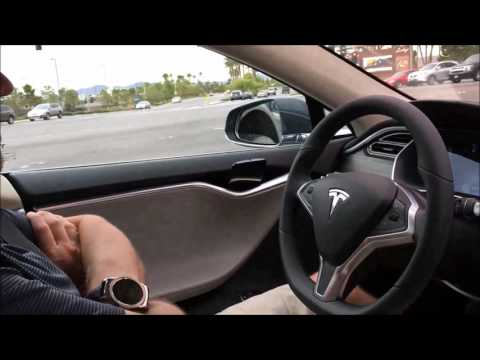
Still from a YouTube video of a Tesla S model owner using the vehicle's autopilot mode.
3 min to read
Still from a YouTube video of a Tesla S model owner using the vehicle's autopilot mode.
A white semitrailer on a bright day proved invisible to the self-driving system of a Tesla S sedan, which failed to brake and ran under the trailer as it crossed in front of the car, said authorities investigating the first fatal crash of an autonomous car in the United States, which happened in early May.
The accident killed 40-year-old Joshua Brown, of Canton, Ohio, on a clear, dry roadway on May 7 in Williston, Fla., according to the Florida Highway Patrol. It’s expected to intensify a debate within the automotive industry and in legal circles over the safety of systems that take partial control of steering and braking from drivers.
The National Highway Traffic Safety Administration said preliminary reports indicate the crash occurred when a tractor-trailer made a left turn in front of the Tesla at an intersection. Tesla said in a blog post on June 30 that "neither autopilot nor the driver noticed the white side of the tractor-trailer against a brightly lit sky, so the brake was not applied."
Brown’s car under-rode the trailer, moved slightly to the right and ran off the road, then continued through two fences and swerved left, coming to rest against a pole, CBS News reported July 1.
Ironically, Brown had posted videos on YouTube showing how well his advanced electric-drive Tesla’s self-driving system worked; so have numerous other Tesla owners.
In its blog post, Tesla explained how drivers can initiate the autopilot feature in its Model S cars and stated that the technology is "still in a public beta phase," and that contrary to videos posted by users, drivers are not supposed to be operating hands-free. "When drivers activate Autopilot, the acknowledgment box explains, among other things, that Autopilot 'is an assist feature that requires you to keep your hands on the steering wheel at all times,' and that 'you need to maintain control and responsibility for your vehicle' while using it."
The truck driver, Frank Baressi, 62, of Palm Harbor, Fla., told a reporter that Brown was “playing Harry Potter on the TV screen” at the time of the crash and that "he went so fast through my trailer I didn’t see him.”
“It’s a warning that drivers need to be vigilant, even if a self-driving feature is engaged,” said the spokesman for the Insurance Institute for Highway Safety, Russ Rader. “It also serves as a notice that these autonomous vehicles are not just around the corner as something we can buy.”
Although IIHS has campaigned for more effective rear impact guards on trailers, Rader did not criticize the trailer’s apparent lack of side under-ride guards. These are required on trucks and trailers in several other countries, but not in the U.S. Some safety groups are arguing for them.
Most van-type semitrailers are painted white, a practical color that’s easy to see under most conditions, but evidently not those on the day of the Tesla crash. It’s now possible that safety advocates will petition for high-visibility markings, in addition to the red-and-white taping now required on semitrailers.
The crash is the first well-reported incident baring glitches in autonomous systems’ controls, possibly involving software as well as cameras and sensors.
Positive reports on the safety of self-driving cars, including Google’s test vehicles operating in California, have cast a favorable glow on development of autonomous cars and trucks, and suggested adoption is not far off. This incident might change that, observers say, and groups like Consumer Watchdog are demanding that NHTSA issue rules requiring long, careful testing.
Developers of control systems for commercial trucks have been cautious in their statements, saying that many steps will be required and that autonomous trucks might be 10 years away from routine operations.
More Safety & Compliance

FMCSA Pauses Biennial-Update Enforcement Amid Motus Transition
Carriers whose updates were due on or after June 1 have more time, while FMCSA works to stabilize its new registration system and warns of phishing sites impersonating its new carrier registration system, Motus.
Read More →
ZF Expands Commercial Vehicle Push in North America
ZF is expanding its North American commercial-vehicle presence with new transmission applications, electrification, trailer technology and autonomous-driving systems.
Read More →
Truck Drivers Need More Than Another Alert
Fleets have more visibility into truck health, safety events, and driver activity than ever. The next challenge is turning all that information into useful guidance for the person who has to decide what to do next.
Read More →
Tesla Wants a Self-Driving Semi. Are Cameras Enough?
Could Tesla’s camera-only autonomous driving technology work on an 80,000-pound Semi? In this commentary, HDT's Deborah Lockridge takes a look at Tesla, Cybercab, and how autonomous trucks see the road.
Read More →
What DOT’s Automated Vehicle Strategy Means for Trucking
The U.S. Department of Transportation issued a new automated-vehicle strategy that outlines plans for driverless-truck regulations, cross-state freight corridors, and federal safety standards.
Read More →
NYC Expands Speed, Pedestrian Safety Tech Across Fleet
New York City is expanding intelligent speed assistance and pedestrian-alert systems across its municipal fleet, moving the technologies from pilot programs into vehicle procurement and retrofit requirements.
Read More →
FMCSA Removes 110 Truck Driver Training Schools from Certified ELDT List
Federal regulators also are targeting more than 160 additional training providers and launching a nationwide audit of third-party CDL skills testers as part of a broader crackdown on trucking fraud.
Read More →
Beyond DOT Compliance: What Makes a Trucking Fleet Truly Safe?
A trucking fleet can follow every rule and still make unsafe decisions. The real test comes when safety conflicts with freight, productivity, or cost.
Read More →
Hours of Service Pilot Programs: FMCSA Readies for 2027 Rollout
Two pilot programs could eventually reshape hours-of-service rules, giving truck drivers options to pause their 14-hour clock or use longer split sleeper rest periods.
Read More →
New Guide Offers Pet Safety Tips for Truck Drivers
Hundreds of thousands of pets travel in truck cabs. A new safety guide from Volvo Trucks and the Center for Pet Safety offers practical advice for truck drivers who bring dogs and cats along for the ride.
Read More →