




“It also comes at a great time because fleets are paying drivers more, which they need to because they are in high demand, therefore this kind of helps with that as well."
What's Behind the Lowest Diesel Prices in Years?
Since the summer, the price of oil has plummeted 50 percent, hitting its lowest level in more than five years about a week before Christmas. Diesel has fallen from a yearly high of $4.021 in March to $3.419 in mid-December.

Evan Lockridge・Former Business Contributing Editor
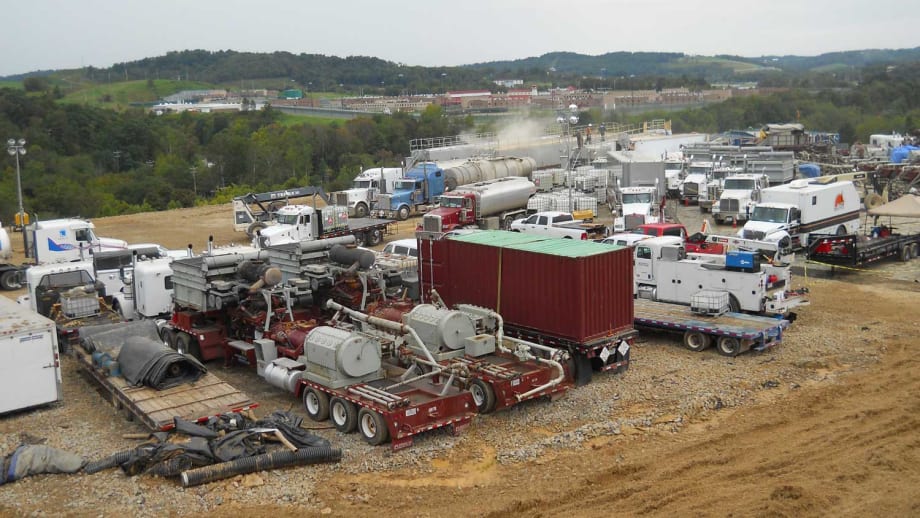
North American shale operations, like this hydraulic fracturing operation at a Marcellus Shale well, are one reason for a global glut of oil.
4 min to read

Since the summer, the price of oil has plummeted 50 percent, hitting its lowest level in more than five years about a week before Christmas. Riding along has been a drop in fuel costs, with diesel falling from the high of the year at $4.021 in March to $3.419 in mid-December, according to U.S. Energy Department figures.
The result has been billions of dollars in savings -- not just for the trucking industry ($350 million to $375 million annually for each one-cent decline, according to the American Trucking Associations), but also for consumers. They have seen gasoline prices fall by an even greater margin, translating into a “consumer windfall” totaling $125 billion, according to research from investment banking firm Goldman Sachs, which called the drop a “middle class tax cut.”
The global glut
One of the main factors behind all this is a worldwide glut of crude oil that’s expected to peak in the spring or summer of 2015, according to Tom Kloza, global head of energy analysis with the Oil Price Information Service. The glut is due in large part to Saudi Arabia and other OPEC member nations not cutting back on crude production.
“One theory is the Saudis would like to do as much collateral damage [as possible] to Iran, one of their main rivals in the region, and to Russia, which is one of the big meddlers in the region," Kloza says. "There [also] is the idea they maybe they want to make North American shale producers realize that finding shale oil is not necessarily a layup, and it’s certainly not a layup when prices are where they are right now.”
Kloza noted increasing U.S. production of oil from shale formations is another cause for the drop in prices, and that growth is expected to continue into 2015. “We are going to get to the highest U.S. crude production since 1973 when Richard Nixon was president,” he says, though growth in the new year could be slower than it was in 2014.
The third, and possibly biggest factor for these declines, has been an easing of worldwide demand for crude. This is due in part to some economies overseas throttling back, according to a U.S. Energy Department outlook issued in December, as well as some emerging economies not performing as strongly as earlier predicted, according to Kloza.
The outlook for fuel prices
He expects the ride of lower prices will continue well into 2015, though it will likely bottom out in mid-January. “We’ll see prices rebound nominally in the first quarter…but generally, without question, 2015 is going to see much deeper valleys for prices and much lower peaks, so it should be a good situation for everyone who is one the end user side.”
Kloza, however, said projections of actual prices into 2015, including a recent one from the U.S. Energy Department that on-highway diesel will retail for an average of $3.07 per gallon next year “is very difficult to say.”
For many trucking companies the decline in fuel prices has been a welcome development, even though the fuel surcharge of their rates has declined, according to Bob Costello, chief economist at the American Trucking Associations.
Winners and losers
“It’s a win not only for the trucking companies, because they don’t recapture 100% of the fuel spent, but it’s also a win for the shippers,” he said. “It also comes at a great time because fleets are paying drivers more, which they need to because they are in high demand, therefore this kind of helps with that as well."
According to Costello, the downside of lower diesel prices is trucking companies involved in oil field operations are not expected to see the kind of growth next year that they have seen over the last few years, because a lot of oil companies are slowing down the growth in fracking as a result of lower oil prices.
The best thing about lower oil and fuel prices, he said, may be for the overall consumer.
“There is the indirect benefit that you and I have more money in our pockets, because we are not spending as much at the gas pump and hopefully we are spending that somewhere else. And of course we know whatever we are buying, trucks are going to bring it."
More Fuel Smarts

Cummins Adjusts 2027 Engine Rollout After EPA Proposal
The engine maker will gradually introduce its new Model Year 2027 diesel engines while continuing to offer current models during the transition, citing the EPA's proposed emissions rule changes.
Read More →
EPA Proposal Could Ease 2027 Truck Costs and Buying Uncertainty
The proposal doesn't change the tougher NOx standard, but it would revise key implementation requirements that manufacturers say have driven up costs and complicated fleet purchasing decisions.
Read More →
Cummins, Paccar Ease DEF Derates After EPA Guidance
Updated diesel engine software gives truck operators more time to address emissions-system issues while staying compliant with EPA emissions standards.
Read More →
Maintenance in the Messy Middle Part 3: Biodiesel
Biodiesel can reduce emissions, improve fuel-system lubricity and use existing diesel infrastructure. But NACFE’s Messy Middle maintenance report says fleets must actively manage storage, cold-weather operation, filters and oil drain intervals to avoid problems.
Read More →
Enhance Fleet Performance with High-Efficiency Auxiliary Power Units
Drive sustainable cost savings while increasing driver comfort during short- and long-haul logistics operations.
Read More →
Maintenance in the ‘Messy Middle’ Part 2: Renewable Diesel Fuel
NACFE's latest Messy Middle Powertrain Service & Maintenance report says renewable diesel gives fleets an opportunity to reduce carbon emissions without changing trucks, fueling infrastructure or maintenance practices. But technicians still need to understand several important operational differences.
Read More →
The Diesel Engine Enters NACFE’s ‘Messy Middle’
NACFE’s new Messy Middle Powertrain Service & Maintenance report says keeping modern diesel engines running now depends as much on software, diagnostics and data as traditional mechanical service.
Read More →
DTNA Software Update Gives Truckers More Time Before DEF Derates Take Effect
The changes reflect EPA guidance aimed at reducing downtime caused by emissions-system faults while maintaining compliance requirements.
Read More →
New Agentic Predictive Maintenance Report Demonstrates How Degraded Aftertreatment Systems Waste Fuel
Questar analyzed a large mixed-class fleet and discovered it was wasting as much as $30 in fuel per vehicle, per day, because of mechanically degraded aftertreatment systems.
Read More →
New York City's Microhub Project is Delivering Results
Trucking, last-mile delivery companies, and environmental advocates like what they are seeing so far with New York's microhub program.
Read More →