




WattEV Opens Heavy-Duty Truck Charger Depot at Long Beach Port
WattEV, working with several companies, launched what it calls the largest charging depot for electric trucks in the nation.
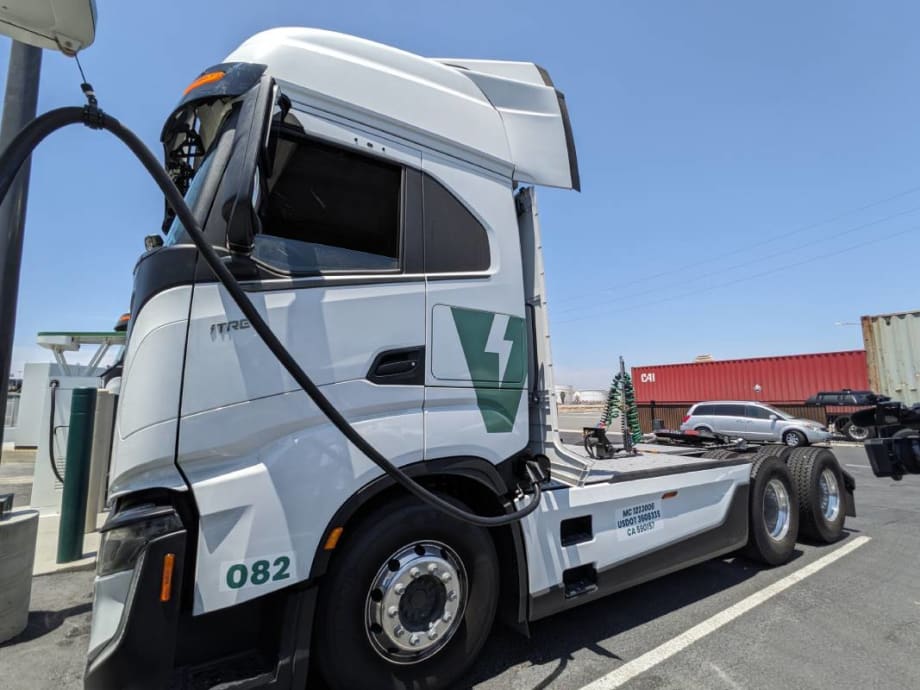
A new Nikola Tre battery-electric truck charges at the just-opened WattEV charging depot at the Port of Long Beach, California. Charging the Class 8 tractor takes 2-3 hours.
Photo: Christian Lopez / Bobit
The Port of Long Beach on July 24 revealed its first electric charging depot for medium- and heavy-duty trucks in a grand opening ceremony.
This facility, located at Pier A in the Port of Long Beach, will operate 14 brand-new Nikola Tre electric trucks. To accelerate zero-emission transportation, WattEV plans to acquire 12,000 heavy-duty trucks to put on the road by 2030.
This facility endeavor took 14 months of construction, with estimated costs around $5 million to $6 million funded in partnership with several companies and nonprofit organizations such as Calstart, Southern California Edison, and the Harbor Community Benefit Foundation.
“We know that the future of, not just our ports, but the country is electric; it’s the transition to clean energy,” said House Rep. Robert Garcia, D-42nd District, in his speech. “So, this is a very exciting time for the Port of Long Beach, and also the state and the country.”
The ceremony, hosting multiple industry, government and environmental partners and stakeholders, highlighted the importance of such a site helping to reduce diesel exhaust emissions generated by trucks working in the port.
“Being a leader in accelerating the transition of U.S. trucking transport to zero emissions is what WattEV does,” said David Chow, vice president and chief operating officer at green tech nonprofit Calstart.
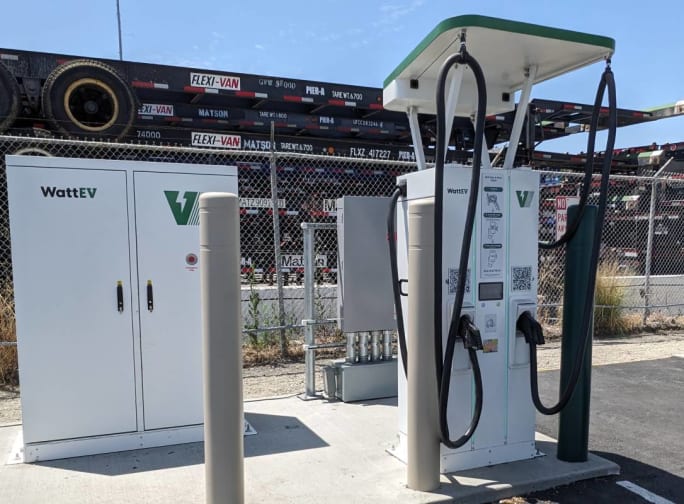
WattEV charging station, producing 360 kilowatts, can achieve a full charge in 2-3 hours.
Photo: Christian Lopez / Bobit
The charging depot has 13 dual-cord CCS 360 kW charging stations. These chargers, while primarily intended for WattEV brand trucks, can be used to charge other electric truck models as well, under its Truck-as-a-Service Model that seeks to make electric Class 8 trucks accessible, affordable, and reliable for all carriers and owner-operators.
Under full charge, which can take about two to three hours, the trucks can travel around 200 to 300 miles. This means vehicle range is an issue compared to diesel-powered trucks. Conventional trucks powered by internal combustion engines can travel more than four times the distance that a battery-electric truck can on a full tank of diesel fuel and only need 20–30 minutes to refuel.
Acknowledging these problems, WattEV CEO Salim Youssefzadeh stressed the development and future implementation of megawatt charging at this facility to help bring that two- to three-hour charging window down to the average.
“Megawatt charging is an important aspect of our business in terms of getting us to where we want to be for battery charge,” Youssefzadeh said.
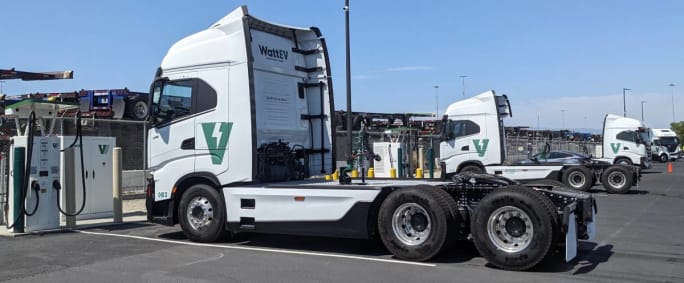
WattEV just took delivery of 14 new Nikola Tre battery-electric trucks. But the company will consider other zero-emission models in the future.
Photo: Christian Lopez / Bobit
Future Electric-Truck Charging Facilities
Although WattEV said this depot is the largest of its kind not only in California, but in the nation, it only takes up 1.5 acres. This will soon change, as there are three more sites under construction and set to be finished by the end of the year in San Bernardino, Gardena, and Bakersfield, California.
“This is our smallest facility. Some of our other ones would be much larger and have the traditional rest area amenities. Bakersfield, for instance, that's 115 acres,” said Youssefzadeh in an interview.
After the four other facilities are finished, WattEV hopes to expand outside of the state in Arizona and New Mexico, while also looking toward the East Coast.
Correction: A caption has been corrected that erroneously identified the Nikola Tre truck.
More Fuel Smarts

How Volvo Updated Its D13 for EPA 2027 [Watch]
Volvo’s updated D13 promises lower emissions without sacrificing performance or fuel economy. Take a closer look at what changed inside the engine in this HDT Spotlight video.
Read More →
Diesel Price Spike Shortens Payback for Natural Gas Trucks, Report Says
Energy Vision estimates fleets could recover the higher purchase price of an RNG-fueled Class 8 tractor in 1.3 to 2.8 years under current fuel-price scenarios.
Read More →
Calstart Becomes Catalyst Mobility, Reflecting Broader Focus
Calstart is now Catalyst Mobility, reflecting the nonprofit’s growing national role in clean transportation, including zero-emission trucks, infrastructure and incentive programs.
Read More →

Record Diesel Prices Squeeze Trucking Fleets
Average U.S. diesel prices have climbed to nearly $6 a gallon, surpassing the 2022 record as tight refinery capacity and Middle East disruptions keep fuel costs elevated.
Read More →
How Fuel Delivery Shapes Engine Performance
Fuel delivery depends on more than what happens at the injector. For fleet, maintenance and technical professionals, looking at the full path from pump to injector can provide useful context for understanding engine performance.
Read More →
East Coast Port Launches $45M Electric Truck Push
The Port Authority of New York and New Jersey announced millions in incentives for zero-emission drayage trucks, yard tractors, and new charging hubs near the port.
Read More →
California Bill Could Shed Light on Electric Truck Prices
Why do battery-electric Class 8 trucks remain so expensive? A California bill headed to Gov. Gavin Newsom would give fleets and state agencies more visibility into what manufacturers charge.
Read More →
Detroit Opens Orders for EPA 2027 Engines
Detroit isn’t starting from scratch to meet EPA 2027 diesel emissions standards. Its Gen 6 DD13 and DD15 engines keep much of today’s platform while updating the fuel and aftertreatment systems.
Read More →
Zero-Emission Truck Corridor Planned for West Coast
California, Oregon, Washington, British Columbia and Baja California are coordinating plans for truck charging and hydrogen fueling from Canada to Mexico.
Read More →
A Closer Look at Kenworth’s Electric T880E Vocational Truck [Video]
Learn more about Kenworth's T880E battery-electric vocational truck at the Paccar Technical Center, including its range, applications, upfitting considerations, and PTO options, in this HDT Spotlight video.
Read More →