




Volvo Trucks: Circularity and Sustainability in Truck Design
Volvo’s zero-emission goals for its global vehicle platforms are well known. But the OEM is also committing to sustainability in how it designs and builds those trucks, as well.

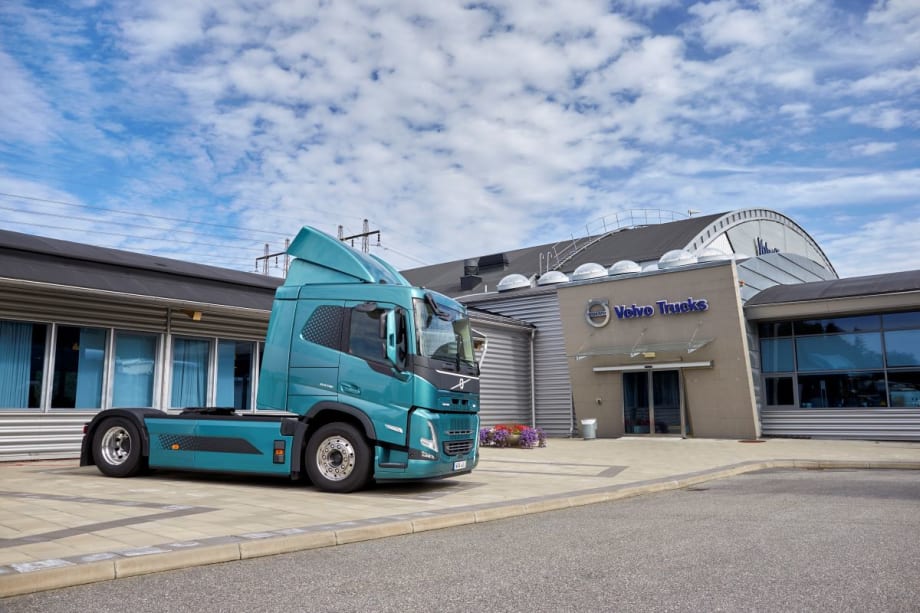
Volvo Trucks is increasingly incorporating the concept of circularity into every aspect of its manufacturing processes to reduce waste and boost sustainability.
Photo: Volvo Trucks
Given Volvo Trucks’ historic commitment to a healthy global environment, it’s not surprising to learn that the OEM is focusing on sustainability throughout its operations and in the products it produces. Given climate change headlines today, its not surprising that most stories regarding Volvo’s sustainability initiatives focus on the new generation of alternative-fuel and zero-emissions trucks it is developing. But the commitment goes far deeper than that.
In early September, 2023, Volvo hosted a contingent of North American transportation journalists to its home city of Gothenburg, Sweden to see up close how the OEM’s global zero-emissions efforts are faring. And Lars Mårtensson, environment and innovation director for Volvo Trucks, detailed just how extensive those green initiatives are behind the scenes as it pushes to become an ecologically friendly manufacturer at every level of its operations.
Rescue, Recycle, Reuse
The manufacturing concept Volvo is pioneering is called “circular design.” And, as the name implies, it’s a process of eliminating as many layers of waste from the design of a truck as possible. “Today, about one-third of a Volvo FH truck is made from recycled materials,” Mårtensson said. “And we do this because we understand that many resources on this planet are finite. So, it is imperative that we find ways to rescue and recycle as many manufacturing materials possible going forward and use those resources in as efficient a way as possible.”
The actual extraction process of obtaining raw materials to use in manufactured goods like commercial vehicles is at the heart of the issue, Martensson said. Doing so is not sustainable and leads to the depletion of irreplaceable resources. On top of that, he said, in many cases, extracting raw materials from the earth causes environmental issues and human suffering. Over time, he cautioned, material scarcity will disrupt supply chains and put business profitability – and even the continuation of businesses -- at risk.
Equally important, Mårtensson stressed, is that in 2021, 45% of all greenhouse gas emissions were created by the extraction and production of materials, products and food, as well as managing land. So, it only makes sense to address those types of emissions as well as tailpipe emissions in order to reach the goals outlined in the Paris Agreement on global warming.
Waste is the third critical component that must be considered, as well, he added. “Waste is increasing on a global scale,” he noted. “In 2023, only 7% of all extracted material will be cycled back into useful consumer products. Not only does this cause large environmental issues, but it also leads to the extraction of more virgin material, which in turn increases GHG emissions. Moreover, the inherent value of waste is not being tapped into. So, it makes sense to reuse as many of these resources as much as possible.”
The Rise of the Circular Economy
As more people realize that environmental sustainability extends far beyond vehicle powertrains, more countries around the world are beginning to issue new regulations designed to boost circularity in what is commonly called a “well-to-wheel” fashion in North America. In other words, making sure that every single step in the production of a consumer product – like a truck – is environmentally friendly as possible. This starts with the extraction of raw materials from the earth and extends all the way to the end of life for a vehicle, when as many of the components and materials used in its manufacture are recycled to be used all over again in a completely new product.
In response to these new regulatory demands, Mårtensson said Volvo Truck has adopted its own holistic approach to circularity. This practice begins with a commitment to narrow down the amount of materials it uses in manufacturing vehicles in order to save both resources and energy. Another important step is to slow down the consumption of resources and materials in order to make them last longer. Finally, the OEM is committing to reusing as many components and resource as possible and regenerating both materials and energy when a truck reaches its end-of-life stage.
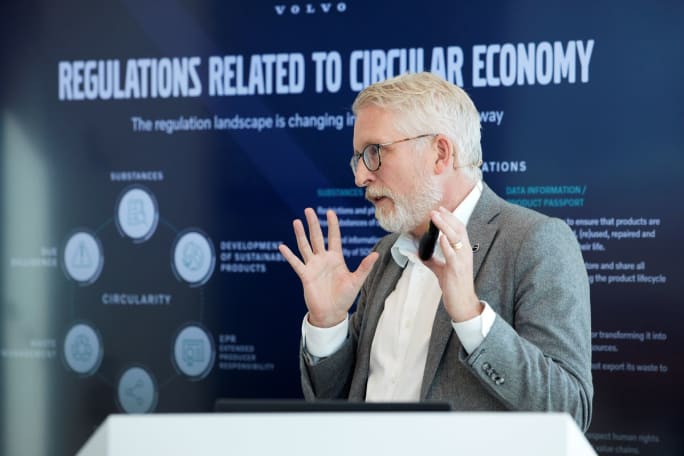
Lars Mårtensson, environment and innovation director for Volvo Trucks, discusses new EU laws mandating circularity in manufacturing products.
Photo: Volvo Trucks
One way of achieving these goals is Volvo’s increasing commitment to use fossil-free steel on its trucks – in other words, steel that has been sourced and produced without any use of fossil fuels to create it. “We want to phase out as many hazardous materials as possible from our trucks,” Mårtensson explained. “We are going step by step through our manufacturing processes to enable a more circular use of materials wherever possible while emphasizing the development of sustainable operations.”
Circular thinking is crucial throughout every step of the process, he added. “Waste has no value for us,” he said. “And new legal demands are helping us design for better circularity throughout our operations and manufacturing processes.”
New European regulations related to the development of a circular economy help by giving Volvo – and EU countries – clear direction forward, Martensson added. “The EU wants to secure a supply of resources for the future of Europe,” he said. “We want to keep these resources and materials in Europe. And, by doing so, prevent levels in supplies from changing and disrupting our ability to manufacture new products.”
More Equipment

How Volvo Updated Its D13 for EPA 2027 [Watch]
Volvo’s updated D13 promises lower emissions without sacrificing performance or fuel economy. Take a closer look at what changed inside the engine in this HDT Spotlight video.
Read More →
Michelin Tire Improves Efficiency and Durability for Regional Fleets
The Michelin X Multi Energy D2 is a regional haul drive tire engineered to help fleets improve fuel efficiency, durability and traction in demanding stop-and-go operations.
Read More →
ZF Expands Commercial Vehicle Push in North America
ZF is expanding its North American commercial-vehicle presence with new transmission applications, electrification, trailer technology and autonomous-driving systems.
Read More →
Tesla Wants a Self-Driving Semi. Are Cameras Enough?
Could Tesla’s camera-only autonomous driving technology work on an 80,000-pound Semi? In this commentary, HDT's Deborah Lockridge takes a look at Tesla, Cybercab, and how autonomous trucks see the road.
Read More →
Kodiak: Driverless Long-Haul Truck Launch on Track for 2026
Kodiak AI says its driverless long-haul safety case is 93% complete and it remains on track to begin commercial operations by year-end 2026.
Read More →
What DOT’s Automated Vehicle Strategy Means for Trucking
The U.S. Department of Transportation issued a new automated-vehicle strategy that outlines plans for driverless-truck regulations, cross-state freight corridors, and federal safety standards.
Read More →
East Coast Port Launches $45M Electric Truck Push
The Port Authority of New York and New Jersey announced millions in incentives for zero-emission drayage trucks, yard tractors, and new charging hubs near the port.
Read More →
PlusAI Going Public to Fund Autonomous Truck Launch
A SPAC deal could provide PlusAI with up to $300 million as it works toward a 2027 commercial launch of factory-built autonomous trucks.
Read More →
NHTSA Moves to Rewrite Truck Fuel-Economy Rules
The National Highway Traffic Safety Administration says it lacks authority to regulate medium- and heavy-duty truck engines separately from complete vehicles, but the existing standards have not yet been eliminated.
Read More →
Detroit Opens Orders for EPA 2027 Engines
Detroit isn’t starting from scratch to meet EPA 2027 diesel emissions standards. Its Gen 6 DD13 and DD15 engines keep much of today’s platform while updating the fuel and aftertreatment systems.
Read More →