




Volvo Trucks Meets the Emissions Moment
Roger Alm, president of Volvo Trucks, is on a mission to replace 1 million diesel trucks with green alternatives by 2050.

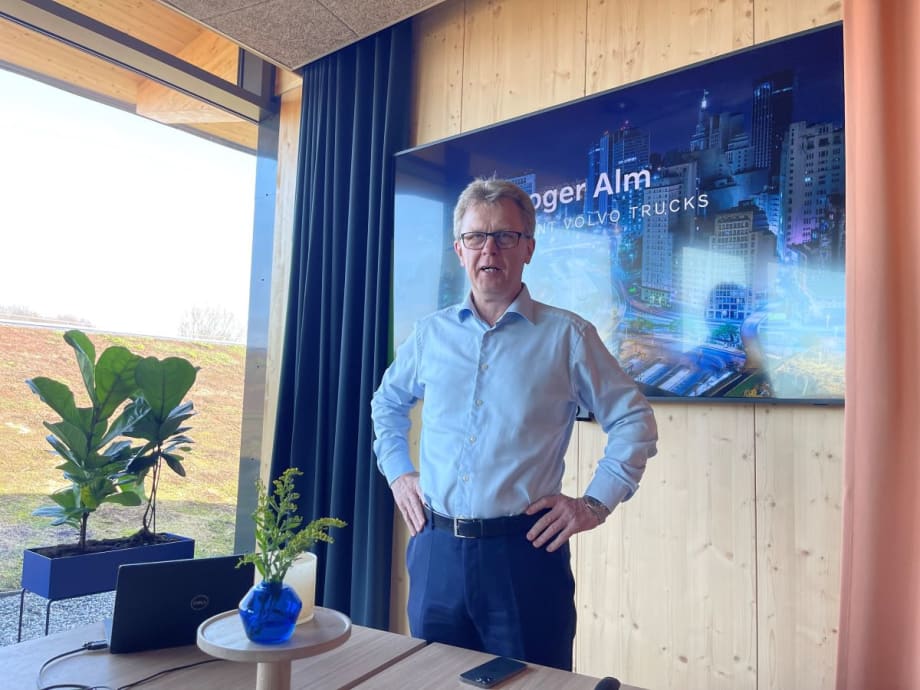
Volvo Trucks President Roger Alm speaks to the media during the opening of Volvo World in Gothenburg, Sweden, on April 8,2024.
Photo: Jack Roberts
Volvo has taken a leadership position in the transition of heavy-duty commercial transport away from fossil fuels. Safety and the environment have been core guideposts at Volvo since the company’s founding. And the company clearly feels that it has risen to meet the moment. Everything in its culture, heritage and very DNA has seemingly been engineered to meet this historic moment.
And it’s not a stretch to say that Roger Alm has Volvo in his DNA.
Today, Alm is the man at Volvo. He is executive vice president of the Volvo Group and president of Volvo Trucks worldwide. It’s a journey that began 35 years ago when he started as a lowly technician at the massive global company he now runs.
During a visit to Volvo’s hometown of Gothenburg, Sweden, in early April, North American journalists sat down with Alm to hear his thoughts on how that transition is going and how Volvo is working to assist in the journey.
A Million-Truck Mission to Net Zero
Volvo calls this global emissions effort The Road to Net Zero. Alm noted that since its inception in 2019, Volvo has taken massive strides toward that goal. This includes huge investments in new technologies, new products, new companies, and new joint ventures. It’s a journey that even includes collaborative research and development partnerships the Volvo’s biggest global competitors, like Daimler Trucks and Traton.
And time is of the essence. Alm noted that by the terms of the Paris Agreement, of which Volvo is a signee, global truck and engine OEMs have agree to decarbonize the planet’s transportation sectors by 2025 — a mere quarter of a century from now.
There are 1.2 million Volvo trucks on the road today, working in 150 countries around the globe. And that entire population of trucks will have to be completely replaced in that time.
“The life of a truck is about 10 years,” Alm noted. “That means that by 2040, every truck Volvo produces will need to be a zero-emission vehicle in order to reach that goal.”
And Volvo is rising to meet the moment, Alm said. He pointed out that Volvo delivered 295,000 trucks worldwide in 2022 and 2023.
“Those were record years for Volvo,” Alm added. “Our global product equaled the number of all trucks sold annually in North America.”
Today, Volvo has close to 1 million connected trucks on the road. And Alm said the company is riding high following its biggest product launches ever.
“We have just introduced the new VNL in North America,” he said. “That is a truck designed to change everything. And at the same time, we launched a new range of cabover trucks here in Europe.”
Volvo designers took advantage of new length regulations for heavy trucks in Europe to design new cabover models with enhanced aerodynamics.
“These trucks feature reduced fuel consumption and CO2 emissions,” Alm noted. “In 2018 we were able to reduce fuel consumption by 18% in our cabover trucks with enhanced aerodynamics. And now we have an additional 5% reduction. And all of these are steps on the road to net zero.”
The new Volvo FM model cabover, launched earlier this year, is the company’s first truck to be designed from the ground up as a pure battery-electric vehicle.
And — seemingly at odds with the company’s quest toward net zero —Volvo has launched a new 17-liter diesel engine for Europe. The new engine churns out an astonishing 780 horsepower. But it is lighter than Volvo’s previous 16-liter high-horsepower engine, emits fewer emissions and uses less fuel, to boot.
All Options on the Table
Setting the tone for the remainder of our visit to Gothenburg, Alm made it clear that internal combustion engines will remain an important part of Volvo’s net zero strategy for many years to come.
"In the short term, this will include engines that run on diesel fuel," he said. "Later, there will be clean-fuel versions running on natural gas and eventually hydrogen."
Globally, Alm noted, the transportation of goods and people accounts for 14% of all C02 emissions. And 7% — half — come from road transportation. Which is why Volvo has pushed hard to get electric trucks to the market and available for sale today.
“We are making a difference by doing so,” he added. “In 2019 Volvo had two battery-electric truck models. The following year, we launched the VNR electric in North America. At the moment Volvo now offers six electric truck models. And that total will grow to eight later this year.”
In the short term, Alm said, it will battery-electric trucks that drive the transition to net zero. To date, he said, Volvo electric trucks have logged more 35 million kilometers on public roadways.
“We have seen transformation before,” Alm noted. “There are regulations now driving us. And there will surely be other legislation as well. But we have our targets now and we are moving ahead.
"How fast will it go? That remains to be seen. But at Volvo, we hare committed to our emissions goals: 50% of our new trucks will be zero-emission vehicles by 2030. And 100% of our new trucks will be zero emission by 2040. And our entire global population of new trucks will will be zero-emission vehicles by 2050.”
More Fuel Smarts

How Volvo Updated Its D13 for EPA 2027 [Watch]
Volvo’s updated D13 promises lower emissions without sacrificing performance or fuel economy. Take a closer look at what changed inside the engine in this HDT Spotlight video.
Read More →
Diesel Price Spike Shortens Payback for Natural Gas Trucks, Report Says
Energy Vision estimates fleets could recover the higher purchase price of an RNG-fueled Class 8 tractor in 1.3 to 2.8 years under current fuel-price scenarios.
Read More →
Calstart Becomes Catalyst Mobility, Reflecting Broader Focus
Calstart is now Catalyst Mobility, reflecting the nonprofit’s growing national role in clean transportation, including zero-emission trucks, infrastructure and incentive programs.
Read More →

Record Diesel Prices Squeeze Trucking Fleets
Average U.S. diesel prices have climbed to nearly $6 a gallon, surpassing the 2022 record as tight refinery capacity and Middle East disruptions keep fuel costs elevated.
Read More →
How Fuel Delivery Shapes Engine Performance
Fuel delivery depends on more than what happens at the injector. For fleet, maintenance and technical professionals, looking at the full path from pump to injector can provide useful context for understanding engine performance.
Read More →
East Coast Port Launches $45M Electric Truck Push
The Port Authority of New York and New Jersey announced millions in incentives for zero-emission drayage trucks, yard tractors, and new charging hubs near the port.
Read More →
California Bill Could Shed Light on Electric Truck Prices
Why do battery-electric Class 8 trucks remain so expensive? A California bill headed to Gov. Gavin Newsom would give fleets and state agencies more visibility into what manufacturers charge.
Read More →
Detroit Opens Orders for EPA 2027 Engines
Detroit isn’t starting from scratch to meet EPA 2027 diesel emissions standards. Its Gen 6 DD13 and DD15 engines keep much of today’s platform while updating the fuel and aftertreatment systems.
Read More →
Zero-Emission Truck Corridor Planned for West Coast
California, Oregon, Washington, British Columbia and Baja California are coordinating plans for truck charging and hydrogen fueling from Canada to Mexico.
Read More →
A Closer Look at Kenworth’s Electric T880E Vocational Truck [Video]
Learn more about Kenworth's T880E battery-electric vocational truck at the Paccar Technical Center, including its range, applications, upfitting considerations, and PTO options, in this HDT Spotlight video.
Read More →