




Volvo Debuts its First Only-Electric Truck Chassis
The Volvo FM Low Entry heavy duty cabover truck is the first truck model ever developed by Volvo available with an electric drive only.

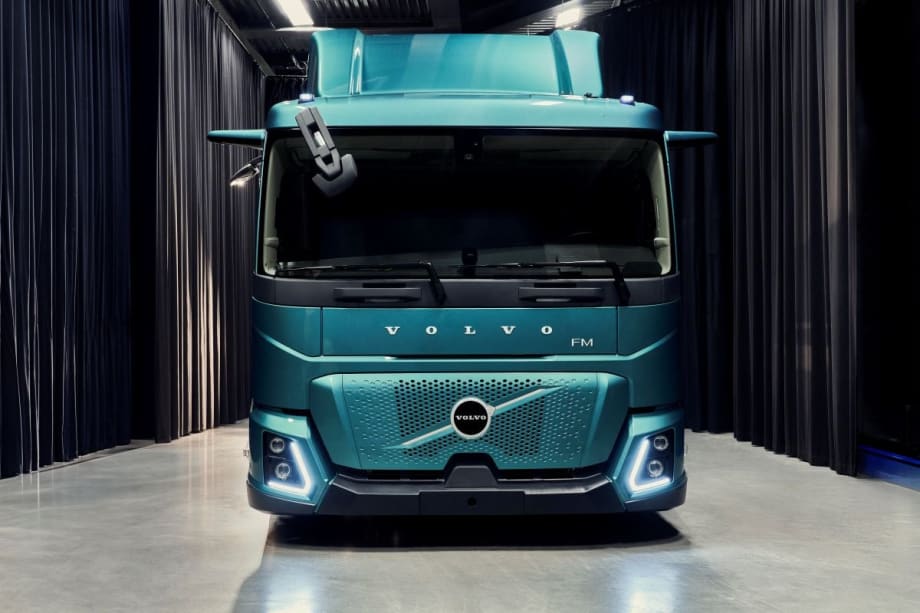
The new FM Low Entry is based on Volvo's FH cabover model and available exclusively with a battery-electric powertain.
Photo: Volvo Trucks
Volvo has been on something of a roll in this new year. The OEM has already launched its new VNL Class 8 conventional tractor in North America. That debut was closely followed by the unveiling of its new global truck platform. Now, Volvo is pulling the curtain back on its new FM Low Entry cabover model, which is the OEM’s first-ever truck offered exclusively with a battery-electric powertrain.
The development of the FM Low Entry was driven by more cities lowering emissions levels to improve quality of life for residents, Volvo said. As a result, demand is rapidly rising for zero-exhaust emission trucks that can meet these new customer requirements. The Volvo FM Low Entry is a direct response to those trends, according to the OEM.
The new FM Low Entry will initially be sold in Europe, including Turkey, as well as South Korea.
A Focus on Urban Trucking Applications
Volvo Trucks said the FM Low Entry is a heavy-duty truck specifically developed to handle a wide variety of transport assignments in city areas.
“This zero-emission truck is a great addition to our electric range, perfectly suited for city transports and designed with the driver in mind. It’s powerful, yet smooth to drive and easy to maneuver," said Roger Alm, president, Volvo Trucks. "The new Volvo FM Low Entry is perfectly in line with our ambitions to expand our electric offer, enabling even more customers to reduce their carbon emissions."
Volvo designed the new truck with a low driving position, which it said offers the driver excellent visibility and control of the surroundings. Thanks to this design feature, the FM Low Entry has earned it a five-star rating in the Direct Vision standard that rates heavy vehicles operating in London and comes into effect in the fourth quarter of 2024, Volvo said.
The Volvo FM Low Entry is a versatile design that can be adapted to meet specific requirements of various transportation tasks, such as waste management, distribution and construction.
The truck is based on Volvo’s FM model. The spacious cab has been lowered and moved forward, and the low instep and flat floor makes it easy to enter and exit the truck. These design features create an ergonomic, comfortable and efficient working environment for drivers in busy city locations.
With this new all-electric city truck, Volvo now has a total of eight electric truck models in its range. In 2019 Volvo said it became the first global manufacturer to start series production of heavy electric trucks, and the company is aiming for 50% of global sales of new Volvo trucks to be electric in 2030.
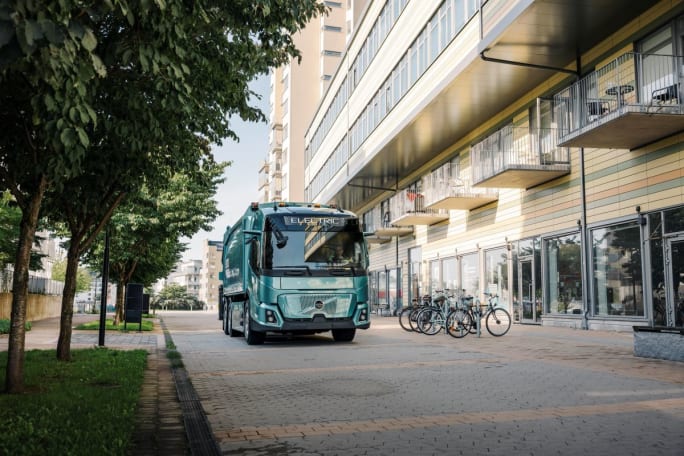
The Volvo FM Low Entry is a versatile design that can be adapted to meet specific requirements of various transportation tasks, such as waste management, distribution and construction.
Photo: Volvo Trucks
Key Volvo FM Low Entry features:
Out-of-cab visibility (with standard specification) fulfills the Transport for London 5-star Direct Vision Standard.
Volvo Dynamic Steering system for steering assistance and reduced vibrations.
Three seat options are available: Driver + 0, 1 or 3 passengers. With three passenger seats placed at the back of the cab, they are out of the driver's view, minimizing blind spots.
Ergonomic features include a low instep, flat floor, and well-positioned grab handles.
Volvo’s new advanced Camera Monitor System (optional).
Two heights (standing): Sleeper cab (1575 mm) and Extended/High sleeper (1945 mm).
Axle configurations available: 4X2, 6X2, 6X4, 8X2, 8X4
GVW: 19-32 tonnes
Motor: 330 kW
Battery: 360 kWh (4 batteries)
Range: up to 200 km (range depends on several parameters such as load weight, driving style, driving cycle, topography, temperature, etc.)
Charging: 250 kW (DC), 43 kW (AC)
Wheelbase: 3900-6000 mm
More Equipment

How Volvo Updated Its D13 for EPA 2027 [Watch]
Volvo’s updated D13 promises lower emissions without sacrificing performance or fuel economy. Take a closer look at what changed inside the engine in this HDT Spotlight video.
Read More →
Michelin Tire Improves Efficiency and Durability for Regional Fleets
The Michelin X Multi Energy D2 is a regional haul drive tire engineered to help fleets improve fuel efficiency, durability and traction in demanding stop-and-go operations.
Read More →
ZF Expands Commercial Vehicle Push in North America
ZF is expanding its North American commercial-vehicle presence with new transmission applications, electrification, trailer technology and autonomous-driving systems.
Read More →
Tesla Wants a Self-Driving Semi. Are Cameras Enough?
Could Tesla’s camera-only autonomous driving technology work on an 80,000-pound Semi? In this commentary, HDT's Deborah Lockridge takes a look at Tesla, Cybercab, and how autonomous trucks see the road.
Read More →
Kodiak: Driverless Long-Haul Truck Launch on Track for 2026
Kodiak AI says its driverless long-haul safety case is 93% complete and it remains on track to begin commercial operations by year-end 2026.
Read More →
What DOT’s Automated Vehicle Strategy Means for Trucking
The U.S. Department of Transportation issued a new automated-vehicle strategy that outlines plans for driverless-truck regulations, cross-state freight corridors, and federal safety standards.
Read More →
East Coast Port Launches $45M Electric Truck Push
The Port Authority of New York and New Jersey announced millions in incentives for zero-emission drayage trucks, yard tractors, and new charging hubs near the port.
Read More →
PlusAI Going Public to Fund Autonomous Truck Launch
A SPAC deal could provide PlusAI with up to $300 million as it works toward a 2027 commercial launch of factory-built autonomous trucks.
Read More →
NHTSA Moves to Rewrite Truck Fuel-Economy Rules
The National Highway Traffic Safety Administration says it lacks authority to regulate medium- and heavy-duty truck engines separately from complete vehicles, but the existing standards have not yet been eliminated.
Read More →
Detroit Opens Orders for EPA 2027 Engines
Detroit isn’t starting from scratch to meet EPA 2027 diesel emissions standards. Its Gen 6 DD13 and DD15 engines keep much of today’s platform while updating the fuel and aftertreatment systems.
Read More →