




Virginia DMV Installs In-Road Sensors to Detect Truck Tire Defects
The Virginia Department of Motor Vehicles' in-road sensor technology enables weigh station techs to identify commercial vehicles traveling with flat, missing, mismatched or underinflated tires.

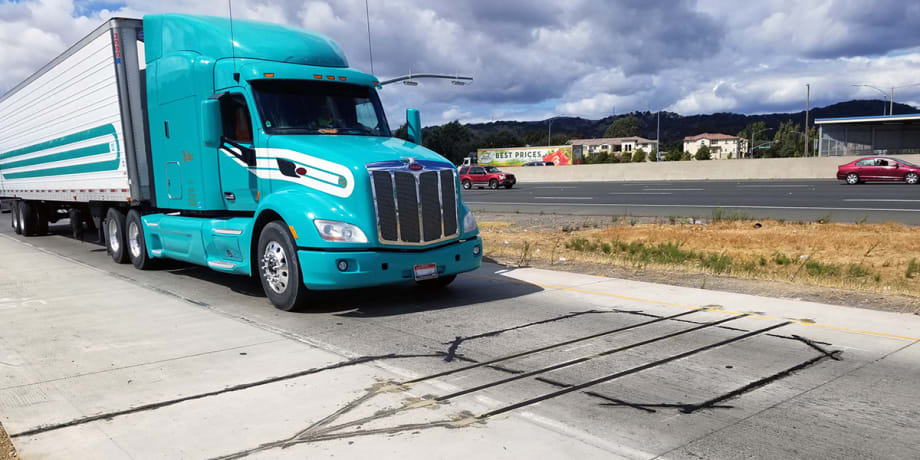
The Virginia Department of Motor Vehicles' in-road sensor technology enables weigh station techs to identify commercial vehicles traveling with flat, missing, mismatched or underinflated tires. (Pictured: Tire anomaly screening using TACS in Cordelia, California.)
Photo: IRD
Using in-road sensors, the Virginia Department of Motor Vehicles was able to identify and remove 13,000 unsafe tires from commercial vehicles traveling on Interstate 81 in one year.
The sensor technology, called Tire Anomaly and Classification System (TACS), enables weigh station technicians to identify commercial vehicles traveling with flat, missing, mismatched or underinflated tires and call the driver into the station to arrange for a repair.
TACS was installed at the Stephens City Motor Carrier Service Center along I-81 near Winchester in June 2020. An average of nearly 1,200 unsafe tires are detected each month. This year, DMV will install the TACS technology, produced by International Road Dynamics Inc., at the Troutville Motor Carrier Service Center on I-81 near Roanoke and the Alberta Motor Carrier Service Center on I-85.
"Tire blowouts can cause serious crashes. By detecting unsafe tires, most times before a truck driver even knows there is a problem, we can prevent crashes from occurring and save lives," said DMV Commissioner Richard Holcomb, the Governor's Highway Safety representative.
DMV operates 13 permanent motor carrier service centers and 12 mobile crews throughout the Commonwealth. A typical motor carrier service center is staffed with size and weight compliance agents who weigh vehicles, collect truck data and partner with the Virginia State Police to issue citations for non-compliance.
More Equipment

Used-Truck Remarketing Math Is Changing
Used-truck value is no longer just a concern at trade-in. Decisions made throughout a truck’s first life can influence what it’s worth years later.
Read More →
How Volvo Updated Its D13 for EPA 2027 [Watch]
Volvo’s updated D13 promises lower emissions without sacrificing performance or fuel economy. Take a closer look at what changed inside the engine in this HDT Spotlight video.
Read More →
Michelin Tire Improves Efficiency and Durability for Regional Fleets
The Michelin X Multi Energy D2 is a regional haul drive tire engineered to help fleets improve fuel efficiency, durability and traction in demanding stop-and-go operations.
Read More →
ZF Expands Commercial Vehicle Push in North America
ZF is expanding its North American commercial-vehicle presence with new transmission applications, electrification, trailer technology and autonomous-driving systems.
Read More →
Tesla Wants a Self-Driving Semi. Are Cameras Enough?
Could Tesla’s camera-only autonomous driving technology work on an 80,000-pound Semi? In this commentary, HDT's Deborah Lockridge takes a look at Tesla, Cybercab, and how autonomous trucks see the road.
Read More →
Kodiak: Driverless Long-Haul Truck Launch on Track for 2026
Kodiak AI says its driverless long-haul safety case is 93% complete and it remains on track to begin commercial operations by year-end 2026.
Read More →
What DOT’s Automated Vehicle Strategy Means for Trucking
The U.S. Department of Transportation issued a new automated-vehicle strategy that outlines plans for driverless-truck regulations, cross-state freight corridors, and federal safety standards.
Read More →
East Coast Port Launches $45M Electric Truck Push
The Port Authority of New York and New Jersey announced millions in incentives for zero-emission drayage trucks, yard tractors, and new charging hubs near the port.
Read More →
PlusAI Going Public to Fund Autonomous Truck Launch
A SPAC deal could provide PlusAI with up to $300 million as it works toward a 2027 commercial launch of factory-built autonomous trucks.
Read More →
NHTSA Moves to Rewrite Truck Fuel-Economy Rules
The National Highway Traffic Safety Administration says it lacks authority to regulate medium- and heavy-duty truck engines separately from complete vehicles, but the existing standards have not yet been eliminated.
Read More →