




Overweight Fuel Loads Allowed in States Affected by Pipeline Shutdown
The federal government says trucks carrying fuel in states affected by the Colonial Pipeline shutdown are allowed to carry overweight loads in an effort to address the fuel supply chain crisis.

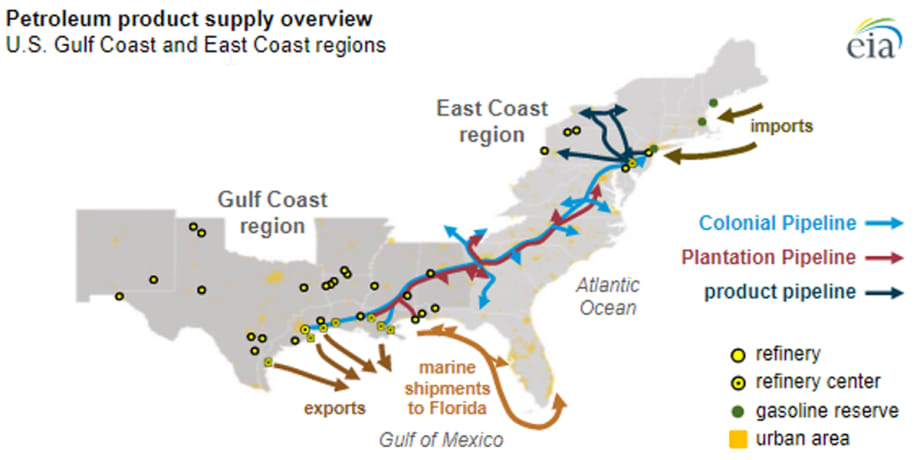
Colonial Pipeline, a major delivery system spanning from the U.S. Gulf Coast to the East Coast for transportation fuels, halted operations.
Illustration: EIA
The federal government says trucks carrying fuel in states affected by the Colonial Pipeline shutdown are allowed to carry overweight loads in an effort to address the fuel supply chain crisis.
The U.S. Department of Transportation on May 12 announced that the East Coast states affected by the shutdown of the Colonial Pipeline can allow transport of overweight loads of gasoline and other fuels on interstate highways. Previous declarations of “major disaster” issued by the president within the past 120 days allow states covered by those declarations to take this action, as fuel shortages have developed after a cyberattack forced a shutdown of the pipeline.
Although the Colonial Pipeline announced late May 12 that it was beginning the restart process after a six-day shutdown, it will take time to refill fuel supplies. The shortages have been made worse by panic-buying and a shortage of fuel-truck drivers. In Charlotte, North Caroline, about 70% of stations were out of gas, according to a May 13 CNN report.
Each state must continue to follow its own procedures for issuance of special permits authorizing the loads, but the added flexibility lawfully permits these trucks to run on the Interstate Highway System and other federal highways, DOT officials said in a press release.
For instance, at the request of New Jersey Motor Truck Association and Fuel Merchants Association, the New Jersey DOT issued a waiver to increase weight on fuel trucks by up to 10% or 88,000 pounds, noting that an overweight permit is needed.
The previous presidential declarations created this authority for up to 120 days. Given the declarations’ varied dates of issuance, that period will expire at different points for the affected states between now and early September. The first state whose 120-day period will expire is Maryland, on June 4. The last is Virginia, on Sept. 7.
The 10 states covered are Alabama, Georgia, Kentucky, Louisiana, Maryland, Mississippi, New Jersey, North Carolina, Tennessee and Virginia. All these states are already covered under the separate Emergency Declaration that the Federal Motor Carrier Safety Administration issued on May 9, which grants truck drivers making emergency fuel deliveries in areas affected by the pipeline disruption relief from the federal hours-of-service limits and certain other safety regulations.
Pipeline Shutdown Leads to Gas Shortages
On the East Coast and Southeast, demand for gasoline is soaring, and gas stations are facing shortages as drivers rush to fill their tanks, in what CNN describes as “panic buying.” Photos on social media and on news broadcasts show long lines at gas stations, with people filling up not only approved gasoline containers, but also non-approved makeshift containers such as plastic tubs and even plastic bags.
At several truck stops, like Pilot Flying J, diesel fuel was the only fuel left available at stations as of the evening of May 11. In a May 12 update on Twitter, it said, "Due to the ongoing Colonial Pipeline situation and increased demand across the Southeast, select locations in Georgia, Florida, South Carolina and North Carolina are experiencing outages. Our fuel drivers and logistics team are doing everything they can to keep resupplying fuel to these affected regions."
(1/3) Colonial Pipeline Outage Update 5/11/21, 7:00PM EST:
• All locations are open
• No Gas, Diesel Only:
◦ Pilot #425, Midway, FL
◦ Pilot #6996, Warsaw, NC
◦ Pilot #6990, Kenly, NC
◦ Pilot #256, Danville, VA
◦ Pilot #500, Jasper, FL
◦ Flying J #712, Columbia, SC— Pilot Flying J (@PilotFlyingJ) May 11, 2021
(2/3)
• No Gas or Diesel:
◦ Pilot #7971, Conover, NC (Diesel delivery tonight
◦ Pilot #7996, Monroe, NC (Diesel delivery tonight)
• No Diesel:
◦ Pilot #56, Kannapolis, NC (Diesel delivery tonight)
◦ Flying J #713, Latta, SC— Pilot Flying J (@PilotFlyingJ) May 11, 2021
(3/3)
◦ Pilot #4584, Latta, SC (Diesel delivery tonight)
◦ Flying J #623, Quincy/Midway, FL (Diesel delivery tonight)
◦ Pilot #4557, Carnesville, GA— Pilot Flying J (@PilotFlyingJ) May 11, 2021
Gas availability is intermittent at others, Love’s officials said in a tweet.
Due to the Colonial Pipeline shutdown, some Love’s locations are experiencing intermittent fuel outages. Love’s and its teams are working diligently to minimize outages. If extended fuel outages occur, Love’s will note those locations on https://t.co/HwA87s4gav.
— Love's Travel Stops (@LovesTravelStop) May 11, 2021
More Safety & Compliance

FMCSA Pauses Biennial-Update Enforcement Amid Motus Transition
Carriers whose updates were due on or after June 1 have more time, while FMCSA works to stabilize its new registration system and warns of phishing sites impersonating its new carrier registration system, Motus.
Read More →
ZF Expands Commercial Vehicle Push in North America
ZF is expanding its North American commercial-vehicle presence with new transmission applications, electrification, trailer technology and autonomous-driving systems.
Read More →
Truck Drivers Need More Than Another Alert
Fleets have more visibility into truck health, safety events, and driver activity than ever. The next challenge is turning all that information into useful guidance for the person who has to decide what to do next.
Read More →
Tesla Wants a Self-Driving Semi. Are Cameras Enough?
Could Tesla’s camera-only autonomous driving technology work on an 80,000-pound Semi? In this commentary, HDT's Deborah Lockridge takes a look at Tesla, Cybercab, and how autonomous trucks see the road.
Read More →
What DOT’s Automated Vehicle Strategy Means for Trucking
The U.S. Department of Transportation issued a new automated-vehicle strategy that outlines plans for driverless-truck regulations, cross-state freight corridors, and federal safety standards.
Read More →
NYC Expands Speed, Pedestrian Safety Tech Across Fleet
New York City is expanding intelligent speed assistance and pedestrian-alert systems across its municipal fleet, moving the technologies from pilot programs into vehicle procurement and retrofit requirements.
Read More →
FMCSA Removes 110 Truck Driver Training Schools from Certified ELDT List
Federal regulators also are targeting more than 160 additional training providers and launching a nationwide audit of third-party CDL skills testers as part of a broader crackdown on trucking fraud.
Read More →
Beyond DOT Compliance: What Makes a Trucking Fleet Truly Safe?
A trucking fleet can follow every rule and still make unsafe decisions. The real test comes when safety conflicts with freight, productivity, or cost.
Read More →
Hours of Service Pilot Programs: FMCSA Readies for 2027 Rollout
Two pilot programs could eventually reshape hours-of-service rules, giving truck drivers options to pause their 14-hour clock or use longer split sleeper rest periods.
Read More →
New Guide Offers Pet Safety Tips for Truck Drivers
Hundreds of thousands of pets travel in truck cabs. A new safety guide from Volvo Trucks and the Center for Pet Safety offers practical advice for truck drivers who bring dogs and cats along for the ride.
Read More →