




UPS Sees Bright and Possibly Transformational Future for Electric Trucks
At the Green Truck Summit, Carlton Rose, president of global fleet maintenance and engineering at UPS, said the desire for clean and quiet trucks is growing and pointed out how the global delivery giant has already made substantial investments in that green future.

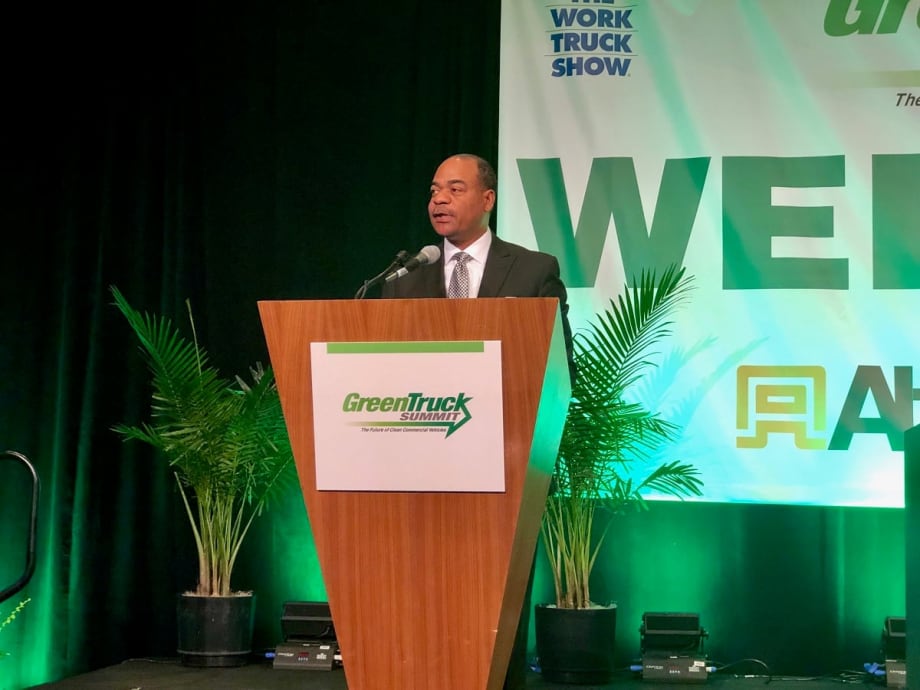
At the Green Truck Summit, Carlton Rose, president of global fleet maintenance and engineering at UPS, said the desire for clean and quiet trucks is growing and pointed out how the global delivery giant has already made substantial investments in that green future.
Photo: David Cullen
Outside the Indianapolis Conference Center early on March 5, with the thermometer barely touching double digits, it was cold enough to burn your breath away. Inside, was another story. Where the Green Truck Summit was getting under way ahead of the NTEA Work Truck Show, the air was fairly crackling with the excitement that stirs when truckers talk electric trucks.
Carlton Rose, president of global fleet maintenance and engineering at UPS, made it clear where the global package-delivery behemoth stands. “The way of the future,” he said in his keynote address, “is electric.”
It’s easy to see why, Rose explained. The desire for clean — and quiet trucks — is growing due to the global trend to urbanize and the accompanying rise in online commerce. Together, these market forces are driving up traffic and thus vehicle emissions in the cities around the world, in which more people than ever are living.
Rose said he is “convinced that electric propulsion will become a significant part of the UPS fleet in the near future.” On the other hand, he allowed that he has “one big problem with predictions — they are wrong more than they are right. That’s because predictions rest on our assumption that the future will be like the past.”
Although UPS already runs 1,000 battery electric and hybrid-electric trucks, he cautioned that the technology is but in its infancy. “Commercial electric trucks are still a work in progress.” An issue that must be overcome is range anxiety. “If you have a vehicle that will only go 100 miles, a delivery driver can’t go out 51 miles,” Rose pointed out. He also pointed to the lack of available and standardized charging infrastructure as another key challenge— and a global one at that.
“UPS has joined a U.K.-based consortium to develop fast charging without impacting the electrical grid,” he noted, adding that there is now “a golden opportunity for electric utilities” to prepare for meeting the demand for juice to power all those electric trucks and cars headed to the highways and city streets.
Why then is UPS still working with electric trucks in its “rolling laboratory” fleet of alternatively powered vehicles? Because, said Rose, “We’re a company that will not let perfect get in the way of good.” He may see electric trucks in UPS’ future, but they will still have to earn their spot and, over time, their keep. “Fleets want solutions that work. If the technology doesn’t work, it doesn’t matter what it costs or what subsidies are in place [to help pay for it].” He noted that he “knows what works for the UPS fleet won’t work for all fleets.
Rose said that “there won’t be widespread adoption [of electric trucks] until these vehicles present businesses with the best choice.” But he also contended that “electric has the potential to be more than another alternative option. The shift to electric could be transformational,” as it can be a platform to enable drive by wire, brake by wire and connectivity on vehicles.
He stressed that the company aims to be part of the green solution, be that with electric trucks or other forms of alternative power. “We play in all the options available. We do that on purpose,” he said, noting that UPS currently runs some 6,000 natural gas trucks. “We know that by trying different propulsions, other people will get in” the market and help advance the technology.
“We’ve always been an early adopter of innovative technologies,” Rose said. Because 6% of all goods shipped globally moves through the UPS delivery system at one point or another, the company “can help move markets” with its leadership.
As an example, he pointed to how UPS was engaged early on with Tesla’s Semi electric truck by pre-ordering some back in 2017. He said that helped push existing truck makers into developing electric models.“Our goal is to get original equipment manufacturers to enter the market,” Rose explained. “When Tesla came in, others started jumping in. That gave us what we want— options.”
More Fuel Smarts

How Volvo Updated Its D13 for EPA 2027 [Watch]
Volvo’s updated D13 promises lower emissions without sacrificing performance or fuel economy. Take a closer look at what changed inside the engine in this HDT Spotlight video.
Read More →
Diesel Price Spike Shortens Payback for Natural Gas Trucks, Report Says
Energy Vision estimates fleets could recover the higher purchase price of an RNG-fueled Class 8 tractor in 1.3 to 2.8 years under current fuel-price scenarios.
Read More →
Calstart Becomes Catalyst Mobility, Reflecting Broader Focus
Calstart is now Catalyst Mobility, reflecting the nonprofit’s growing national role in clean transportation, including zero-emission trucks, infrastructure and incentive programs.
Read More →

Record Diesel Prices Squeeze Trucking Fleets
Average U.S. diesel prices have climbed to nearly $6 a gallon, surpassing the 2022 record as tight refinery capacity and Middle East disruptions keep fuel costs elevated.
Read More →
How Fuel Delivery Shapes Engine Performance
Fuel delivery depends on more than what happens at the injector. For fleet, maintenance and technical professionals, looking at the full path from pump to injector can provide useful context for understanding engine performance.
Read More →
East Coast Port Launches $45M Electric Truck Push
The Port Authority of New York and New Jersey announced millions in incentives for zero-emission drayage trucks, yard tractors, and new charging hubs near the port.
Read More →
California Bill Could Shed Light on Electric Truck Prices
Why do battery-electric Class 8 trucks remain so expensive? A California bill headed to Gov. Gavin Newsom would give fleets and state agencies more visibility into what manufacturers charge.
Read More →
Detroit Opens Orders for EPA 2027 Engines
Detroit isn’t starting from scratch to meet EPA 2027 diesel emissions standards. Its Gen 6 DD13 and DD15 engines keep much of today’s platform while updating the fuel and aftertreatment systems.
Read More →
Zero-Emission Truck Corridor Planned for West Coast
California, Oregon, Washington, British Columbia and Baja California are coordinating plans for truck charging and hydrogen fueling from Canada to Mexico.
Read More →
A Closer Look at Kenworth’s Electric T880E Vocational Truck [Video]
Learn more about Kenworth's T880E battery-electric vocational truck at the Paccar Technical Center, including its range, applications, upfitting considerations, and PTO options, in this HDT Spotlight video.
Read More →