




Uber Freight Launches EV Fleet Accelerator Program
Uber Freight has partnered with Tesla to introduce a new program to make electric trucks more affordable for fleets.

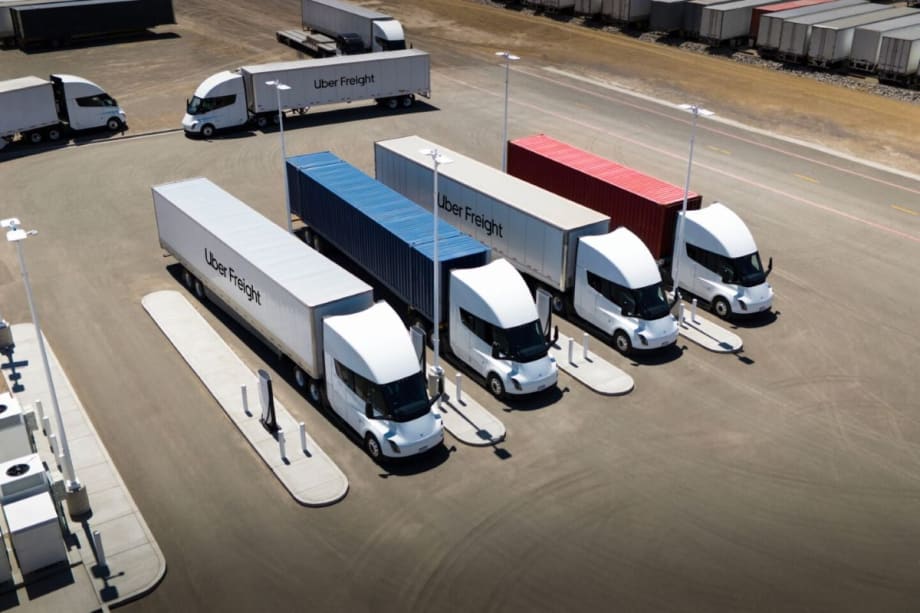
A new partnership between Uber Freight and Tesla seeks to help fleets with the upfront investment and infrastructure hurdles to EV adoption.
Photo: Tesla
Reducing operational costs, cutting emissions, and diversifying fuel options have long been priorities for both carriers and shippers.
According to Uber Freight, electric vehicles (EVs) offer a smart option for fleets. They also benefit the environment and customers alike by delivering lower costs, quieter, and more efficient solution. And do so while diversifying fleet operations, expanding their fleets’ business and increasing capacity for shippers.
But for many fleets, the upfront investment and infrastructure hurdles remain significant barriers to adoption.
A Dedicated EV Fleet Accelerator Program
In alignment with Uber’s global commitment to building a zero-emissions transportation ecosystem, Uber Freight is launching the Dedicated EV Fleet Accelerator Program in partnership with Tesla.
The company said this is a first-of-its-kind buyer’s program designed to make electric freight more affordable and accessible by addressing key adoption barriers.
With this initiative, Uber Freight aims to accelerate the adoption of EVs across supply chains, making the journey to a zero-emission future more achievable than ever.
Uber Freight said it works closely with fleet partners to understand both the opportunities and hurdles of EV adoption.
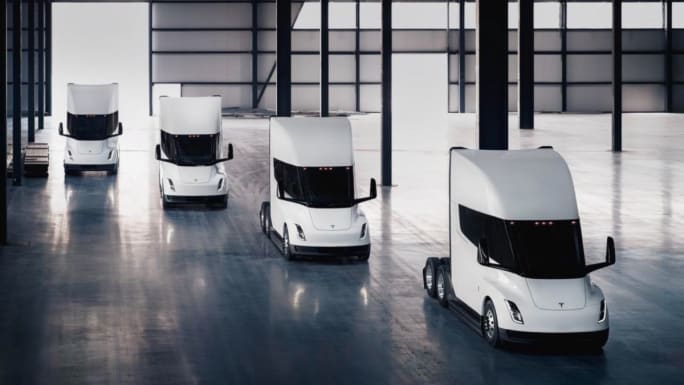
Uber Freight has been working closely with fleet partners to understand both the opportunities and hurdles of EV adoption.
Photo: Tesla
The shift toward electric Class 8 trucks is gaining momentum due to the demonstrated benefits to total cost of ownership (TCO), the company said. But most electric trucks still cost more upfront than conventional diesel trucks. And this price gap is the primary barrier to widespread adoption, even as EV transportation becomes an increasing priority for shippers and carriers.
Uber Freight said its feedback has been consistent: while there is enthusiasm around new technology and long-term efficiencies, concerns about upfront costs and financial risk remain high.
Carriers want a path to electrification that supports their bottom line and positions their businesses for growth.
Fleets are also closely watching the buildout of charging infrastructure and how it aligns with route planning. As Tesla expands its Semi Charger network, Uber Freight is designing dedicated routes around available infrastructure to help fleets adopt EVs more practically.
Making Electric Affordable
Using Freight’s Dedicated EV Fleet Accelerator Program provides fleets with a subsidized entry point into electrification, paired with reliable demand from its dedicated freight network.
It starts with solving for the biggest obstacles facing EV adoption: upfront cost, predictability, and ROI.
Here’s how the program works:
Subsidized price: Fleets purchasing Tesla Semis through this program will receive a subsidy on the purchase price.
Predictable growth: Fleets will integrate their Tesla Semis into Uber Freight’s dedicated solutions for shippers for a pre-determined period. This creates an opportunity for carriers to forecast revenue with confidence, while shippers gain consistent access to reliable, zero-emission capacity.
Optimize utilization: Uber Freight taps into its extensive freight network to match carriers with consistent, high-quality freight from our strong shipper base—helping ensure the addition of these Tesla Semis stay fully utilized and carriers see dedicated, real, measurable returns from the start.
Tesla insights: Participating fleets can schedule dedicated sessions with Tesla to review technical details and total cost of ownership assumptions specific to the fleets’ operational profile. With reduced pricing, fleets will start seeing savings from avoided diesel fuel and reduced maintenance costs from day one.
Uber Freight said this partnership model offers fleets the chance to adopt cutting-edge EV technology without taking on added risks.
Key benefits include:
Lowering upfront costs for the Tesla Semi
Secured revenue stream over multi-year dedicated contracts
Future-proofing their fleets by diversifying with zero-emission assets
Access to Uber Freight’s network of shippers demanding EV transport options
Uber Freight handles the heavy lifting—finding ongoing demand for dedicated EV capacity—so fleets can focus on delivering outstanding service.
Long-Term Cost Advantages
The Tesla Semi offers a combination of battery range (up to 500 miles), rapid charging (up to 1.2 MW), and strong payload capabilities (45,000–47,000 lbs) at a projected lower TCO than diesel.
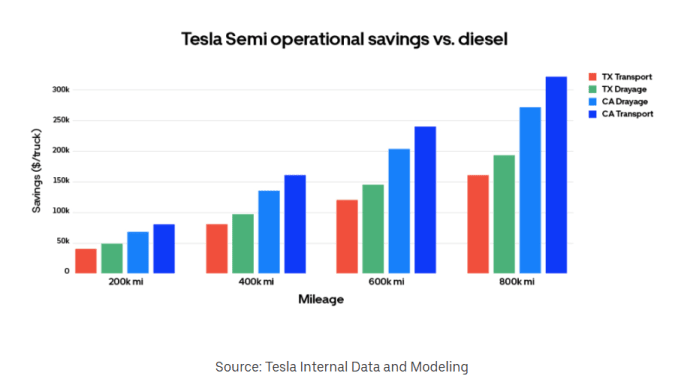
Uber Freight said the long-term cost advantages of electric trucks will drive widespread adoption of the technology if acquisition costs can be curtailed.
Graphic: Uber Freight
While the upfront purchase price is often the focus, it’s the long-term cost of ownership that tells the real story, according to the company.
Here’s how EVs and diesel trucks stack up over years on the road:
Fuel savings: Diesel trucks average 6 to 8 miles per gallon, with fuel often exceeding $4 per gallon. Electric Class 8 trucks operate at a significantly lower cost per mile. Charging is estimated at just 20 to 30 percent of the diesel equivalent, leading to thousands in annual savings.
Lower maintenance: Diesel engines are complex, require regular oil changes, and involve many components that wear down. EVs have fewer moving parts, fewer items requiring regular maintenance, and simpler drivetrains. Studies suggest EVs can cut maintenance costs by up to 40 percent compared to diesel trucks.
Total cost of ownership:Accounting for these fuel savings and lower maintenance costs, EVs can match or beat the TCO of diesel trucks, resulting in attractive paybacks ahead of a fleet’s standard diesel replacement cycle.
Uber Freight’s Dedicated EV Fleet Accelerator Program accelerates this transition by helping fleets achieve price parity with diesel faster.
Instead of waiting on operational savings to offset an incrementally higher purchase price, Uber Freight’s program allows electric truck operators to accrue savings from lower operating costs immediately. California and Texas are the largest road transportation markets in the U.S. Across two example applications, drayage and transport, electric trucks will realize savings in accordance with their operational profiles, which are impacted by factors such as speed, miles driven, cost of diesel and electricity, and more.
Lessons From the Road
Before launching at scale, Uber Freight partnered with a select group of carriers to pilot the Dedicated EV Fleet Accelerator Program using Tesla Semis.
The pilot helped validate program structure and gather key learnings from the field.
During the two-month pilot program, the Tesla Semis showcased both reliability and efficiency for Uber Freight’s shipper network.
Over 394 hours of drive time, carriers covered 12,377 miles. With an average net energy consumption of just 1.72 kWh per mile and only 60 hours of total charge time, these results highlight the operational viability of Tesla Semis on demanding freight lanes.
From early adopters, two things stood out: the real-world impact of lower fuel and maintenance costs, and the value of working alongside Uber Freight’s dedicated support team.
The success of the pilot program reinforces Uber Freight’s belief that electric trucking isn’t just an innovative vision—it’s a practical, profitable path forward.
With lessons learned from its partners on the ground, the company said it is confident the Dedicated EV Fleet Accelerator Program is built to deliver benefits from day one.
The Network of Choice for Freight Electrification
With nearly 18 million shipments per year, industry-leading logistics technology, and partnerships with thousands of world-class shippers, Uber Freight said it is uniquely positioned to lead the industry’s transition to electric.
The company has been investing in electrification for years, piloting EV capacity with select carriers and gaining valuable experience on how to deploy electric trucks effectively across real routes and operations. The Dedicated EV Fleet Accelerator Program builds on that foundation and represents another step forward in our ongoing commitment to a smarter, more efficient freight ecosystem.
More Fuel Smarts

How Volvo Updated Its D13 for EPA 2027 [Watch]
Volvo’s updated D13 promises lower emissions without sacrificing performance or fuel economy. Take a closer look at what changed inside the engine in this HDT Spotlight video.
Read More →
Diesel Price Spike Shortens Payback for Natural Gas Trucks, Report Says
Energy Vision estimates fleets could recover the higher purchase price of an RNG-fueled Class 8 tractor in 1.3 to 2.8 years under current fuel-price scenarios.
Read More →
Calstart Becomes Catalyst Mobility, Reflecting Broader Focus
Calstart is now Catalyst Mobility, reflecting the nonprofit’s growing national role in clean transportation, including zero-emission trucks, infrastructure and incentive programs.
Read More →

Record Diesel Prices Squeeze Trucking Fleets
Average U.S. diesel prices have climbed to nearly $6 a gallon, surpassing the 2022 record as tight refinery capacity and Middle East disruptions keep fuel costs elevated.
Read More →
How Fuel Delivery Shapes Engine Performance
Fuel delivery depends on more than what happens at the injector. For fleet, maintenance and technical professionals, looking at the full path from pump to injector can provide useful context for understanding engine performance.
Read More →
East Coast Port Launches $45M Electric Truck Push
The Port Authority of New York and New Jersey announced millions in incentives for zero-emission drayage trucks, yard tractors, and new charging hubs near the port.
Read More →
California Bill Could Shed Light on Electric Truck Prices
Why do battery-electric Class 8 trucks remain so expensive? A California bill headed to Gov. Gavin Newsom would give fleets and state agencies more visibility into what manufacturers charge.
Read More →
Detroit Opens Orders for EPA 2027 Engines
Detroit isn’t starting from scratch to meet EPA 2027 diesel emissions standards. Its Gen 6 DD13 and DD15 engines keep much of today’s platform while updating the fuel and aftertreatment systems.
Read More →
Zero-Emission Truck Corridor Planned for West Coast
California, Oregon, Washington, British Columbia and Baja California are coordinating plans for truck charging and hydrogen fueling from Canada to Mexico.
Read More →
A Closer Look at Kenworth’s Electric T880E Vocational Truck [Video]
Learn more about Kenworth's T880E battery-electric vocational truck at the Paccar Technical Center, including its range, applications, upfitting considerations, and PTO options, in this HDT Spotlight video.
Read More →