





Are Your Technicians Ready for Lower- and Zero-Emissions Trucks?
Q&A: Rush's Lacy Robertson on Emissions Regulations
Right now, the only thing certain about truck emissions regulations is that they are always subject to change. Truck sustainability expert Lacy Robertson gives fleets advice on what they can do.
January 13, 2025
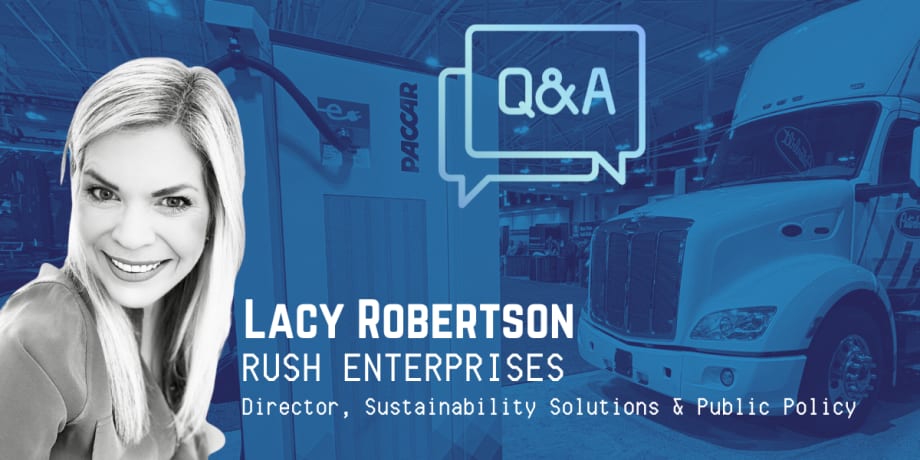
It's Lacy Robertson's job to keep up with the latest developments on sustainability and environmental regulations in trucking.
Image: HDT Graphic
8 min to read
Staying on top of all the increasingly complex and changing regulations regarding truck emissions and sustainability can be a full-time job — and that’s exactly what Lacy Robertson’s job is at Rush Enterprises.
As director of sustainability solutions and public policy for the huge dealership group, her role is to help customers, company executives, and dealerships understand the rapidly changing regulatory environment.
We spoke to Robertson shortly after the November election.
This interview has been edited for length and clarity. Watch or listen to the full interview on the HDT Talks Trucking podcast.
Deborah Lockridge: Tell us what you do at Rush Enterprises and why a position like yours is needed.
Lacy Robertson: It’s really an unprecedented time with a lot of complexities, from CARB [California Air Resources Board] regulations to EPA — and then OEM by OEM, differing interpretations of these regulations. On top of that, there are fleet-specific regulations that impact the fleets directly.
What we’ve found over the last couple of years is that every regulated party tends to look at which regulation impacts them directly. So, the engine manufacturers look at the engine regulations, and the vehicle/chassis OEMs look at the chassis and typically also the engine regulations. Then the fleets are all looking at the fleet-specific regulations.
But all of the regulations — whether it be low-NOx Omnibus, Advanced Clean Trucks, or Advanced Clean Fleets — they are all independent, but they are all interrelated, and they impact what our customers can buy and what we can sell them.
So you have to think of it holistically, so you understand the full impact.
Lockridge: Explain more about how emissions regulations affect dealers like yours when you are selling trucks to fleets.
Robertson: There have been a lot of cases in the last year where a fleet is looking at Advanced Clean Fleets and their electrification requirements under that regulation. If all their vehicles are in, say, Group 3, which is sleeper trucks or specialty vehicles, they wouldn't have any fleet-specific electrification requirements until 2030.
But when you look at Advanced Clean Trucks, if they want to continue buying combustion vehicles between now and then, the OEM has zero-emission vehicle sales requirements, which they are pushing through to the dealer.
Lockridge:So the Advanced Clean Trucks rule, which affects truck manufacturers, ends up affecting fleets, even if they’re not required by the Advanced Clean Fleets rule yet to buy an electric truck?
Robertson: We need the customers that are purchasing the combustion trucks to also purchase the electric trucks to fill those [ACT] requirements.
Lockridge: So that's kind of a balancing act on the part of the dealer to help your customers understand that.
Robertson: Absolutely. And a lot of this stuff is changing so rapidly, that we have to keep track of it and make sure we understand what our customers’ needs are — in the immediate this year, but also really looking at the next three years.
Unfortunately, the only thing that’s certain right now is that everything is very uncertain, and there's not a very clear path forward. So agility and being able to adapt to these changes and stay abreast of them are absolutely critical.
Lockridge: What are some of the things that you suggest to customers to deal with all this uncertainty?
Robertson: We work really closely with our customers as a partner to understand what their current needs are and what they’re looking at for the next five years, to figure out, how do we make sure that we meet all of your needs, your replacement needs, and also your growth needs.
Where are these vehicles going to be operating? That’s one of the big changes to the way that a lot of trucking companies operate, and frankly, the way dealers operate.
Historically, a lot of trucking companies would buy 1,000 trucks from us that meet their specs and then decide where they would be deployed across the United States. Unfortunately, with the regulations as they stand today, we can't do that anymore. So we actually have to know where [the trucks] are going so that we can track credits and deficits.
And that’s a huge change in the way we all do business, from a dealership level to our customers.
Lockridge: Do you have any thoughts on how the new administration might affect the whole situation? The Trump administration appears to be trying to cut regulations. I would guess that the EPA is probably going to be part of that.
I think that that’s a very fair assumption based on Trump’s first presidency and the plans that he’s laid out so far. However, what that actually looks like and what it actually materializes into, we'll have to wait and see.
I’m optimistic that the trucking community has an opportunity to have more realistic, achievable goals in sight that that are that work for everyone. However, a lot of these things can’t go away overnight.
Also, the OEMs have invested billions of dollars, and there are other complicating factors, like the Clean Truck Partnership between [the Truck and Engine Manufacturers Association], the OEMs, and CARB to comply.
So, it's going to take some time to see how everything plays out. I think we’re going to have to wait and see.
Lockridge:And regulations take time to change, so fleets shouldn’t think, “All right, we got a new president, I don’t have to worry about this anymore.”
Robertson: Yes, and I think that’s important. My initial recommendation to our customers is always that we can hope for the best, but let's have a contingency plan for both potential outcomes. Because if you fail to plan, you plan to fail.
So let’s have a best-case scenario and a plan that addresses that, and then also a plan that addresses the worst-case scenario, so there’s no situation where the customer is left flat-footed and not able to run their business.
Lockridge: Do you see more interest in options such as leasing trucks as opposed to buying them, to help deal with some of this uncertainty?
Robertson: I think leasing is a great option. And you know, depending on the fleets, what their needs and their replacement cycle, there’s so many different factors that come into play.
Do they own the property where they’re going to domicile the trucks? If they lease it, can they get approval to put infrastructure there? Or would they prefer to work through a charging as a service provider, who can kind of do the whole package, or even a truck as a service provider? There’s so many different options.
I think every fleet is going to have to figure out what works best for them based on their location, their utility rates, their space on their property.
What about the state of incentives and grants and tax credits? At the Fleet Forward Conference recently, a panel was discussing how, as regulations kick in, some of the incentives are going away.
Robertson: Absolutely. So kind of a good rule of thumb when you’re thinking about incentives is they typically do not pay for a fleet to do something that they’re required, from a regulatory standpoint, to do. So you think about it as early and extra, or extra.
So, doing something earlier than you’re required to do, getting an EV years ahead of when you would be required to buy it, or buying a truck that is cleaner than you’re required to do, which would generate emission reduction.
Outside of California, there are many great grant opportunities, so it's important to look state by state, location by location, and even utility by utility.
If you’ve got multiple locations in a state that are serviced by different utilities, one of them could have much better make-ready or different utility incentives as well.
Lockridge: The electric truck conversation tends to focus a lot on California because of the CARB regulations. But there are other areas of the country where there aren't incentives or regulations yet. Any thoughts there?
Robertson: There’s a report that shows all the medium- and heavy-duty truck deployments across the country last year, and the volume by state. And Texas is actually number two, behind California. A lot of that has to do with, the economics can work. Electricity is very expensive in California, ironically, where this is all being pushed.
But the ROI can happen. Especially when you look at the medium-duty market, it can make total sense. And when it makes sense for the business to do it on their own, that ultimately is the goal. We don’t want this subsidy environment to go on forever. We want the electric trucks to stand on their own and have a use case that works.
Lockridge: What are some of the common questions that you get from your customers?
Robertson: When should I start looking at electric, adding charging to my site?
Lockridge: Three years ago?
Robertson: Yeah, two years ago, last year, yesterday, anytime except for tomorrow.
But seriously, the sooner that our customers can have a plan, the better.
I’m not saying implement it everywhere, but identify key sites where they can, where the routes are potential good fits for electrification. And if they don’t know where to start with that, we’re here to help them identify those routes.
Understanding what their future procurement plans are is very important. So, where are you going to want trucks? Where are you looking to grow? Where are you looking to replace trucks?
All of that's critical for us to be able to provide trucks to our customers moving forward.
Watch the full interview:
Subscribe to Our Newsletter
More Fuel Smarts

How Volvo Updated Its D13 for EPA 2027 [Watch]
Volvo’s updated D13 promises lower emissions without sacrificing performance or fuel economy. Take a closer look at what changed inside the engine in this HDT Spotlight video.
Read More →
Diesel Price Spike Shortens Payback for Natural Gas Trucks, Report Says
Energy Vision estimates fleets could recover the higher purchase price of an RNG-fueled Class 8 tractor in 1.3 to 2.8 years under current fuel-price scenarios.
Read More →
Calstart Becomes Catalyst Mobility, Reflecting Broader Focus
Calstart is now Catalyst Mobility, reflecting the nonprofit’s growing national role in clean transportation, including zero-emission trucks, infrastructure and incentive programs.
Read More →

Record Diesel Prices Squeeze Trucking Fleets
Average U.S. diesel prices have climbed to nearly $6 a gallon, surpassing the 2022 record as tight refinery capacity and Middle East disruptions keep fuel costs elevated.
Read More →
Sponsored•September 9, 2026
How Fuel Delivery Shapes Engine Performance
Fuel delivery depends on more than what happens at the injector. For fleet, maintenance and technical professionals, looking at the full path from pump to injector can provide useful context for understanding engine performance.
Read More →
East Coast Port Launches $45M Electric Truck Push
The Port Authority of New York and New Jersey announced millions in incentives for zero-emission drayage trucks, yard tractors, and new charging hubs near the port.
Read More →
California Bill Could Shed Light on Electric Truck Prices
Why do battery-electric Class 8 trucks remain so expensive? A California bill headed to Gov. Gavin Newsom would give fleets and state agencies more visibility into what manufacturers charge.
Read More →
Detroit Opens Orders for EPA 2027 Engines
Detroit isn’t starting from scratch to meet EPA 2027 diesel emissions standards. Its Gen 6 DD13 and DD15 engines keep much of today’s platform while updating the fuel and aftertreatment systems.
Read More →
Zero-Emission Truck Corridor Planned for West Coast
California, Oregon, Washington, British Columbia and Baja California are coordinating plans for truck charging and hydrogen fueling from Canada to Mexico.
Read More →
A Closer Look at Kenworth’s Electric T880E Vocational Truck [Video]
Learn more about Kenworth's T880E battery-electric vocational truck at the Paccar Technical Center, including its range, applications, upfitting considerations, and PTO options, in this HDT Spotlight video.
Read More →