





Listen: Is the Real World Ready for Driverless Trucks?
unknown nodeU.S. Xpress, Embark Team up for Autonomous-Truck Network Development
What happens when an autonomous truck pulls into a fleet terminal? U.S. Xpress and Embark are teaming up to develop procedures in the fleet's network.
May 12, 2022
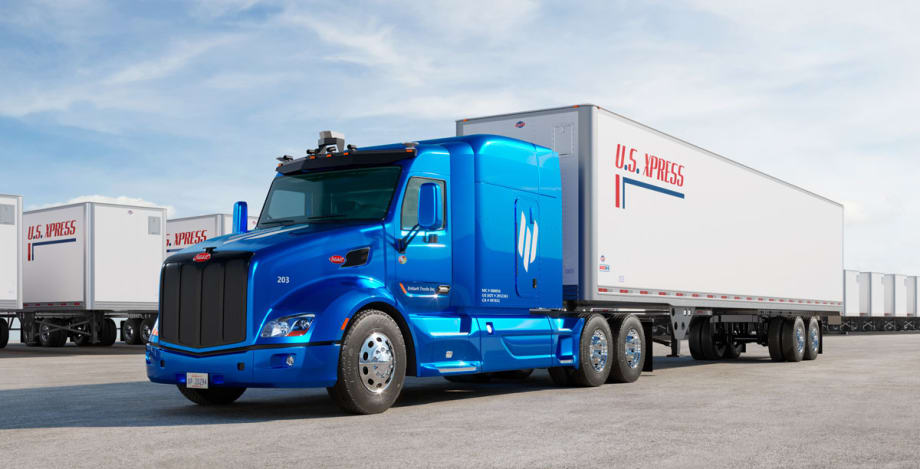
U.S. Xpress and Embark plan to co-develop an onsite operations playbook that captures standard processes for when autonomous trucks enter U.S. Xpress properties.
Photo: Embark
3 min to read
U.S. Xpress has added another company to the list of those it’s working on to make autonomous trucks a reality. It has joined the Embark Partner Development Program and plans to add its terminals to the Embark Coverage Map.
According to Embark, this partnership marks a significant milestone by adding a fleet's properties into an autonomous truck developer’s transfer point network.
The Chattanooga, Tennessee-based truckload giant is also working with other autonomous-truck developers, including TuSimple and Kodiak.
Embark said it pioneered the transfer point model in 2019 when the company unveiled its first sites in Los Angeles and Phoenix. Transfer points are used to move freight from driverless, long-haul trucks to driver-enabled trucks for first- and last-mile delivery. Since developing the model, Embark has conducted hundreds of hauls through these sites, refining required transfer point features and developing process flows for important onsite activities.
Through this partnership, Embark and U.S. Xpress will identify priority terminals based on traffic patterns, customer needs, and technical requirements. The companies will start with two terminals in Sunbelt states, creating a path to opening a high-volume lane for autonomous hauling.
The two companies plan to co-develop an onsite operations playbook that captures standard processes for when autonomous trucks enter U.S. Xpress properties. Expected solutions will include gate access, onsite vehicle movement, trailer swap procedures, inspections, data and power management, and more.
“We’ve established U.S. Xpress as a carrier leader in autonomous trucking, and this partnership is further evidence of our intention to be an early adopter of autonomous vehicle technology,” said Eric Fuller, president and CEO. “Through this partnership with Embark, we’re taking the next important step in planning and preparing our terminal network to support executing our autonomous strategy.”
Alex Rodrigues, CEO of Embark, said the partnership gives it a “unique opportunity to leverage U.S. Xpress’ existing truck terminals, unlocking a more seamless scaling process. By utilizing existing truck terminals for transfer operations, Embark autonomous trucks will be able to more easily integrate with existing U.S. Xpress network assets such as last-mile driver capacity, parking, and maintenance services.”
The Latest in U.S. Xpress' Autonomous Partnerships
In early 2021, U.S. Xpress announced an investment in TuSimple, and later in the year it was one of the first fleets to place reservations for the TuSimple/Navistar autonomous truck, expected to be available beginning in 2024. The company has been working with TuSimple since 2019. The fleet also said it would help to develop TuSimple’s Autonomous Freight Network.
Earlier this year, Kodiak Robotics and U.S. Xpress teamed up to launch Level-4 autonomous freight service between Dallas-Fort Worth and Atlanta using Kodiak’s self-driving trucks. U.S. Xpress was set to become the first cornerstone truckload partner in Kodiak’s Partner Deployment Program.
U.S. Xpress also announced earlier this year that it will work with Aurora Innovations.
More Fleet Management

Sponsored•September 16, 2026
Color Match Smarter: Tools That Restore & Perform
For fleet managers and collision repair professionals keeping heavy-duty trucks on the road, getting the color right the first time isn't just about appearance — it's about efficiency, turnaround time, and bottom-line results. Discover how today's digital color tools are transforming the repair process from guesswork to precision.
Read More →
FMCSA Pauses Biennial-Update Enforcement Amid Motus Transition
Carriers whose updates were due on or after June 1 have more time, while FMCSA works to stabilize its new registration system and warns of phishing sites impersonating its new carrier registration system, Motus.
Read More →
Sponsored•September 14, 2026
2026 Blueprint for Countering Smarter Supply Chain Theft
Cargo theft is no longer just the cost of doing business. It's a multi-billion-dollar criminal enterprise exploiting vulnerabilities across your fleet, drivers, and supply chain.
Read More →


Sponsored•September 1, 2026
How Telematics Improves Visibility, Control, and Performance in Refrigerated Fleets
Explore how telematics help refrigerated fleets improve visibility, uptime, efficiency, compliance, and cargo protection across connected cold chain operations.
Read More →
What the U.S.-Canada Trade War Means for Trucking
Escalating U.S.-Canada tariffs could disrupt cross-border freight, reduce truck volumes, raise costs, and create new uncertainty for carriers on both sides of the border.
Read More →
What Are Trucking’s Top Concerns for 2026?
The American Transportation Research Institute wants to know what's worrying trucking fleet managers, drivers, and other stakeholders in its annual Industry Issues survey.
Read More →
American Trucking Associations Looks for a New Leader
ATA President and CEO Chris Spear abruptly left his job at the association on August 21, at a pivotal time for the trucking industry.
Read More →
Public Wi-Fi Cybersecurity Risks: How Truck Drivers and Fleets Can Protect Their Data
Public Wi-Fi can expose truck drivers and fleets to credential theft, malware, and other cyber threats. Here’s how to reduce the risk on the road.
Read More →
For Nicky Cupp, Fleet Innovation Starts With Frustration
HDT Truck Fleet Innovator Nicky Cupp turns everyday pain points at Fraley & Schilling into opportunities for better technology and smarter processes.
Read More →
Adam Buttgenbach’s Approach to Electric Trucks: Start With Where They Fit
HDT Truck Fleet Innovator Adam Buttgenbach helped PepsiCo build one of North America’s largest EV fleets by focusing on where electric trucks make operational sense.
Read More →