




Trucking Groups Slam FMCSA Approach to Safety-Fitness Rule
A coalition of trucking interests has come out bluntly critical of the Federal Motor Carrier Safety Administration’s efforts to put in place its proposed Safety Fitness Determination rule.

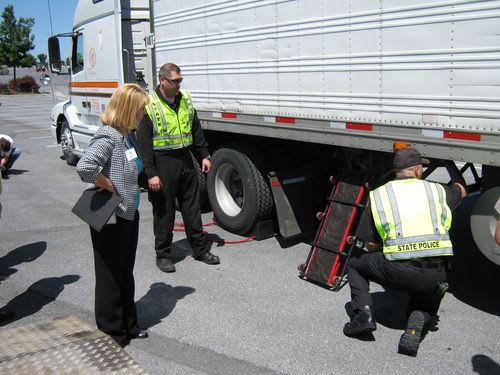
A roadside safety inspection. Photo: U.S. DOT
A roadside safety inspection.Photo: U.S. DOT
A coalition of trucking interests has come out bluntly critical of the Federal Motor Carrier Safety Administration’s efforts to put in place its proposed Safety Fitness Determination rule.
In a strongly worded April 11 letter to FMCSA Acting Administrator Scott Darling, the ten signatories, which include the Western States Trucking Association and the Alliance for Safe, Efficient and Competitive Truck Transportation, express “considerable concern” that the agency is not taking into account “deliberatively the widespread concern throughout the motor carrier industry over the timing and details of the Notice of Proposed Rulemaking on the carrier Safety Fitness Determination process.”
Rather, the undersigned organizations argue that “the agency is choosing simply to dig in and defend its proposal. This is unfortunate and gives us additional reason to question whether FMCSA will properly consider public comments on the NPRM.”
The letter references “April 7 comments to the media” attributed to FMCSA Director of Enforcement and Compliance Joe DeLorenzo as well as analysis of agency data that the writers stated had been conducted by coalition signatories.
However, the opening of the broadside is aimed even higher: “At the outset, we do not believe FMCSA should even be conducting this rulemaking at this time,” the writers declare.
They then argue that provisions within the FAST Act highway bill that reform the agency’s rulemaking procedures underscore that FMCSA’s Safety Measurement System (SMS) is “not fit for use in establishing SFDs for motor carriers without a compliance review.”
“The [FAST Act] provisions ordering a withdrawal of SMS)alerts and relative percentiles from public view for property carriers, pending a full study and corrective action, were the culmination of years of expressed frustration by the industry,” the letter states. “Simply put, SMS as currently constructed does not work due to flaws in methodology and data quality. SMS might be fine as an internal tool for targeting enforcement, but it is not fit for public consumption.”
The letter further argues that “By FMCSA’s own admission, the SFD NPRM rests squarely on SMS data and methodology– and the FAST Act includes several provisions that are properly read to bar moving forward with such a rulemaking.”
Moving onto referencing “DeLorenzo’s comments to the media,” the writers contend that FMCSA “continues to argue that the NPRM fully complies with the FAST Act because the SFDs are not based on relative percentiles but rather ‘absolute’ failure standards calculated using relative percentiles.
“Putting aside the obvious sophistry of this claim, Section 5223(b)– the very provision FMCSA clings to as supposedly supporting its decision to move forward with the NPRM– does not provide the cover that the agency claims,” continue the writers.
The coalition then argues that the agency “overlooks two very important points” about Section 5223(b):
The provision does not merely prohibit use of alerts and relative percentiles. It bars ‘information regarding’ alerts and relative percentiles. If, in an effort to circumvent the intent of Congress, FMCSA chooses to use relative percentiles to calculate fixed measures, those measures still represent ‘information regarding alerts and the relative percentile for each BASIC.’”
The legislation is restrictive, not permissive. It does not grant FMCSA authority to move forward with a rulemaking that also uses a means other than information about alerts and relative percentiles to establish SFDs. It states that the agency cannot move forward if its rulemaking proposal uses such methods. Nothing in Section 5223(b) would trump the clear intent of Section 5221(d)(2)(C) that FMCSA hold off on any rulemaking that is so fundamentally intertwined with CSA/SMS until the program is reformed.
The writers cited “the other major theme of Mr. DeLorenzo’s remarks” as advising that the proposed SFD rule would allow the agency to assess more than 75,000 carriers a month.
Although conceding that the basis for this claim may be FMCSA’s analysis of 2011 data, done for purposes of drafting the SFD NPRM, the letter goes on to state, albeit “with all due respect,” that “this assertion simply is not true– at least not in 2016. The actual figure is more than 60% lower.”
The coalition details in the letter how exactly it arrived at that conclusion, by way of a “preliminary analysis” of SMS data published for February and March 2016.
The letter wraps up by stating that the coalition’s concerns with the NPRM “go far beyond” its stated points and “include serious problems with due process, Administrative Procedure Act compliance, the regulatory analysis and, of course, the heavy reliance on flawed SMS data and methodology. Those all will be developed in detail in our comments for the [rulemaking] docket.
“If FMCSA is to move forward with this process,” the writers conclude, “we hope that the agency will consider a more circumspect and thoughtful approach.”
Related: FMCSA: Safety-Fitness Proposal Gives Carriers Fixed Target
More Fleet Management

Why Private Fleets Are Taking More Freight
Private fleets are putting their own trucks on demanding customers and high-cost lanes as companies seek greater control over service, costs, and capacity.
Read More →
Color Match Smarter: Tools That Restore & Perform
For fleet managers and collision repair professionals keeping heavy-duty trucks on the road, getting the color right the first time isn't just about appearance — it's about efficiency, turnaround time, and bottom-line results. Discover how today's digital color tools are transforming the repair process from guesswork to precision.
Read More →
FMCSA Pauses Biennial-Update Enforcement Amid Motus Transition
Carriers whose updates were due on or after June 1 have more time, while FMCSA works to stabilize its new registration system and warns of phishing sites impersonating its new carrier registration system, Motus.
Read More →


2026 Blueprint for Countering Smarter Supply Chain Theft
Cargo theft is no longer just the cost of doing business. It's a multi-billion-dollar criminal enterprise exploiting vulnerabilities across your fleet, drivers, and supply chain.
Read More →
How Telematics Improves Visibility, Control, and Performance in Refrigerated Fleets
Explore how telematics help refrigerated fleets improve visibility, uptime, efficiency, compliance, and cargo protection across connected cold chain operations.
Read More →
What the U.S.-Canada Trade War Means for Trucking
Escalating U.S.-Canada tariffs could disrupt cross-border freight, reduce truck volumes, raise costs, and create new uncertainty for carriers on both sides of the border.
Read More →
What Are Trucking’s Top Concerns for 2026?
The American Transportation Research Institute wants to know what's worrying trucking fleet managers, drivers, and other stakeholders in its annual Industry Issues survey.
Read More →
American Trucking Associations Looks for a New Leader
ATA President and CEO Chris Spear abruptly left his job at the association on August 21, at a pivotal time for the trucking industry.
Read More →
Public Wi-Fi Cybersecurity Risks: How Truck Drivers and Fleets Can Protect Their Data
Public Wi-Fi can expose truck drivers and fleets to credential theft, malware, and other cyber threats. Here’s how to reduce the risk on the road.
Read More →
For Nicky Cupp, Fleet Innovation Starts With Frustration
HDT Truck Fleet Innovator Nicky Cupp turns everyday pain points at Fraley & Schilling into opportunities for better technology and smarter processes.
Read More →