




Trucking Conditions Index Shows Slow Growth in Freight
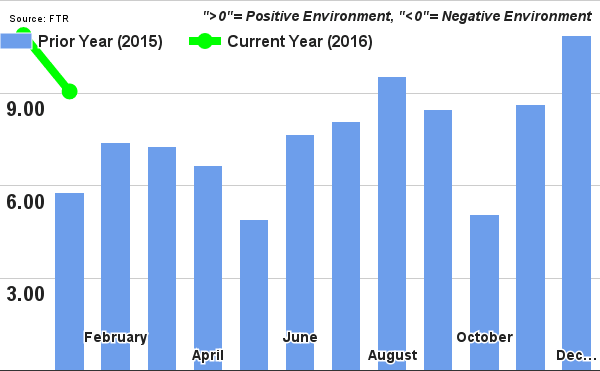
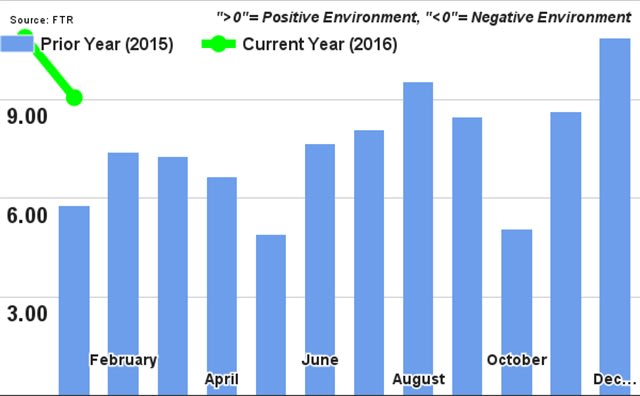
The Trucking Conditions Index measure fell to a reading of 9.05 for January, indicating slowing growth patterns for truck freight.
Source: FTR
Source: FTR
The Trucking Conditions Index measure fell to a reading of 9.05 for January, indicating slowing growth patterns for truck freight, according to FTR.
The index fell from a recent high of 10.88 in December, showing that current freight demand can be easily handled by current carrier capacity. Growth in the long-haul dry van segment has slowed significantly in the last year, causing spot rates to drop and capacity to loosen, according to FTR.
“The data that has come out of the spot market for the last year highlights those results with capacity much looser and rates down,” said Jonathan Starks, chief operating officer of FTR. “However, the contract market has held up relatively well during that same stretch of time.”
As the current economic recovery is extended, market conditions are slowly slipping and becoming more volatile. FTR expects 2016 not to be a strong year for truck operators with a less than ideal negotiating environment for truckers heading into the usual spring freight increase.
However, a looming crisis caused by regulations such as for ELDs and speed limiters could tighten capacity and potentially reverse the current situation by next year.
“The situation could begin to reverse as carriers implement ELDs and speed limiters ahead of the mandatory dates set for late 2017 and early 2018,” said Starks. “Even if the economy sours between now and then, the impact of those regulations could be enough to keep capacity relatively tight and rates neutral.”
More Fleet Management

Why Private Fleets Are Taking More Freight
Private fleets are putting their own trucks on demanding customers and high-cost lanes as companies seek greater control over service, costs, and capacity.
Read More →
Color Match Smarter: Tools That Restore & Perform
For fleet managers and collision repair professionals keeping heavy-duty trucks on the road, getting the color right the first time isn't just about appearance — it's about efficiency, turnaround time, and bottom-line results. Discover how today's digital color tools are transforming the repair process from guesswork to precision.
Read More →
FMCSA Pauses Biennial-Update Enforcement Amid Motus Transition
Carriers whose updates were due on or after June 1 have more time, while FMCSA works to stabilize its new registration system and warns of phishing sites impersonating its new carrier registration system, Motus.
Read More →


2026 Blueprint for Countering Smarter Supply Chain Theft
Cargo theft is no longer just the cost of doing business. It's a multi-billion-dollar criminal enterprise exploiting vulnerabilities across your fleet, drivers, and supply chain.
Read More →
How Telematics Improves Visibility, Control, and Performance in Refrigerated Fleets
Explore how telematics help refrigerated fleets improve visibility, uptime, efficiency, compliance, and cargo protection across connected cold chain operations.
Read More →
What the U.S.-Canada Trade War Means for Trucking
Escalating U.S.-Canada tariffs could disrupt cross-border freight, reduce truck volumes, raise costs, and create new uncertainty for carriers on both sides of the border.
Read More →
What Are Trucking’s Top Concerns for 2026?
The American Transportation Research Institute wants to know what's worrying trucking fleet managers, drivers, and other stakeholders in its annual Industry Issues survey.
Read More →
American Trucking Associations Looks for a New Leader
ATA President and CEO Chris Spear abruptly left his job at the association on August 21, at a pivotal time for the trucking industry.
Read More →
Public Wi-Fi Cybersecurity Risks: How Truck Drivers and Fleets Can Protect Their Data
Public Wi-Fi can expose truck drivers and fleets to credential theft, malware, and other cyber threats. Here’s how to reduce the risk on the road.
Read More →
For Nicky Cupp, Fleet Innovation Starts With Frustration
HDT Truck Fleet Innovator Nicky Cupp turns everyday pain points at Fraley & Schilling into opportunities for better technology and smarter processes.
Read More →